Free sample lesson · Systems Thinking for Research
System Definition
Why do seemingly independent events create predictable patterns?
Lesson 1 of the Wondering course Systems Thinking for Research
What Is a System?
A system is a set of things interconnected in such a way that they produce their own pattern of behavior over time.
That last part matters. The pattern comes from inside, not from something pushing from outside.
So a pile of sand is not a system. A forest is.
- Pile of sand
- Forest
Once you learn to spot this, patterns you thought were coincidence start looking like structure.
Three Parts of the Definition
The definition packs three requirements into one sentence.
There must be things. Those things must be interconnected. Together they must produce a pattern of behavior over time.
Drop any one requirement and you no longer have a system.
- Things: A system is made of a set of identifiable things.
- Interconnected: Those things are interconnected rather than merely nearby.
- Pattern over time: Together they produce their own pattern of behavior over time.
Treat the definition as a checklist, not a slogan.
The Three-Question Test
You can test for a system with three questions.
Can you identify parts? Do they affect each other? Do they produce a collective effect?
Three yes answers means you are looking at a system. A single no means you are not.
- Something you observe
- Identify parts?
- Parts affect each other?
- Collective effect?
- It is a system
- Not a system
This test is quick enough to run in your head during any observation.
More Than the Sum of Parts
Systems are more than the sum of their parts.
List every component and you still have not described the system. The relationships between components are missing from that list.
Behaviors emerge from those relationships.
- Emergent behavior: The pattern that no single part contains.
- Relationships: The interconnections between components.
- Parts: The individual things you can list and count.
Each level rests on the one below
This is why taking something apart to study it can destroy the very thing you wanted to explain.
Structure Drives Behavior
Here is the central claim of systems thinking.
The system's structure determines its behavior. Not external forces. Not individual elements acting in isolation.
This flips the usual explanation. Most of us blame an outside event or one bad component.
- External forces
- Single elements
- Structure
Structure means how the parts are wired together, and that wiring sets the range of behaviors available.
What Emergence Looks Like
Emergent behavior is behavior that appears at the level of the whole.
No single element carries it. You cannot find it by inspecting one component closely.
It shows up only once the parts are connected and running over time.
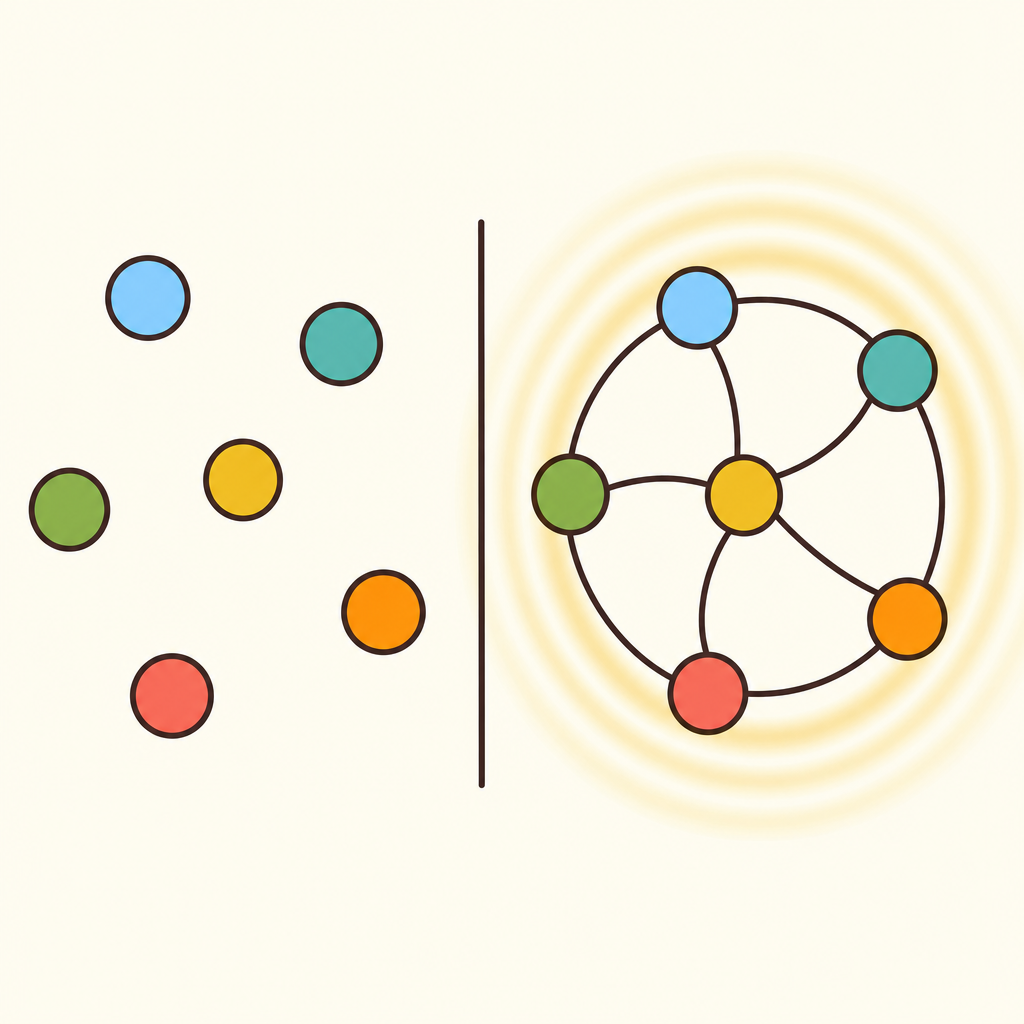
Notice that the parts are identical on both sides; only the connections differ, and only the connected side shows a pattern.
That is why a system can surprise you even when every part behaves exactly as expected.
Patterns Repeat Over Time
The definition says pattern of behavior over time. A single snapshot will not reveal a system.
You need repeated observation to see the pattern the structure produces.
Watch a forest for one hour and you see trees. Watch for years and you see growth, decay, and regrowth.
- Growth: Trees add mass and the forest thickens.
- Decay: Older material breaks down within the system.
- Regrowth: New growth follows, returning the cycle to its start.
Time is the medium in which system behavior becomes visible.
A Common Misreading
Beginners often assume the biggest external event explains the behavior.
But if structure determines behavior, then removing the outside shock may change nothing. The same pattern returns.
Swapping one component often changes nothing either, because the relationships remain the same.
Ask what would have to be rewired, not what would have to be removed.
Seeing Systems Everywhere
You now have a working definition and a three-question test.
Parts. Interconnections. A collective pattern produced over time.
Carry the test into anything you observe: an ecosystem, an organization, a household routine.
- Parts: The things you can identify.
- Interconnections: The way the parts affect each other.
- Structure: How the parts are wired together.
- Pattern over time: The collective effect the system produces.
- Emergent behavior: Behavior that belongs to the whole.
Recognizing the system is the first step toward understanding how change happens inside it.
Check yourself
A system produces its own pattern of behavior from interactions among its parts.
- True
- False
Answer: True
This is correct. A system’s behavior comes from its interconnected elements and their relationships, not merely from an outside force acting on them.
A researcher observes a forest. Which observation best supports the conclusion that it is a system?
- It contains many individual trees.
- It occupies a large area of land.
- Its organisms interact and produce recurring patterns over time.
- It can be viewed in a single snapshot.
Answer: Its organisms interact and produce recurring patterns over time.
A forest qualifies because its living elements affect one another and produce collective patterns such as growth, decay, and regrowth over time. A list of trees alone would omit those relationships.
A single observation of an arrangement is usually enough to reveal its system behavior pattern.
- True
- False
Answer: False
This is false. System behavior appears as a pattern over time, so repeated observation is needed rather than one snapshot.
Keep going
This is lesson 1 of 24 in Systems Thinking for Research. Next up:
- System Components
- Stocks
- Flows
- Balancing Loops
- Reinforcing Loops
Wondering turns any topic into short lessons you can read, watch, or listen to, with practice questions and an AI tutor.