Free sample lesson · System Prompts and Structured Output
Explicit Criteria Over Vague Rules
Your review prompt says be conservative and returns a different verdict every run. Why?
Lesson 1 of the Wondering course System Prompts and Structured Output
Explicit Criteria Over Vague Rules
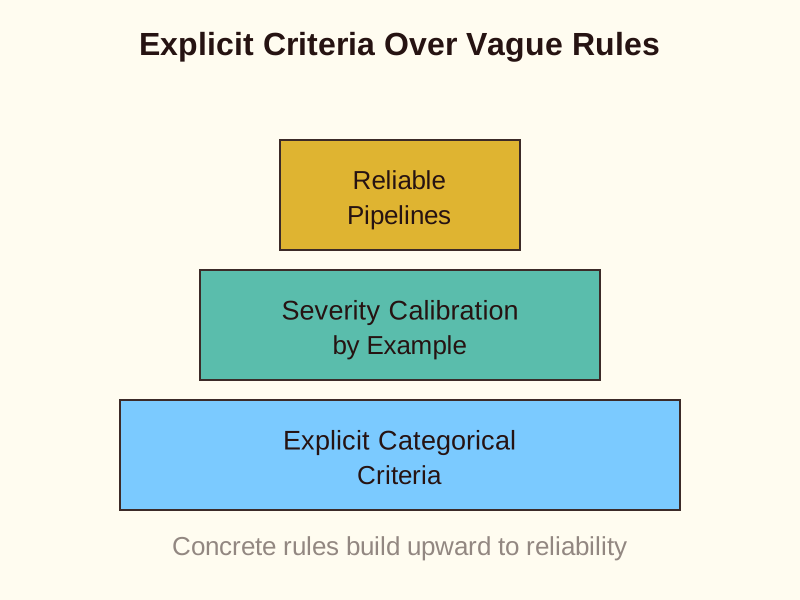
Discover how replacing vague prompt qualifiers with explicit categorical criteria and concrete code anchors builds reliable production extraction pipelines.
The Trap of Vague Rules
Prompts often fail because they use subjective words like conservative or high-confidence. These terms provide no clear decision boundary for the model.
A model cannot calibrate its own confidence levels reliably. When you ask for good judgment, the output varies between every run.
- Vague Prompts
- Explicit Rules
To fix this, you must replace vague qualifiers with explicit categorical criteria. Tell the model exactly what to include and what to ignore.
Defining Actionable Boundaries
Instead of saying be conservative, name the specific categories to report. A precise prompt lists clear triggers for action.
For example, instruct the model to report bugs and security vulnerabilities. Simultaneously, tell it to skip minor style preferences or local patterns.
This creates a hard boundary. The model no longer guesses your intent; it follows a checklist of defined categories.
- Name Categories: Specify the exact categories to report instead of asking for generic conservatism.
- Set Triggers: List clear triggers for action like bugs and security vulnerabilities.
- Skip Noise: Explicitly instruct the model to ignore minor style preferences or local patterns.
- Enforce Checklist: Eliminate model guessing by requiring adherence to defined categories.
Calibrating Severity with Code
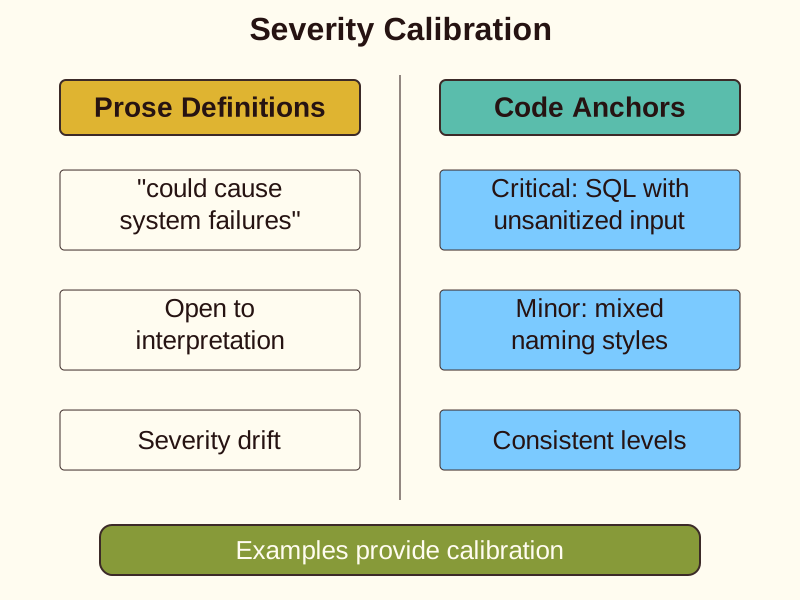
Prose definitions for severity levels often drift. Phrases like could cause system failures are open to interpretation by the LLM.
Consistency requires anchoring each level to a concrete code sample. Use an unsanitized user input in a SQL query to define a Critical issue.
For a Minor issue, show a sample where two different naming conventions coexist in one module. Examples provide the calibration that text descriptions lack.
Criteria Versus Routing
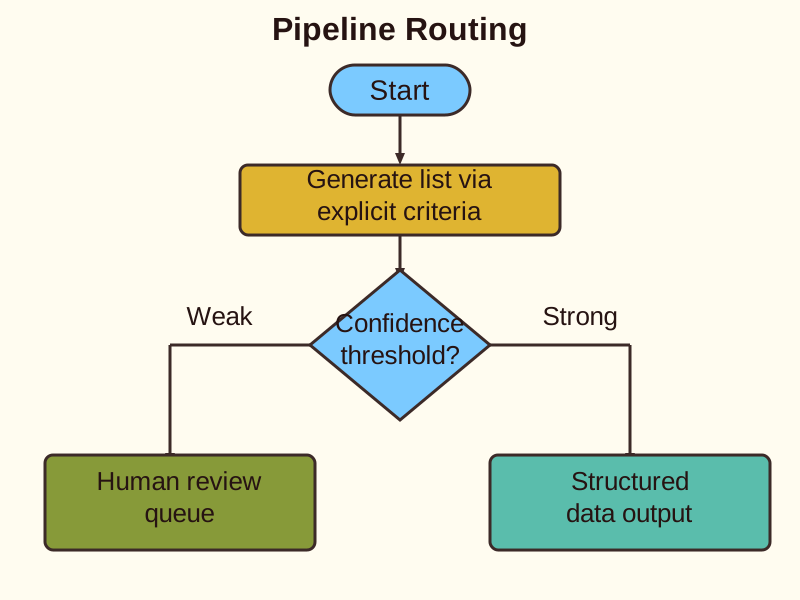
Explicit criteria define what counts as a finding. Confidence scores are different; they serve as a routing signal for your pipeline.
Use criteria to generate the initial list of issues. Then, use confidence thresholds to move weak findings into a human review queue.
Do not use confidence as a filter for precision. Reliable systems rely on categorical rules first and routing logic second.
Putting It All Together
- Define Criteria: Replace vague qualifiers with explicit inclusion and exclusion rules.
- Anchor Severity: Calibrate levels with concrete code samples rather than open-ended prose.
- Route Signals: Use categorical rules for generation and confidence thresholds for routing.
Check yourself
In production system prompts, subjective qualifiers like "conservative" or "high-confidence" fail to establish an actionable _____ for the model.
- decision boundary
- routing queue
Answer: decision boundary
Subjective words give the model no concrete criteria to evaluate, making outputs inconsistent across runs.
To prevent classification drift, a _____ severity level is anchored to an unsanitized SQL injection sample, whereas a _____ severity level is anchored to mixed naming conventions in a single file.
Answer: To prevent classification drift, a Critical severity level is anchored to an unsanitized SQL injection sample, whereas a Minor severity level is anchored to mixed naming conventions in a single file.
Anchoring severity definitions to concrete code examples provides clear calibration that prose descriptions lack.
Why does adding "only report high-confidence findings" to a system prompt fail as a precision control mechanism?
- Models cannot reliably calibrate their own internal confidence without explicit categorical criteria.
- Confidence thresholds can only be evaluated after low-confidence findings undergo human review.
- High-confidence findings force the LLM to skip all minor style preferences automatically.
- System prompts only accept binary inclusion lists rather than descriptive instructions.
Answer: Models cannot reliably calibrate their own internal confidence without explicit categorical criteria.
Asking an LLM for high confidence relies on self-assessment, which the model cannot calibrate reliably. Precision is achieved by defining explicit categorical criteria for what to report or skip.
Keep going
This is lesson 1 of 9 in System Prompts and Structured Output. Next up:
- When False Positives Bleed
- Four Parts of a System Prompt
- Examples Carry the Reasoning
- Shape Versus Force
- Nullable Fields Stop Fabrication
Wondering turns any topic into short lessons you can read, watch, or listen to, with practice questions and an AI tutor.