Free sample lesson · System Design Foundations
Server-Database Separation
What happens when your startup's all-in-one server can't keep up with success?
Lesson 1 of the Wondering course System Design Foundations
Everything On One Box
Your first deployment is usually one server doing all the work.
The web app, the database, and the cache all share the same CPU, memory, and disk. One machine handles DNS resolution, HTTP requests, and every data operation.
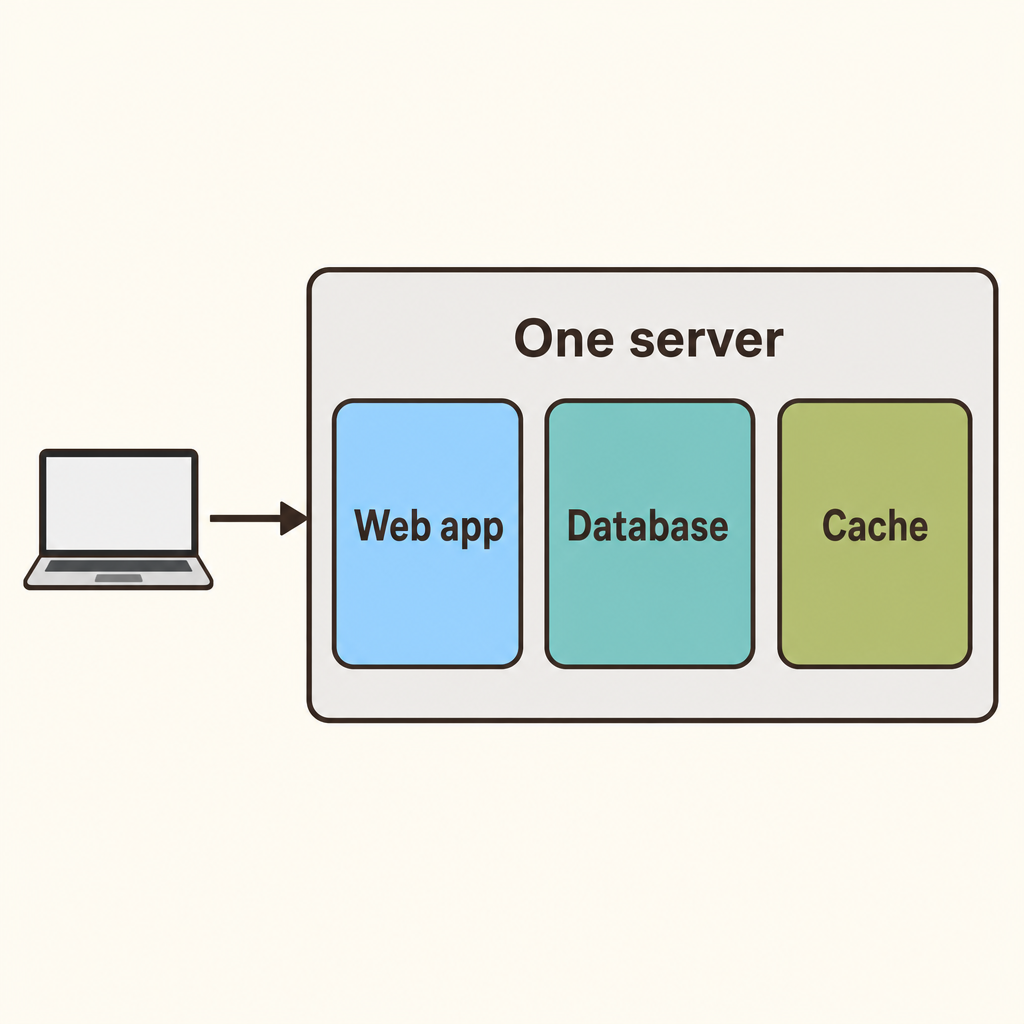
Notice that the web app, database, and cache sit inside one machine boundary, so they compete for the same CPU, memory, and disk.
This is simple to deploy, cheap to run, and easy to debug.
It is also the setup that breaks first when traffic grows.
How A Request Flows
Follow one user request through the single server setup.
The browser resolves the domain through DNS, gets an IP address, then sends an HTTP request to that address.
The web app on that server handles the request and reads or writes data locally.
- DNS lookup: The browser resolves the domain name into an IP address.
- HTTP request: The browser sends an HTTP request to that IP address.
- App handles: The web app on the server processes the incoming request.
- Data operation: The app reads or writes data on the same machine.
- Response back: The response travels back to the browser from that one server.
The response travels back. Every stage happens on one machine.
Why One Machine Runs Out
A single server is limited by single-machine capacity.
That means one pool of CPU, one pool of memory, one disk. Your web tier and your data tier fight over the same resources.
A heavy query can starve request handling. A traffic spike can starve the database.
Success is what exposes this limit.
Two Tiers Hiding Inside One
Inside that single server, two very different workloads are hiding.
The web tier is compute work: parsing requests, running application logic, building responses.
The data tier is storage work: reading, writing, and persisting data durably.
- Web tier
- Data tier
They grow at different rates and need different hardware. Yet on one box they are forced to share.
The First Scaling Move
The first major scaling step is moving the database onto its own server.
Nothing about your application logic has to change fundamentally. The web server now reaches the database over the network instead of locally.
What changes is the boundary.
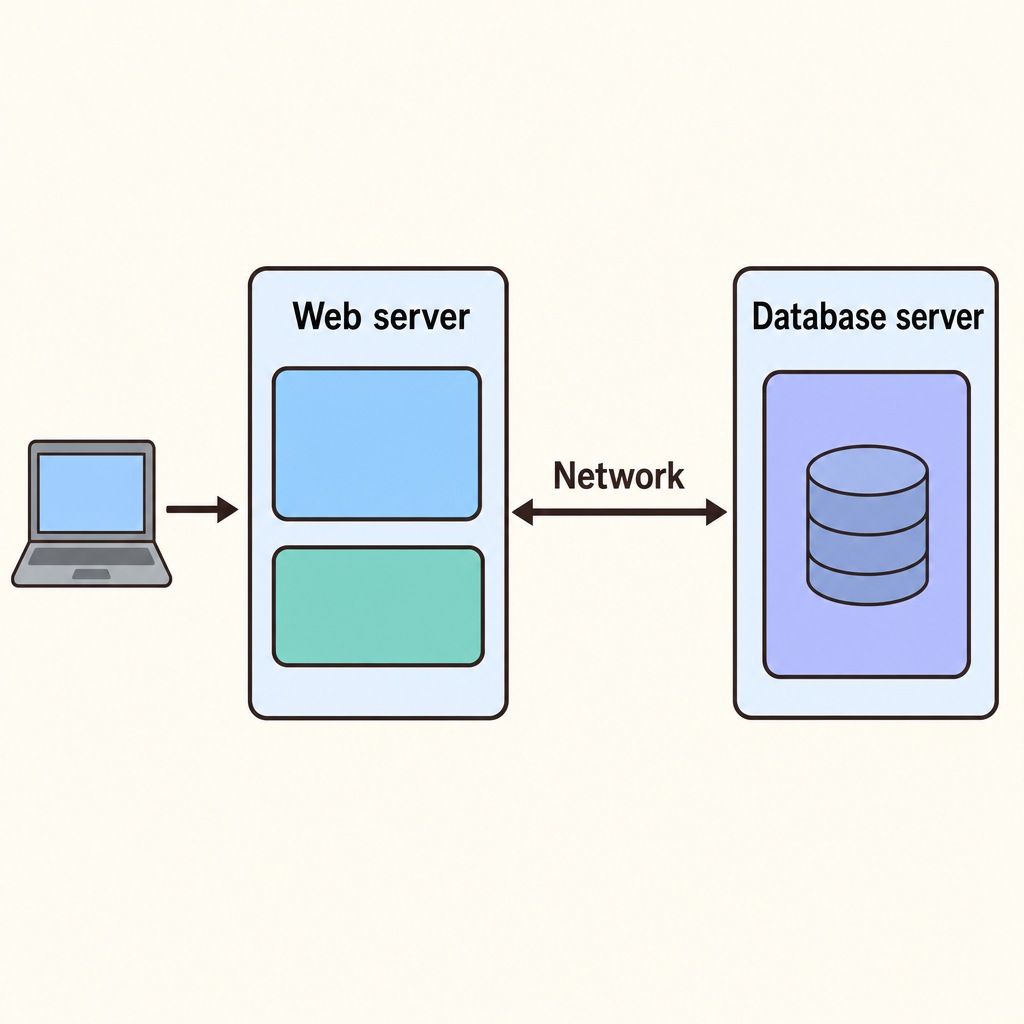
Notice the database has moved outside the web server's box, so the two tiers now talk across a network link instead of sharing one machine.
Compute and storage stop competing for the same machine.
Independent Scaling
Separation buys you one thing above all: independent scaling.
If request volume climbs, add web servers without touching the database. If your dataset grows or queries slow down, give the database more memory and faster disks.
Each tier gets the hardware profile it actually needs.
- Single server
- Separated database
On one box, every upgrade meant paying for both.
.
What The Split Costs
Separation is not free.
Data access now crosses the network, so every query carries latency it did not have before. You have a second machine to configure, secure, and monitor.
A network failure between the tiers is a new way for the system to break.
- Single server
- Separated tiers
The trade is worth it because the ceiling moves. Complexity is the price of headroom.
Knowing When To Split
Do not separate on day one out of habit. Separate when the evidence says to.
Watch for the database and the web app competing: CPU pinned during queries, memory pressure, disk contention.
Ask one question. Is the bottleneck compute or storage?
- Single server running: Web app, database, and cache share one machine.
- Resource contention?: CPU pinned during queries, memory pressure, or disk contention.
- Keep it simple: Stay on one box while it is cheap and easy to debug.
- Compute or storage?: Identify which tier is the real bottleneck.
- Move database out: Give the database its own server.
- Scale each tier
- Keep watching
- Either tier
If you cannot answer it on one box, that is your signal to split.
Key Takeaways
One server is a fine starting point and a poor ending point.
The web app, database, and cache all sharing one machine is simple but limited by single-machine capacity.
Separating the database is the first major scaling step. It lets you scale compute and storage independently.
- Single server: Web app, database, and cache all run on one machine.
- Machine capacity: One server is limited by single-machine capacity.
- Web tier: The compute side that handles HTTP requests.
- Data tier: The storage side that reads and writes data.
- Network hop: Data access now crosses the network and carries latency.
Everything after this, replication and caching layers, builds on that boundary.
Check yourself
Moving the database to its own server allows the web tier and data tier to scale independently.
- True
- False
Answer: True
Correct. Separation gives each tier its own machine, so web capacity and database capacity can be adjusted separately. Keeping both on one server forces upgrades to support both workloads together.
Word pool: web tier; data tier. Parsing requests and building responses belong to the _____, while reading and durably storing data belong to the _____.
Answer: Word pool: web tier; data tier. Parsing requests and building responses belong to the web tier, while reading and durably storing data belong to the data tier.
The web tier performs compute-oriented request and application work. The data tier performs storage-oriented reading, writing, and durable persistence. These workloads may share one machine initially but have different resource needs.
A web application and its database share one server. Queries are causing CPU and memory pressure, while request traffic is also increasing. What is the first major scaling move described here?
- Move the database to its own server
- Add a cache while keeping everything on one server
- Replace the web application with a different framework
- Combine database queries with request parsing
Answer: Move the database to its own server
Moving the database to its own server separates compute work from storage work. The application can then reach the database over the network, allowing each tier to receive hardware suited to its workload.
Keep going
This is lesson 1 of 52 in System Design Foundations. Next up:
- Scaling with Caching Layers
- Load Balancers & Stateless
- Caching & CDNs
- Power of Two
- Latency & Storage
Wondering turns any topic into short lessons you can read, watch, or listen to, with practice questions and an AI tutor.