Free sample lesson · Swing Power and Mobility Training
Hip Rotation
Ever wonder why your backswing feels uncomfortably tight?
Lesson 1 of the Wondering course Swing Power and Mobility Training
Why The Backswing Feels Tight
Your backswing does not stall because your arms are too short.
In golf and tennis, the hips are the primary engine for rotational power. The thigh bone turns inside the pelvis, and that turn creates torque.
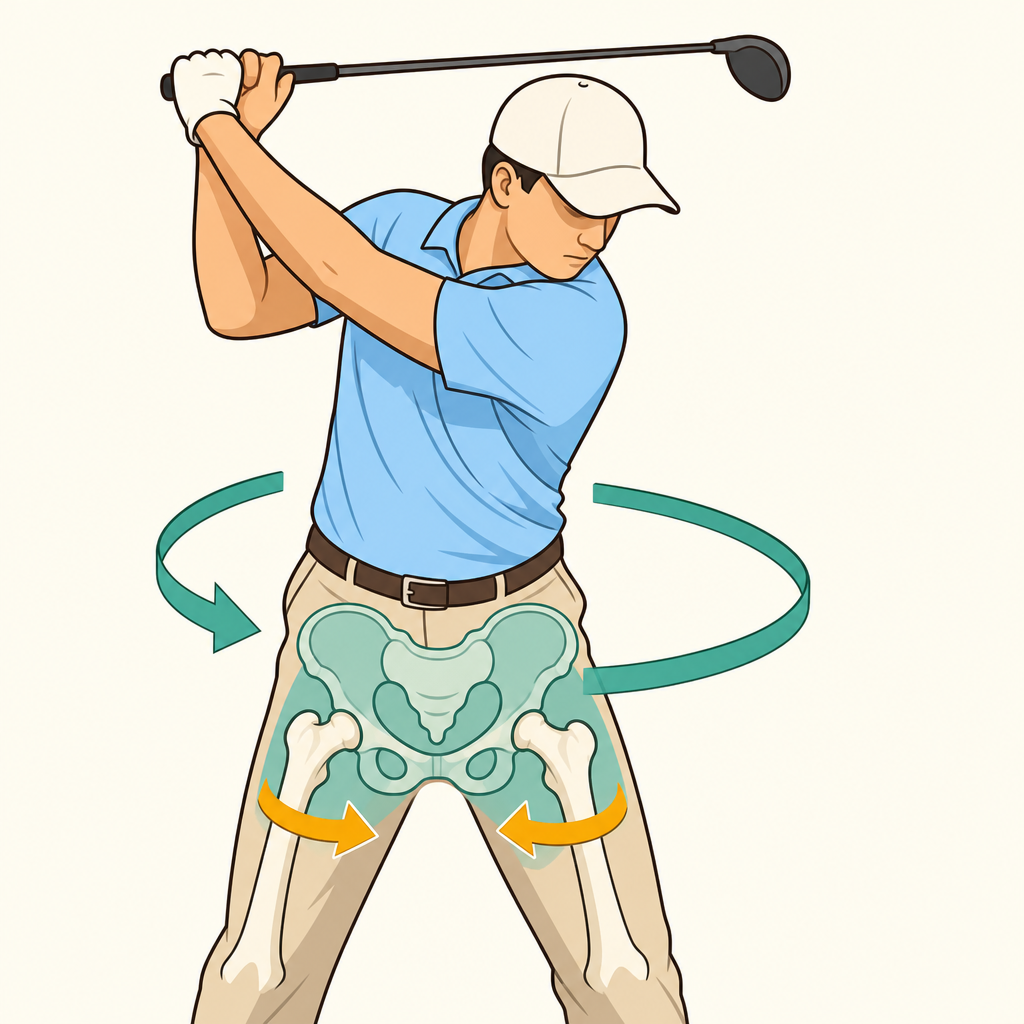
A full backswing is built on hip turn, not arm reach
When the hips run out of range, the swing runs out of room. The body then hunts for movement somewhere else.
Two Directions Of Rotation
Hip rotation runs in two directions, and both matter.
Internal rotation happens when the femur turns inward, toward the midline of the body. It is what opens the follow-through.
External rotation happens when the femur turns outward, away from the midline. It is what lets a hip load and coil.
- Internal rotation
- External rotation
Torque comes from having both directions available.
Golf Needs Both Hips
A golf swing asks each hip for a different job.
The trail hip needs external rotation to load during the backswing. The lead hip needs internal rotation for a complete follow-through.
Both movements happen inside the hip socket. Neither one requires the lower back to twist further.
Tennis Power Starts Low
A powerful forehand follows the same rule.
The hips transfer energy from the ground up through the kinetic chain. Force enters at the feet, passes through the pelvis, and arrives at the racket.
- Ground force: The feet push into the court to start the chain.
- Hip rotation: The hips turn and pick up that force.
- Trunk transfer: Energy passes upward through the kinetic chain.
- Racket speed: The stroke arrives at the ball with the accumulated speed.
Every link that cannot rotate leaks speed before it reaches the ball.
When The Hips Say No
Restricted hips do not simply reduce your turn. The body compensates.
It borrows rotation from the lower back, over-rotating the lumbar spine to finish the swing.
- Swing begins
- Hip range available?
- Hips rotate: The femur turns inside the pelvis.
- Lower back over-rotates: The body borrows rotation from the lumbar spine.
- Power, safe spine
- Lumbar strain: Strain and disc injuries follow repeated compensation.
That compensation is a leading cause of lumbar strain and disc injuries.
Decouple Hips From Spine
The goal of mobility work is separation.
Dynamic stretching and active mobilization teach the pelvis to rotate while the ribcage and spine stay quiet. That is decoupling hip movement from spinal movement.
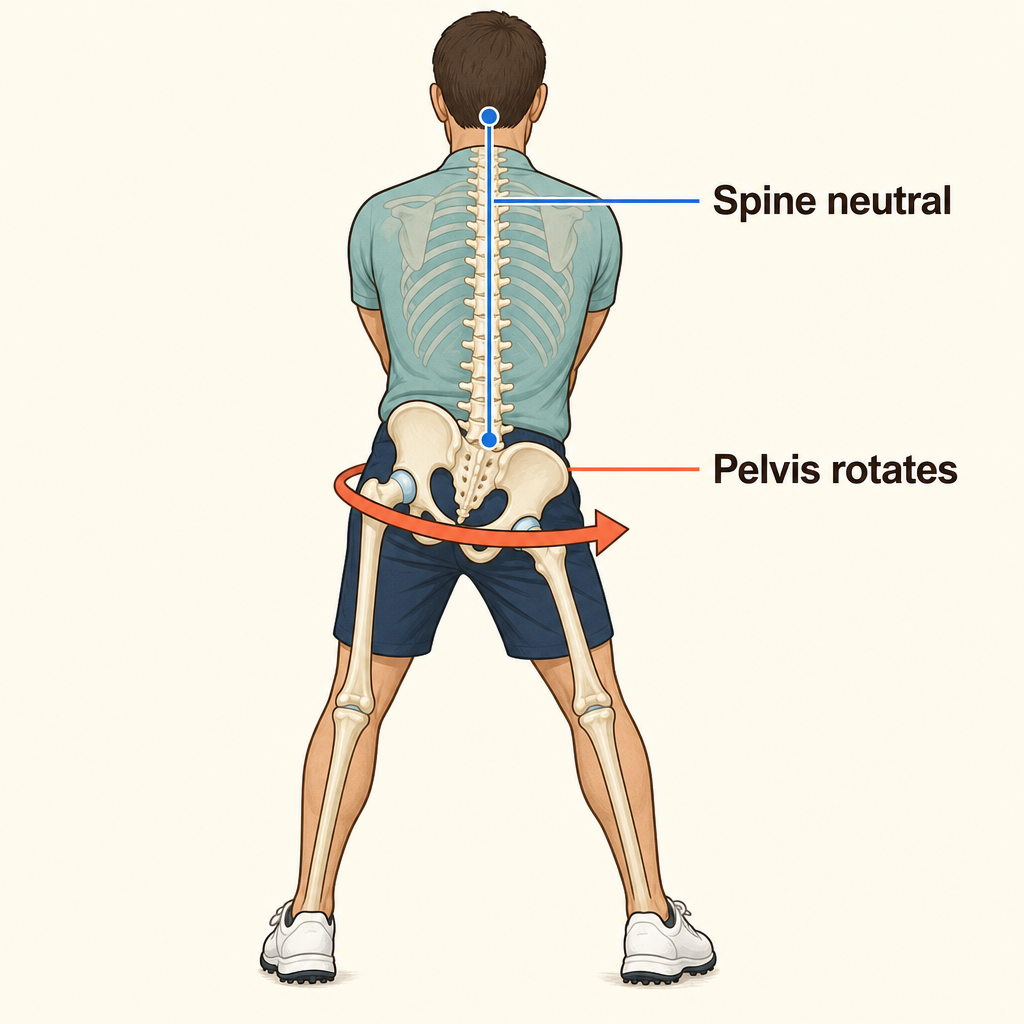
Notice that the pelvis has turned around the standing thigh bone while the ribcage and spine stay stacked and quiet.
Once the two are separate, a deeper turn costs your back nothing.
What Mobility Buys You
Improved hip range of motion changes two things at once.
It allows a deeper turn and greater clubhead or racket speed. It also removes the reason your lower back compensates.
- Deeper turn: Greater range of motion allows a fuller rotation.
- Clubhead speed: A deeper turn adds yards to the drive.
- Racket pace: More pace arrives at the serve and stroke.
- Lumbar protection: The lower back no longer needs to compensate.
- Joint durability: Consistent work insures against long-term degeneration.
Consistent work adds yards to the drive, pace to the serve, and acts as insurance against long-term joint degeneration.
Big Joints Or Vulnerable Ones
Every swing produces rotation. The only open question is which joint absorbs it.
Your hips are your largest joints. Your lumbar spine is among your most vulnerable.
Building It In Order
Mobility work is not a warm-up ritual. It is the base layer of your power.
Range of motion comes first. Separation of hip from spine comes next. Speed and distance follow from both.
- Speed and distance: Yards on the drive and pace on the serve.
- Hip and spine separation: Hip movement is decoupled from spinal movement.
- Hip range of motion: Dynamic stretching and active mobilization build the base.
Each level rests on the one below
Check yourself
During a golf backswing, the trail hip needs external rotation to load and coil.
- True
- False
Answer: True
External rotation turns the femur outward and helps the trail hip load during the backswing. Internal rotation is more important for the lead hip during the follow-through.
For a golf swing, the trail hip uses _____ to load, while the lead hip uses _____ to open the follow-through.
Answer: For a golf swing, the trail hip uses external rotation to load, while the lead hip uses internal rotation to open the follow-through.
The trail hip externally rotates during the backswing to load and coil. The lead hip internally rotates to help open the follow-through. Torque and control depend on having both directions available.
A tennis player with restricted hip rotation tries to create a larger turn. What compensation is most likely?
- The lumbar spine over-rotates
- The feet stop transferring any force
- The racket becomes the main source of hip torque
- The pelvis becomes unable to rotate at all
Answer: The lumbar spine over-rotates
When the hips cannot provide enough rotation, the body borrows movement from the lumbar spine. Over-rotating this vulnerable area can contribute to lumbar strain and disc injuries.
Keep going
This is lesson 1 of 8 in Swing Power and Mobility Training. Next up:
- Thoracic Spine
- Shoulder Freedom
- Anti-Rotation Strength
- Pelvic Control
- Ground Force
Wondering turns any topic into short lessons you can read, watch, or listen to, with practice questions and an AI tutor.