Free sample lesson · Startups in 13 Sentences
Cofounders
Why is choosing your cofounder like buying real estate—a decision you can never really change?
Lesson 1 of the Wondering course Startups in 13 Sentences
The Real Estate Rule
Think about buying a house. You can repaint it, rebuild the kitchen, or add a new floor.
But you can never change where it is. The location comes with the house forever.
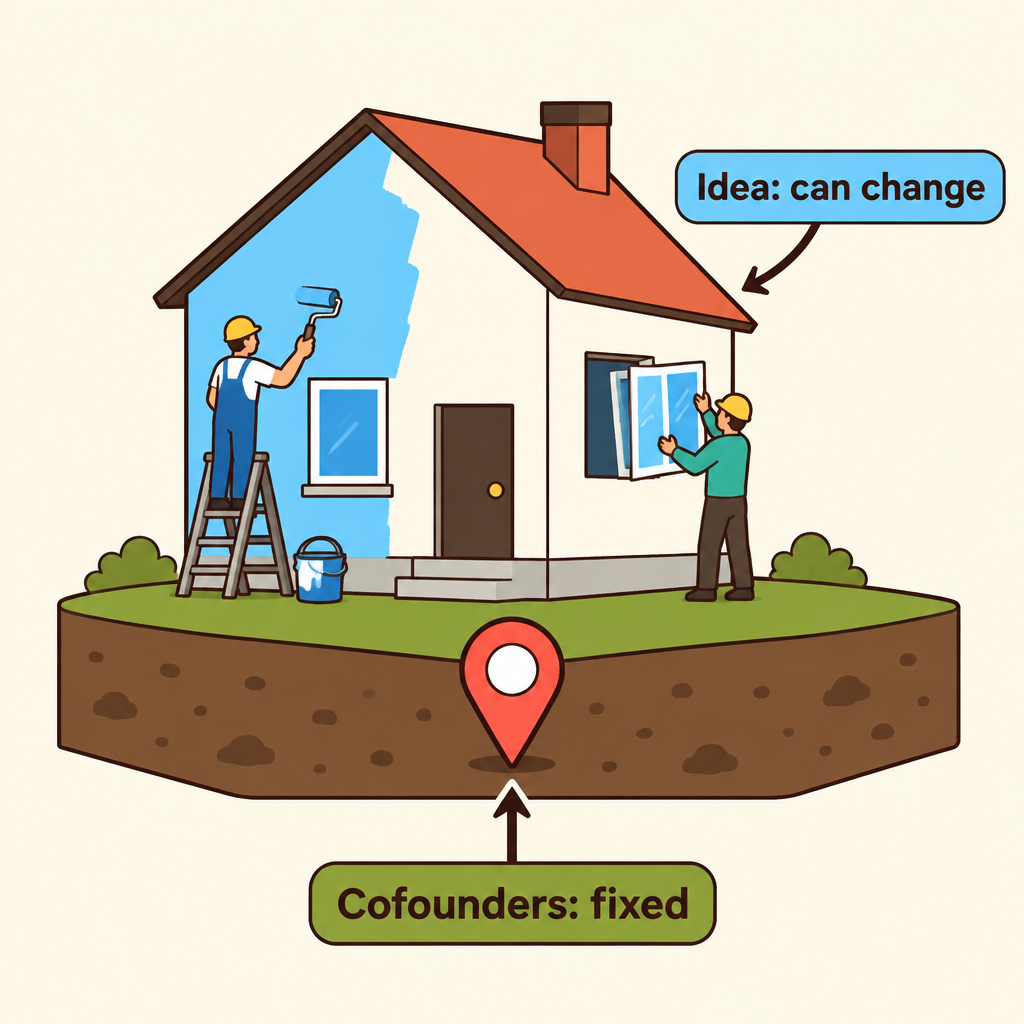
Notice that workers can change the walls and paint freely, while the ground under the house stays put, just like cofounders under a startup.
Startups work the same way. Your idea is like the paint and walls, and you can change it easily.
Your cofounders are like the location. Once you choose them, they are very hard to change.
Why You Cannot Easily Swap
Startups change all the time. You can pivot your product or rewrite your strategy.
Cofounders are different. Changing cofounders later often kills the company.
- Something is not working
- What must change?
- Pivot idea or strategy: Products and strategies are easy to change.
- Company keeps going
- Replace a cofounder: The foundation itself has to move.
- Often starting over: Changing cofounders later often kills the company.
Replacing a cofounder usually means starting over entirely. The people are the foundation everything else rests on.
So treat this choice as effectively permanent, even if nothing formally stops you from changing it.
The Best Predictor of Success
Of everything that shapes a startup, founder quality is the single best predictor of how it turns out.
That ranks it above the idea, which you can change anyway.
This makes choosing cofounders the most important decision you will make.
Yet founders often treat it casually, as if it were easy to undo later.
What Good Cofounders Look Like
So what should you look for? Three qualities matter.
- Good cofounder
- Formidable: Strong and capable at hard things.
- Complementary skills: Good at what you are not.
- Shared commitment: Cares and works as much as you.
Formidable: they are strong, capable people who get hard things done.
Complementary skills: they are good at what you are not, so the team covers more ground.
Shared commitment: they care as much as you do and match your effort.
Missing any one of these weakens the foundation.
A Weak Cofounder Is Worse Than None
It is tempting to grab any cofounder just to avoid going alone.
But a weak cofounder is worse than no cofounder.
A weak cofounder creates drag without providing benefit. You carry their weight and get little back.
- No cofounder
- Weak cofounder
Going alone has limits, but at least nothing is pulling you backward.
Putting It Into Practice
Before you commit to a cofounder, slow down. Treat it like buying land you can never move.
Ask whether this person is formidable, brings skills you lack, and matches your commitment.
- Slow down: Treat the choice as effectively permanent.
- Check strength: Ask if this person is formidable.
- Check skills: Ask if they bring skills you lack.
- Check commitment: Ask if they match your commitment.
- Decide: If any answer is no, walk away.
If the answer is no, walk away. A weak cofounder is worse than none.
Your idea can change later. Your cofounders mostly cannot.
Check yourself
Founder quality is the single best predictor of a startup's _____
- outcome
- funding speed
Answer: outcome
Founder quality predicts startup outcomes better than any other factor. That is why choosing cofounders is the most important decision a founder makes.
Cofounders are to a startup what _____ is to real estate. In a startup you can easily change your _____, but changing your _____ is hard.
Answer: Cofounders are to a startup what location is to real estate. In a startup you can easily change your idea, but changing your cofounders is hard.
You can renovate anything about a house except where it sits. Likewise, a startup can pivot its idea, but its cofounders are effectively permanent.
A startup realizes its product idea isn't working, and two cofounders also disagree badly. Which change is most likely to force the company to essentially start over?
- Replacing one of the cofounders
- Pivoting to a new product idea
- Changing the marketing strategy
- Targeting a different customer group
Answer: Replacing one of the cofounders
Products and strategies can be pivoted fairly easily. Replacing cofounders is hard, and it often kills the company or means starting over entirely.
Keep going
This is lesson 1 of 13 in Startups in 13 Sentences. Next up:
- Launch Fast
- Idea Evolution
- User Understanding
- Depth Over Breadth
- Customer Service
Wondering turns any topic into short lessons you can read, watch, or listen to, with practice questions and an AI tutor.