Free sample lesson · Social Network Architecture and Theory
Weak Ties
Why do casual acquaintances offer better opportunities than close friends?
Lesson 1 of the Wondering course Social Network Architecture and Theory
The Weak Tie Paradox
Your closest friends already know what you know.
The Strength of Weak Ties theory says infrequent, low-intensity connections are more likely to link different social clusters than strong, high-intensity ties.
That is why a casual acquaintance often hands you the opportunity your inner circle never saw.
For a network builder, this reframes what a valuable connection actually is.
Strong Ties And Redundancy
Close-knit groups are not weak performers. They provide high engagement and trust.
But they suffer from information redundancy. Everyone inside the cluster tends to see the same things.
Weak ties carry lower intensity and lower frequency. Their value is positional rather than emotional.
- Strong ties
- Weak ties
Neither type is better. They do different structural work.
How A Bridge Works
A bridge is a tie that connects two clusters which would otherwise not touch.
Picture two dense clusters of users. Inside each one, information loops back on itself.
One low-intensity link between them becomes the only path new ideas can travel.
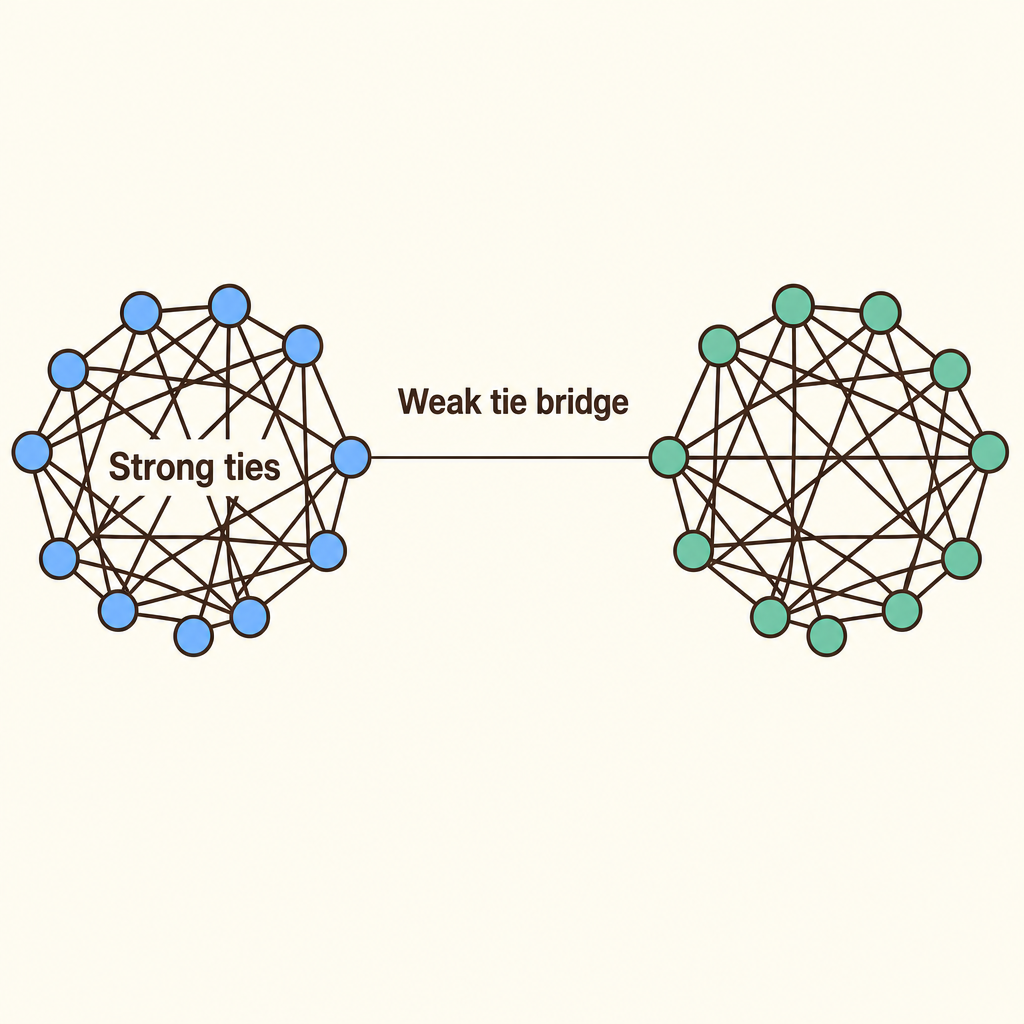
Notice that the thick internal links only circle back inside each cluster, while the single thin line is the one path between them.
Remove that link and the two communities stop exchanging anything.
What Flows Across Bridges
Bridges are conduits. Three things move across them.
New ideas enter a cluster that had exhausted its own supply.
New users arrive from communities the core never reached.
Social objects travel between disparate communities and pull attention with them.
- New ideas: Enter a cluster that had exhausted its own supply.
- New users: Arrive from communities the core never reached.
- Social objects: Travel between disparate communities.
- Disparate communities: Clusters that would otherwise not exchange anything.
The Echo Chamber Failure
When a network has no bridges, it collapses into isolated pockets.
Each cluster keeps recirculating its own content. Engagement may stay high while novelty drops to zero.
This is the stagnant echo chamber. It looks healthy on retention dashboards and is quietly dying.
- No bridges: Clusters form with no low-intensity links between them.
- Recirculation: Each cluster keeps recirculating its own content.
- Redundancy: Information redundancy rises and novelty drops to zero.
- Stagnation: The network becomes a stagnant echo chamber despite high engagement.
Bridging features are the countermeasure.
Designing Bridging Features
You cannot force friendship, but you can engineer exposure.
Discovery feeds surface content from outside a user's immediate cluster.
Cross-community recommendations put a user in front of a group they have no strong tie to.
- Discovery feeds
- Cross-community recs
Both create the low-intensity contact from which a bridge can form.
Bridges Inside Growth Loops
Weak ties are what keep a growth loop from closing in on itself.
A social object travels across a bridge into a new cluster. Users there engage with it.
Some of them form their own weak ties outward, creating fresh bridges.
- Object crosses bridge: A social object travels across a weak tie into a new cluster.
- New cluster engages: Users in that cluster interact with the object.
- New weak ties: Some of them form their own low-intensity ties outward.
- Fresh bridges: Those ties become new conduits into further communities.
The loop restarts with a wider surface than before.
A Common Misreading
Weak ties are not a replacement for strong ties.
Strong ties still supply the trust and engagement that make a core user base worth having.
The mistake is optimizing only for depth, then wondering why reach stalls beyond the initial core.
- High trust
- Information redundancy
- Reach stalls
- Dense clusters
- Sparse links between them
- Sustainable growth loop
- Low engagement
- No conduits
- Wide exposure
- Little trust
Healthy networks need dense clusters and the sparse links between them.
Building For Bridges
Treat bridges as infrastructure, not as a happy accident.
Ask of any feature: does it expose a user to a cluster they are not already inside?
Measure novelty flowing between communities, not only activity inside them.
- Design for
- Discovery feeds: Surface content from beyond the immediate cluster.
- Cross-community recommendations: Expose users to groups they have no strong tie to.
- Watch for
- Information redundancy: Everyone inside a cluster sees the same things.
- Stagnant echo chambers: High retention while novelty drops to zero.
- Aim for
- Cross-community growth: New users and ideas flowing between disparate clusters.
- Sustainable growth loops: Network effect expanding beyond the initial core user base.
Weak ties supply the variety that keeps the loop running.
Variety is what keeps a network effect expanding past the core.
Check yourself
A weak tie is usually an infrequent, low-intensity connection between people.
- True
- False
Answer: True
Correct. Weak ties are less frequent and less intense than close relationships, but they often connect different social clusters.
Strong ties often provide _____ within a group, while weak ties often provide _____ beyond that group.
Answer: Strong ties often provide trust and engagement within a group, while weak ties often provide cross-cluster reach beyond that group.
Strong ties help create a trusted, engaged core. Weak ties are valuable because they connect the core to people and information outside it.
Wundr wants to help users encounter communities outside their immediate groups. Which feature most directly creates this opportunity?
- A discovery feed showing content from outside the user's cluster
- A feed showing only posts from the user's closest friends
- A setting that removes all unfamiliar recommendations
- A feature that increases messaging frequency within one friend group
Answer: A discovery feed showing content from outside the user's cluster
A discovery feed can surface content from outside a user's immediate cluster, creating low-intensity contact that may develop into a bridge. It does not require forcing friendship.
Keep going
This is lesson 1 of 21 in Social Network Architecture and Theory. Next up:
- Small Worlds
- Homophily
- Cold Start
- Hard Sides
- Negative Effects
Wondering turns any topic into short lessons you can read, watch, or listen to, with practice questions and an AI tutor.