Free sample lesson · Securing Software Development Lifecycles
Threat Modeling
Where do attackers first strike in your system architecture?
Lesson 1 of the Wondering course Securing Software Development Lifecycles
Modeling Before Code
Attackers rarely start where you expect. They start where the architecture leaks trust.
Threat modeling is a structured decomposition of your application architecture. You look for entry points and attack vectors before a single line of code exists.
Done early in the SDLC, it moves a team away from patch-and-fix reaction toward secure-by-design intent.
- Patch-and-fix
- Secure-by-design
Draw The Data Flow
The work starts with a picture, not a checklist.
Data flow diagrams show how data actually moves through the system. They expose the paths an adversary can follow.
On top of the DFD you mark trust boundaries: the points where data transitions between different levels of control. Those transitions are where scrutiny pays off most.
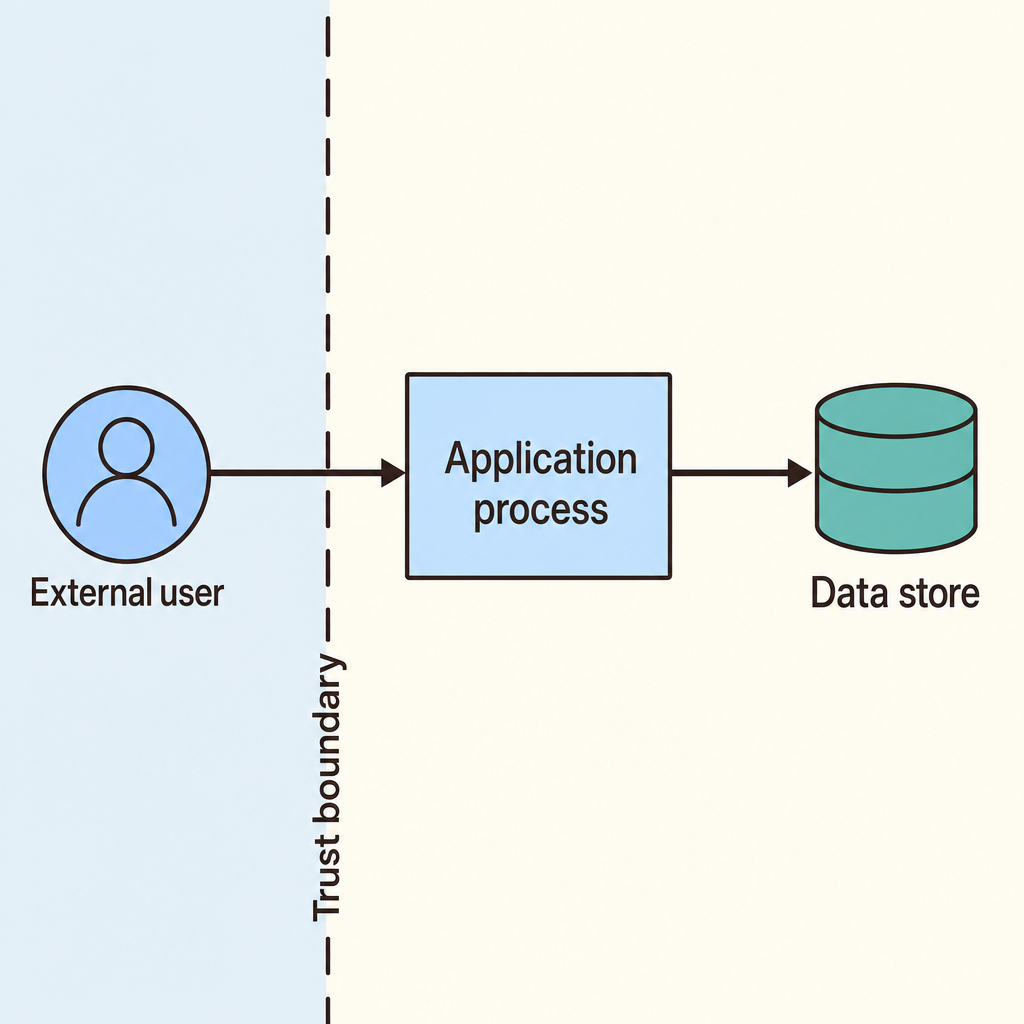
Notice that the risk concentrates exactly where the data flow arrow crosses the dashed boundary between two levels of control.
STRIDE As A Lens
Frameworks keep the analysis honest. STRIDE gives you six categories to anticipate adversary behaviour at each element of the diagram.
Spoofing, Tampering, Repudiation, Information Disclosure, Denial of Service, Elevation of Privilege.
Walk each category against each data flow and trust boundary. Gaps that intuition skips become visible.
Applying STRIDE Systematically
STRIDE is systematic because you apply it the same way every time.
Take one element of the diagram. Ask all six questions. Record what the architecture does not defend against. Then move to the next element.
The discipline is in the repetition, not in cleverness.
- Decompose architecture: Break the application into elements and data flows on the diagram.
- Mark boundaries: Identify where data transitions between different levels of control.
- Apply categories: Ask all six STRIDE questions against each element and flow.
- Record threats: Capture every unaddressed threat as a candidate risk.
- Prioritise risks: Rank the most critical risks facing the software ecosystem.
Keeping Pace With CI/CD
A threat model that ages becomes fiction.
Advanced practitioners automate threat model updates so the model keeps pace with CI/CD pipelines.
The goal is simple: architectural changes must not introduce unforeseen vulnerabilities that nobody re-examined.
The Blueprint For Everything Else
The threat model is not the end of the work. It is the blueprint for what follows.
Security testing, code review, and incident response planning all draw their priorities from it.
When the model ranks the most critical risks, downstream effort lands where it matters.
- Threat model: The blueprint for subsequent security activities.
- Security testing: Tests target the prioritised risks.
- Code review: Review focuses on high-risk components.
- Incident response: Planning anticipates the modelled attack vectors.
Check yourself
Threat modeling should begin during architecture design, before implementation, so teams can identify threats early.
- True
- False
Answer: True
Threat modeling is most valuable early in the software development lifecycle, when architectural changes are still practical. This supports secure-by-design work instead of reacting with patches after deployment.
When analyzing an application, a _____ shows how data moves, while _____ mark transitions between control levels.
Answer: When analyzing an application, a data flow diagram shows how data moves, while trust boundaries mark transitions between control levels.
A data flow diagram maps movement through the system. Trust boundaries are marked on that diagram to identify changes in control that may require deeper security analysis.
Which action best follows a systematic STRIDE analysis of an application architecture?
- Ask all six STRIDE questions for each diagram element and record gaps
- Focus only on the attack category that seems most likely
- Wait until code review to search for threats in implementation details
- Review only the application's public login endpoint
Answer: Ask all six STRIDE questions for each diagram element and record gaps
Systematic STRIDE analysis examines one diagram element with all six threat categories, records missing defenses, and proceeds to the next element. This repetition reduces gaps that intuition might miss.
Keep going
This is lesson 1 of 6 in Securing Software Development Lifecycles. Next up:
- Secure Coding
- Static Analysis
- Dependency Management
- Pipeline Security
- Continuous Monitoring
Wondering turns any topic into short lessons you can read, watch, or listen to, with practice questions and an AI tutor.