Free sample lesson · Save the Cat!: The Last Book on Screenwriting You'll Ever Need
The Power of the Logline
What if you could sell your entire movie in just two sentences?
Lesson 1 of the Wondering course Save the Cat!: The Last Book on Screenwriting You'll Ever Need
Your Movie in Two Sentences
What if you could sell your entire movie in just two sentences?
That short pitch is called a logline. It is a one- or two-sentence summary of your film.
Snyder argues that you must be able to say it before you write a single scene.
Get it right, and it guides every choice you make afterward.
What a Logline Carries
A strong logline packs five things into one or two sentences.
Tone: what the film feels like. Characters: who it follows. Dilemma: the problem they face.
Potential: why the idea could grow into a full movie. Target audience: who will want to see it.
Leave one out, and your listener gets a blurry picture of the film.
The Logline Is Your Story's DNA
Many writers treat the logline as something to write after the script, only for selling.
Snyder sees it differently. He calls the logline the DNA of your story.
DNA holds the instructions for a whole living thing. Your logline holds the core instructions for your whole film.
- Sales afterthought
- Story DNA
It still helps you sell. It also shapes the story from the inside.
Pitch First, Story Second
Snyder puts it bluntly: "Until you have your pitch, and it grabs me, don't bother with the story."
So the logline comes first. You draft it, pitch it to a listener, and rewrite until it grabs them.
- Draft logline
- Pitch to listener
- Does it grab them?
- Rewrite logline
- Write screenplay
Only then do you start the screenplay.
Expect this to take real time. Snyder says crafting the logline deserves significant effort.
Be a Slave to the Logline
Snyder's phrase is blunt: be a slave to the logline.
Once it is set, the logline becomes your guiding principle. Every later decision answers to it.
Imagine a made-up case: your logline promises a light comedy about a nervous chef. A new scene turns grim and slow, so it does not fit the tone. You rethink it.
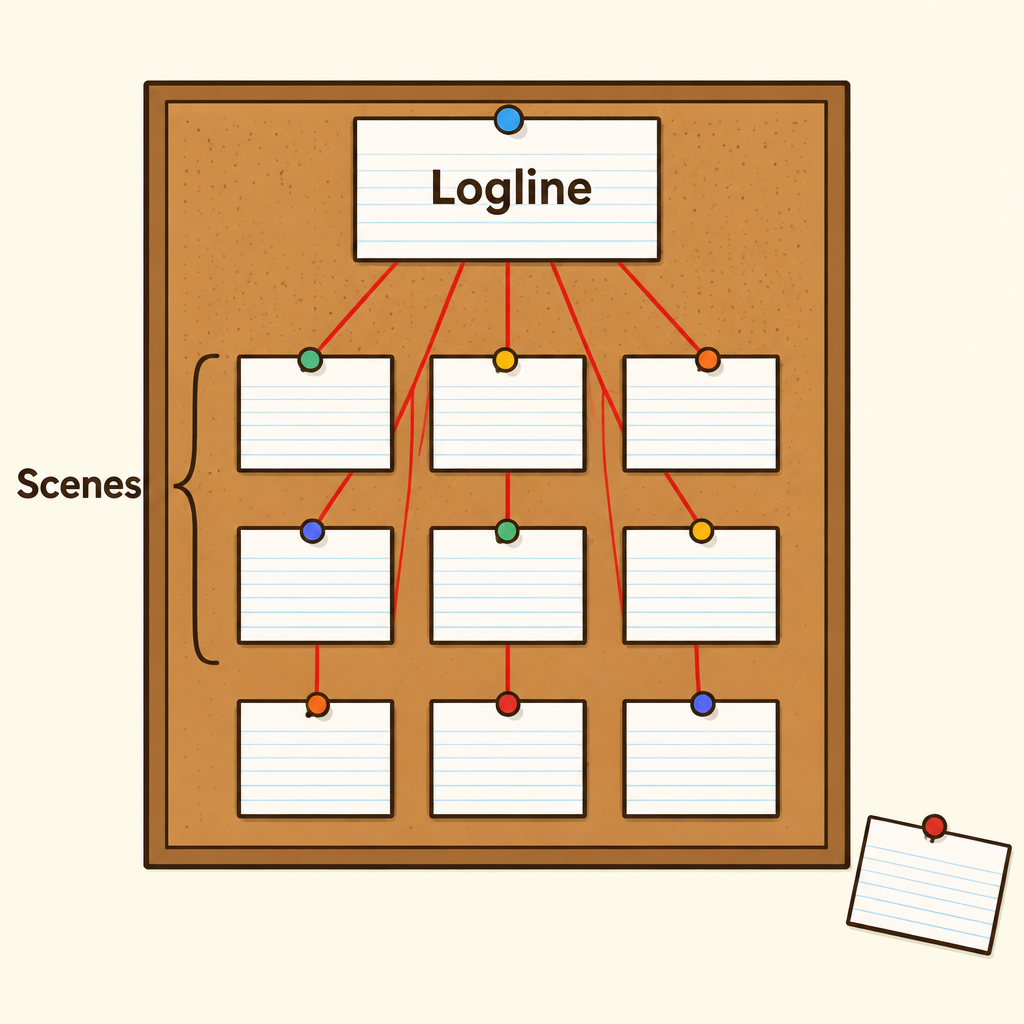
Notice how every scene card connects back to the single logline card, while the card that breaks the tone sits off the board until it is reworked.
The logline is the backbone. Scenes, characters, and tone all hang on it.
The 'What Happens Next?' Test
How do you know a logline works? Watch your listener.
A great logline makes them ask, "What happens next?"
Snyder compares it to a book cover. A good cover makes you want to open the book.

HK TST 尖沙咀 Tsim Sha Tsui 星光行 Star House shop 誠品書店 Eslite Bookstore display April 2024 R12S · HOA16 HONON · CC0 1.0 · Wikimedia Commons

If your listener shrugs, the logline is not done yet. Go back and sharpen it.
Putting It to Work
Two ideas carry this whole lesson.
Logline as DNA: one or two sentences that hold your film's tone, potential, dilemma, characters, and target audience.
Slave to the logline: write it before the script, then let it guide every creative decision.
- Draft: Write your movie in one or two sentences.
- Check five: Confirm tone, potential, dilemma, characters, and target audience.
- Pitch: Rewrite until a listener asks what happens next.
- Write and obey: Write the script, testing every decision against the logline.
On your next project, start with the logline. Pitch it, and rewrite until people ask what happens next.
Check yourself
Snyder says a logline is best understood as _____
- the DNA of the story that shapes the whole film
- mainly a sales tool used to pitch a finished script
Answer: the DNA of the story that shapes the whole film
Snyder calls the logline the DNA of the story. It is not just a marketing tool. It holds the core of the film and guides the writing.
A screenwriter says, "I have a logline for my movie." What should she have written?
- One or two sentences that show the story's tone, dilemma, main characters, and audience
- A three-page summary of every major event in the story
- A short catchy slogan to print on the movie poster
- A numbered list of the main scenes in story order
Answer: One or two sentences that show the story's tone, dilemma, main characters, and audience
A logline is a one- or two-sentence summary that captures the film's tone, potential, dilemma, characters, and target audience. A long synopsis, a scene list, or a catchy slogan doesn't hold all of that in such a short space.
You tell a friend the one-sentence logline for your movie. Which reaction shows your logline is working?
- "Wait, what happens next?"
- "Sorry, what is the movie actually about?"
- "Okay. Is that the whole story?"
- "That's a lot of detail to follow."
Answer: "Wait, what happens next?"
A great logline works like a good book cover. It makes the listener want more and ask "What happens next?" Confusion or polite boredom means it isn't grabbing them yet.
Keep going
This is lesson 1 of 39 in Save the Cat!: The Last Book on Screenwriting You'll Ever Need. Next up:
- Irony in Loglines
- Mental Picture and Market
- The Primal Connection
- Same But Different
- Beyond Traditional Genres
Wondering turns any topic into short lessons you can read, watch, or listen to, with practice questions and an AI tutor.