Free sample lesson · Sapiens
Sapiens Rise
Why did humans dominate Earth while stronger species disappeared?
Lesson 1 of the Wondering course Sapiens
The Surprising Winner
Today, Homo sapiens is the only human species on Earth. We live in every ecosystem on the planet.
That makes our success look inevitable. It was not.
For most of history, we shared the planet with other kinds of humans. Some of them were physically stronger than us.
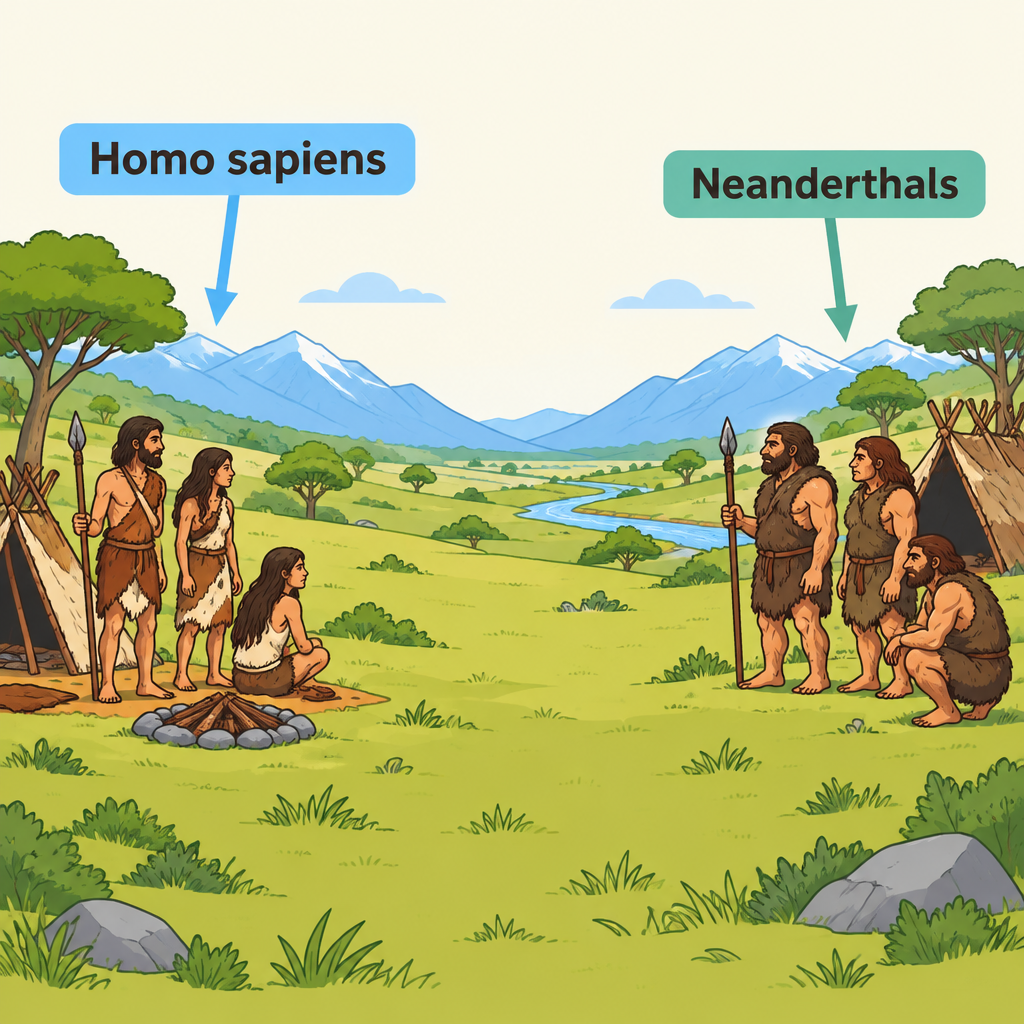
Notice that both groups are human and live at the same time, which is why our survival as the last species needs explaining.
So why are we the ones still here? The answer lies in how our minds changed, rather than in our muscles.
Many Humans, One Planet
For millions of years, several human species lived on Earth at the same time.
Two well-known examples are the Neanderthals and Homo erectus. Others existed too.
A common misconception is that human history is one single line, with one species slowly improving.
- Human species: Several coexisted for millions of years.
- Homo sapiens: The only one left by about 30,000 years ago.
- Neanderthals: Another human species that disappeared.
- Homo erectus: Another human species that disappeared.
- Others: Further human species also existed.
Instead, picture several branches alive side by side. Only around 30,000 years ago did Homo sapiens become the last one remaining.
An Unremarkable Beginning
Homo sapiens appeared in East Africa around 200,000 years ago.
At first, nothing about us stood out. We were an ordinary animal with no special advantages over other species.
For roughly 130,000 years after appearing, Sapiens gave no sign of future dominance.
So when someone says humans were destined to rule, the early record says otherwise.
Scavengers, Not Top Predators
Early humans were not at the top of the food chain. They sat somewhere in the middle.
As mid-level scavengers, they often ate what stronger hunters left behind.
Apex predators sit at the very top of the food chain. Nothing hunts them.
- Mid-level scavenger
- Apex predator
Humans only began their rapid climb toward the top around 70,000 years ago. In the long story of life, that is very recent.
The 70,000-Year Turning Point
Around 70,000 years ago, something changed dramatically for Sapiens.
They developed unique cognitive abilities, meaning new ways of thinking.
These abilities let Sapiens cooperate in large, flexible groups. Many individuals could work together and change how they worked together.
- New thinking: Around 70,000 years ago, Sapiens developed unique cognitive abilities.
- Flexible cooperation: Those abilities let Sapiens cooperate in large, flexible groups.
- Every ecosystem: Cooperation let Sapiens eventually dominate every ecosystem on the planet.
That cooperation, rather than strength, carried Sapiens into dominance over every ecosystem on the planet.
From Many to One
Put the dates together and a clear pattern appears.
For millions of years, several human species shared Earth. Sapiens joined them around 200,000 years ago as a mid-level player.
The rise began only around 70,000 years ago. By about 30,000 years ago, Sapiens was the only human species left.
- Many humans coexist: Neanderthals, Homo erectus, and others share Earth.
- Sapiens appear: An unremarkable animal emerges in East Africa.
- The rise begins: New cognitive abilities enable flexible cooperation.
- Only Sapiens remain: The other human species are gone.
Notice how short the final stretch is. Most of our history was spent as one ordinary species among several.
What to Take Away
Human dominance was not inevitable. Sapiens began as an unremarkable scavenger in the middle of the food chain.
It also did not come from physical superiority. Stronger human species existed and disappeared.
Our edge came from cognitive abilities that emerged recently, letting us cooperate in large, flexible groups.
Explaining it to a friend? Say: many humans once lived together, and the one that could cooperate flexibly in big groups is the one still here.
Check yourself
For most of human history, Homo sapiens was _____ human species on Earth
- one of several
- the only
Answer: one of several
For millions of years, several human species lived at the same time, including Neanderthals and Homo erectus. Sapiens was just one of them.
Homo sapiens appeared in East Africa about _____ years ago. A major cognitive shift began about _____ years ago. By about _____ years ago, Sapiens was the only human species left.
Answer: Homo sapiens appeared in East Africa about 200,000 years ago. A major cognitive shift began about 70,000 years ago. By about 30,000 years ago, Sapiens was the only human species left.
Sapiens emerged ~200,000 years ago as an ordinary animal, began its rapid rise ~70,000 years ago, and was the sole surviving human species by ~30,000 years ago.
Which group lived on Earth at the same time as Homo sapiens?
- Neanderthals and Homo erectus
- Dinosaurs and early mammals
- Only great apes like chimpanzees
- No other human-like species
Answer: Neanderthals and Homo erectus
Neanderthals and Homo erectus were other human species that coexisted with Sapiens. The other options are not human species living alongside early Sapiens.
Keep going
This is lesson 1 of 41 in Sapiens. Next up:
- Megafauna Extinctions
- Species Extinction
- Language
- Cooperation
- Fictions
Wondering turns any topic into short lessons you can read, watch, or listen to, with practice questions and an AI tutor.