Free sample lesson · Remember
Memory Reconstruction
Why do two people remember the same event completely differently?
Lesson 1 of the Wondering course Remember
Same Event, Different Memories
Two friends attend the same birthday party. A year later, they tell the story very differently.
One remembers a rainy evening. The other is sure the sun was out. Both feel completely certain.

Both friends attended the same party, yet each mind holds its own version, one rainy and one sunny.
Neither friend is necessarily lying. Their brains are doing exactly what brains do.
Memory does not save a perfect copy of events. It reconstructs them, and that changes how much we can trust it.
Not a Video Camera
Many people picture memory as a video camera. It records an event, stores the file, and plays it back unchanged.
That picture is wrong.
Your brain does not keep a finished recording. It keeps neural patterns, traces of the experience spread across brain cells.
- Video camera
- Your memory
When you remember, your brain uses those patterns to build the scene again. It feels like playback, but it is a fresh reconstruction.
Encode, Store, Rebuild
Memory works in three broad stages.
First, your brain encodes sensory information: the sights, sounds, smells, and feelings of the moment.
Next, it stores that information as neural patterns.
Later, when you recall the event, it rebuilds the experience from those patterns.
- Encode: Your brain takes in sights, sounds, smells, and feelings.
- Store: That information is kept as neural patterns.
- Rebuild: At recall, the brain constructs the experience from those patterns.
The key word is rebuilds. Every act of recall is an act of construction.
Rebuilt Every Time
Here is the surprising part: each time you remember something, you reconstruct it again.
Your brain does not pull up the same finished version twice. It assembles the memory anew from stored patterns.
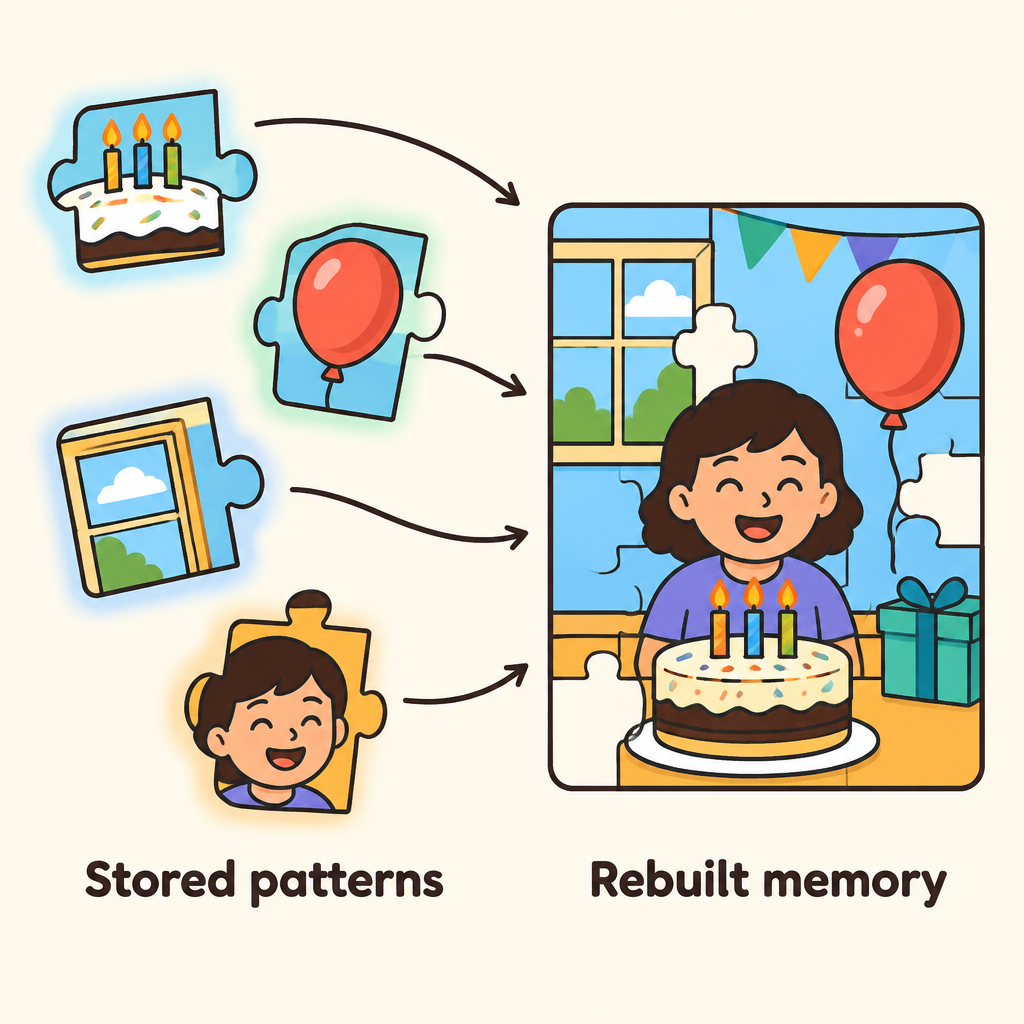
Notice that the remembered scene is put together from scattered stored pieces, so each assembly can come out a little different.
Because of this, memories are malleable. They can shift and change over time.
Think of the two friends. Each rebuilt the party many times, and their versions drifted apart.
Feels Real, Can Be Unreliable
Reconstructed memories still feel vivid and true. Your brain rebuilds them so smoothly that you rarely notice the construction.
That is why a memory can feel real and still be unreliable.
Feeling confident does not prove accuracy. A detailed, emotional memory is rebuilt from neural patterns like any other.
This is how healthy brains work, so it is no sign of a faulty memory.
Setting Realistic Expectations
Knowing memory is reconstructive helps you respond wisely.
When someone remembers an event differently, assume an honest rebuild before assuming a lie.
When accuracy really matters, such as dates or agreements, check notes, photos, or records instead of trusting recall alone.
Stay a little humble about your own vivid memories. They are useful reconstructions that can drift over time.
Check yourself
Your brain stores memories like a video camera, replaying exact recordings when you remember.
- True
- False
Answer: False
False. Memory is not a recording. The brain rebuilds experiences from stored neural patterns each time you remember them.
In memory, the brain _____ incoming sensory information, _____ it as neural patterns, and later _____ the experience from those patterns.
Answer: In memory, the brain encodes incoming sensory information, stores it as neural patterns, and later rebuilds the experience from those patterns.
Memory runs in three stages: sensory information is encoded, kept as neural patterns, and later reconstructed from those patterns when recalled.
Why are memories described as malleable?
- They are rebuilt each time they are recalled
- They are saved as exact sensory recordings
- They are erased and replaced every night
- They are only stored for a few seconds
Answer: They are rebuilt each time they are recalled
Each time you recall something, the brain reconstructs it from neural patterns rather than replaying a fixed copy. Every reconstruction is a chance for details to shift, so memories can change.
Keep going
This is lesson 1 of 22 in Remember. Next up:
- Memory Stages
- Hippocampus
- Working Memory
- Memory Types
- Attention Gateway
Wondering turns any topic into short lessons you can read, watch, or listen to, with practice questions and an AI tutor.