Free sample lesson · Quantitative Trading Career Path
Probability Basics
How can a simple coin toss decide millions in market value?
Lesson 1 of the Wondering course Quantitative Trading Career Path
A coin toss and a trade
A coin toss has exactly two outcomes: heads or tails. Neither one is guaranteed before it lands.
A trade behaves the same way. The price moves up or down, and you do not know which before you commit.
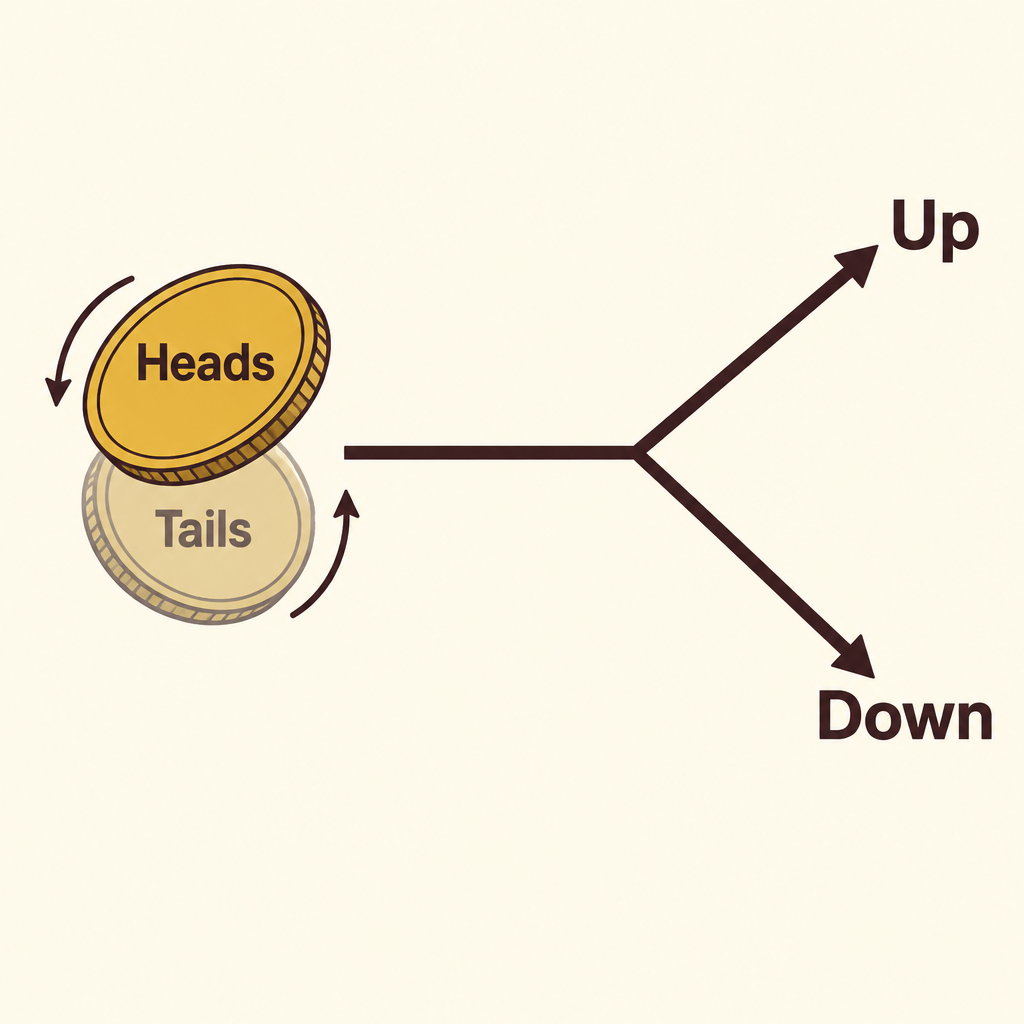
Notice that the coin and the price have the same shape of uncertainty: two possible results, one unknown outcome.
Probability is the framework for that gap. It turns I do not know into here is how likely.
Outcome, event, probability
An outcome is one single result, such as heads.
An event is a set of outcomes you care about, such as the coin lands heads or the trade finishes profitable.
A probability is a number from 0 to 1 attached to that event. For a fair coin, heads carries 0.5.
Three words, one ladder: outcomes build events, and events carry probabilities.
The 0 to 1 scale
Zero means impossible. One means certain. Every interesting case sits somewhere in between.
A fair coin splits the whole space into two equal parts: heads 50%, tails 50%.
- Heads: A probability of 0.5 written as a percentage.
- Tails: The remaining half of the same event space.
The parts of one event space always add to 100%. That is a cheap sanity check on any model you build.
Estimate it by repeating
Often you do not know the true probability. You estimate it by repetition.
In Python, flip a virtual coin many times and count how often the event happens. Divide the count by the number of flips.
- List outcomes: Write down every possible result, such as heads and tails.
- Define the event: Decide which outcomes count as a success.
- Repeat many times: Draw the outcome again and again in code.
- Count and divide: Divide successes by the total number of draws.
- Grow the sample: Increase the number of draws and watch the estimate settle.
As the number of flips grows, that fraction settles near the true value.
One trade proves nothing
No single trade is guaranteed. A winner does not prove the strategy is good, and a loser does not prove it is bad.
Over many observations, the pattern becomes measurable. That is the level where probability actually speaks.
- One trade
- Many trades
So judge a process by its repeated results, not by its last result.
So what decides the millions?
A 50/50 coin sounds like nothing worth trading on. The odds never move.
What does move is how many times you repeat the toss, and how much rides on each one.
Sit with that before you write your next strategy.
Putting the pieces together
Start with outcomes. Group them into events. Attach a probability between 0 and 1.
Estimate that probability by simulating many draws, then judge the result over many observations rather than one.
- Outcomes: The single possible results you start from.
- Events: Sets of outcomes you care about.
- Probability: A number between 0 and 1.
- Simulation: Many simulated draws give an estimate.
- Many observations: Where patterns become measurable.
- Single trade: One result that proves little.
No single trade is guaranteed, but a repeated process can be measured. That is the whole framework in one line.
Check yourself
A single result, such as heads on one coin toss, is an outcome.
- True
- False
Answer: True
An outcome is one possible result from a random process. Heads is one result, so it is an outcome.
A single result such as heads is an _____; a set of results you care about is an _____.
Answer: A single result such as heads is an outcome; a set of results you care about is an event.
An outcome is one result. An event groups outcomes that share the condition being studied, such as a profitable trade.
A fair coin has equal probabilities for heads and tails. What is the probability of tails?
- 0
- 0.25
- 0.5
- 1
Answer: 0.5
A fair coin divides the two possible outcomes equally, so tails has probability 0.5, or 50%.
Keep going
This is lesson 1 of 24 in Quantitative Trading Career Path. Next up:
- Expected Value
- Linear Algebra
- Calculus Essentials
- Pandas Data
- NumPy Arrays
Wondering turns any topic into short lessons you can read, watch, or listen to, with practice questions and an AI tutor.