Free sample lesson · Python Foundations for AI Engineering
Variables
How do computers remember information?
Lesson 1 of the Wondering course Python Foundations for AI Engineering
What You Will Learn
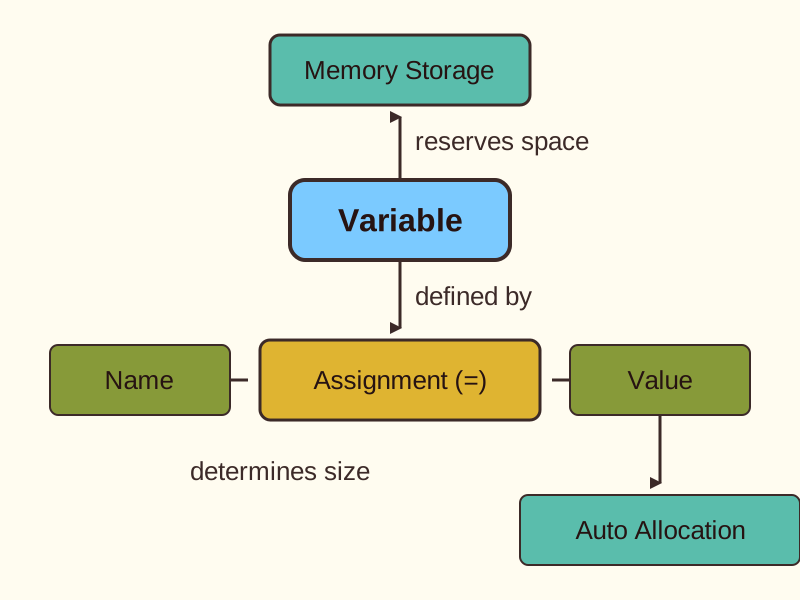
Storing data is the first step in any program.
Variables as Memory Containers
In Python, a variable is a reserved location in your computer memory used to store data.
Think of it as a labeled box. When you create a variable, you are telling the computer to set aside space for specific information.
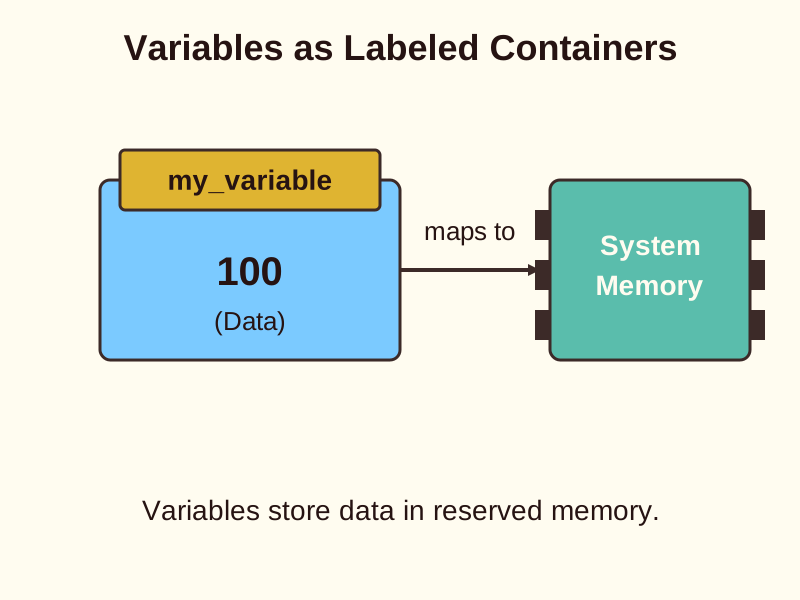
This is the foundation of all data manipulation. In AI engineering, these boxes will eventually hold complex data like model weights and input tensors.
Automatic Memory Allocation
Unlike Java, Python does not require you to declare a variable type before using it.
The Python interpreter handles memory allocation automatically. It looks at the data you provide and decides how much space is needed.
This allows you to store integers, decimals, or text strings without writing complex setup code. The declaration happens the moment you assign a value.
- Static (Java/C++)
- Dynamic (Python)
The Assignment Operator
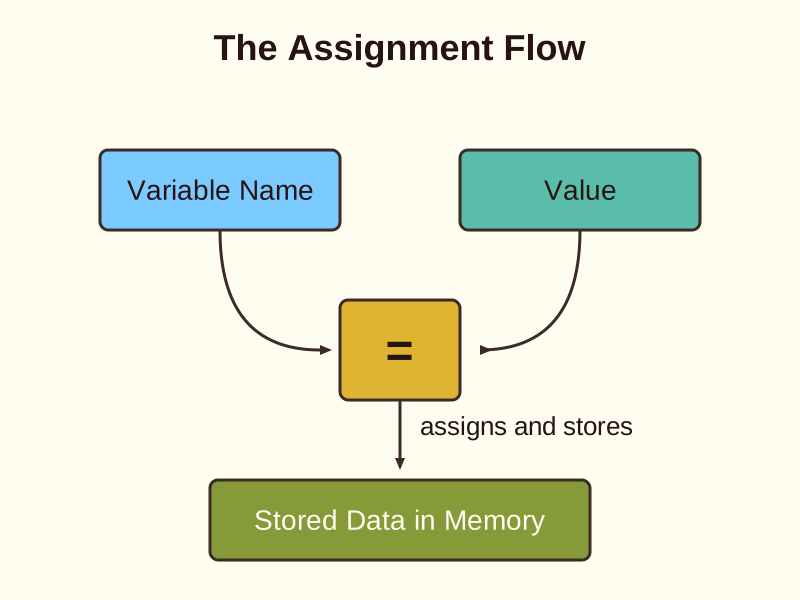
You use the equal sign (=) to assign a value to a variable name.
The name of the variable goes on the left side. The value you want to store goes on the right side.
How to Apply It in Real Life
- Name the Variable: Choose a descriptive name that identifies the data's purpose.
- Assign Value: Use the equal sign to link the name to a specific piece of data.
- Reference Data: Use the variable name later in your code to retrieve the stored value.
Check yourself
In Python, you must declare a variable's type before assigning a value to it.
- True
- False
Answer: False
Python uses automatic declaration; the variable is created the moment you assign a value to it.
When assigning data, the _____ is placed on the left, while the _____ is placed on the right.
Answer: When assigning data, the variable name is placed on the left, while the value is placed on the right.
The syntax follows the pattern: name = value.
How does the Python interpreter handle memory when a new variable is assigned?
- It allocates memory automatically based on the data type.
- It requires the developer to manually reserve memory blocks.
- It only allocates memory for integer data types.
Answer: It allocates memory automatically based on the data type.
Python automatically reserves space and determines the storage requirements based on the data type provided.
Keep going
This is lesson 1 of 21 in Python Foundations for AI Engineering. Next up:
- Data Types
- Control Flow
- Functions
- Lists
- Dictionaries
Wondering turns any topic into short lessons you can read, watch, or listen to, with practice questions and an AI tutor.