Free sample lesson · Prompt Engineering & Structured Output
Define Explicit Decision Criteria
Why did “be conservative” still flood a review with style comments?
Lesson 1 of the Wondering course Prompt Engineering & Structured Output
Overview of Explicit Decision Criteria
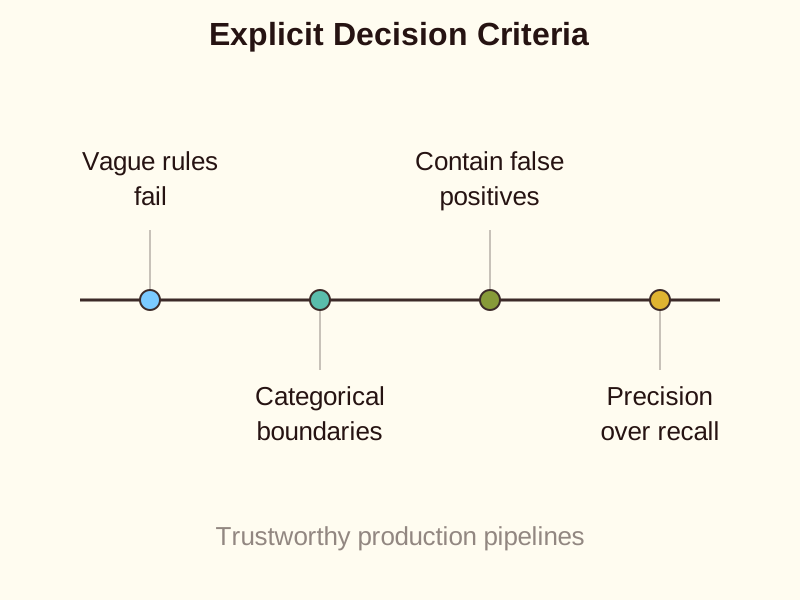
Learn how to build robust Claude prompting and output pipelines by replacing vague guidelines with categorical decision boundaries and false-positive containment.
The Failure of Vague Instructions
Vague prompts like "be conservative" or "use your best judgment" fail in production. They delegate the definition of correctness back to the model.
This creates inconsistent results. One review might flood a developer with style comments, while another misses a critical bug.
To build trust, you must define exactly what the model should report and what it should skip.
- Vague Instructions
- Explicit Criteria
Define Explicit Decision Boundaries
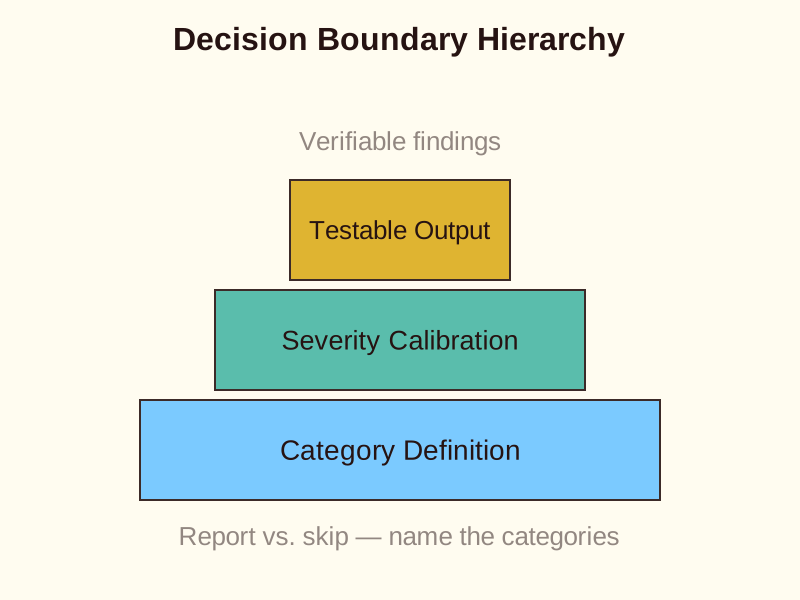
A production prompt needs clear conditions. Name the specific categories to report and those to ignore.
For example, report unsanitized SQL queries as critical findings. Skip variable naming preferences unless they violate a specific declared standard.
- Criteria precede confidence
Concrete examples at different severity levels help the model calibrate its threshold.
Contain Noisy Categories
Users do not evaluate findings in isolation. If one category is noisy, it damages trust in the entire system.
Imagine a tool that finds valid security bugs but also generates dozens of false documentation errors. Users will eventually ignore all findings.
When a category underperforms, disable it. Improve its precision in a separate environment before reintroducing it to the main pipeline.
- Identify Noise: Detect categories generating false positives that damage overall system trust.
- Disable Category: Turn off the underperforming category to protect user confidence.
- Improve Precision: Refine thresholds and examples in a separate environment.
- Reintroduce: Deploy the improved category back into the main pipeline.
Precision Over Recall
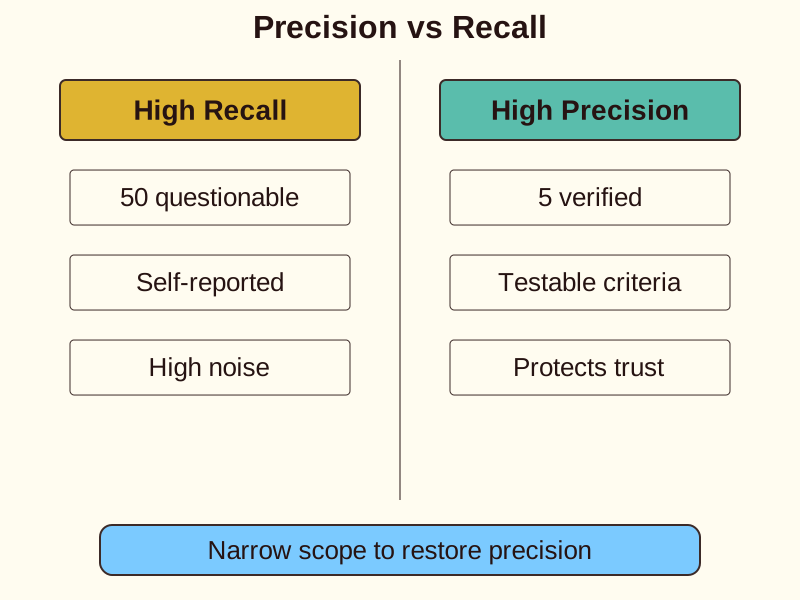
More findings do not always mean better coverage. High-value findings are only useful if they are testable and observable.
Self-reported confidence is not a substitute for validity criteria. The model might be confident and still be wrong.
Narrow your scope to restore precision. It is better to report five verified issues than fifty questionable ones.
Putting It All Together
- Define Boundaries: Specify exact report and skip rules.
- Calibrate Severity: Provide concrete examples for each severity tier.
- Contain Noise: Isolate and disable noisy or unverified categories.
Check yourself
Vague prompt instructions like "use your best judgment" fail in production because they delegate the definition of _____ back to the model.
- correctness
- latency
Answer: correctness
Vague instructions delegate correctness back to the model, leading to inconsistent outputs. Explicit decision criteria define exact standards in advance.
In the containment cycle for noisy categories, teams first _____ high false-positive rates, then _____ the category in production, next _____ precision in isolation, and finally _____ the category to the pipeline.
Answer: In the containment cycle for noisy categories, teams first identify high false-positive rates, then disable the category in production, next improve precision in isolation, and finally reintroduce the category to the pipeline.
To maintain user confidence, underperforming categories are identified, disabled in production, refined in a separate environment, and reintroduced only after precision improves.
Why should an underperforming, noisy finding category be disabled even if all other reported categories are highly accurate?
- A noisy category damages user trust in the entire system, leading users to ignore all findings.
- Models stop executing review prompts if any individual category falls below perfect accuracy.
- Disabling a category forces the model to automatically re-calibrate its self-reported confidence.
- High recall in one category automatically reduces the detection accuracy of valid security bugs.
Answer: A noisy category damages user trust in the entire system, leading users to ignore all findings.
Users do not evaluate categories independently. Frequent false positives in one area erode trust across the whole tool, leading users to disregard valid findings.
Keep going
This is lesson 1 of 6 in Prompt Engineering & Structured Output. Next up:
- Teach Patterns with Examples
- Guarantee Structured Shapes
- Retry Only Correctable Failures
- Match Batches to Latency
- Review with Fresh Passes
Wondering turns any topic into short lessons you can read, watch, or listen to, with practice questions and an AI tutor.