Free sample lesson · Professional English for Career Growth
Professional Greetings
Do you know how to start an email without sounding too casual?
Lesson 1 of the Wondering course Professional English for Career Growth
The Digital Handshake
A professional greeting is the digital equivalent of a handshake. It sets the tone for your entire conversation.
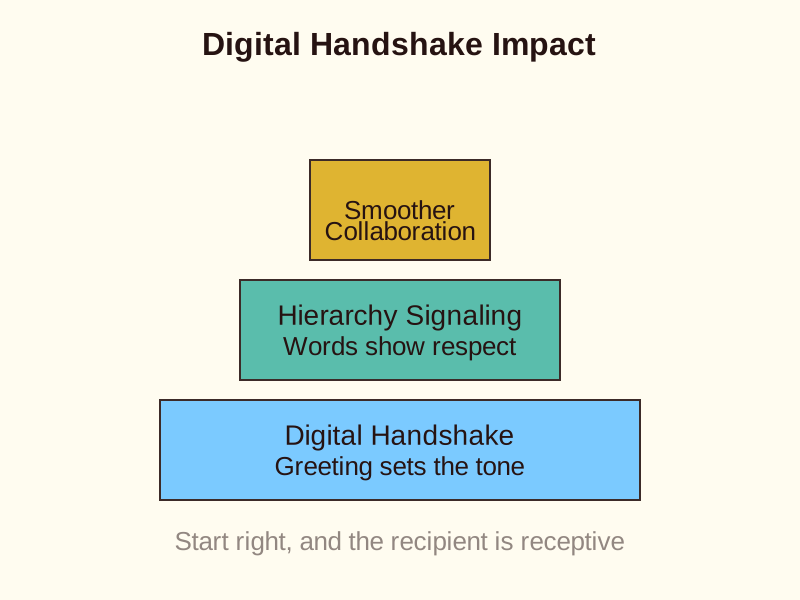
Your choice of words signals respect. It also shows you understand the workplace hierarchy.
Starting correctly ensures the recipient is receptive to your message. This leads to smoother collaboration and clearer communication.
The Gold Standard Greeting
For formal situations, use Dear [Name]. This is the best choice when contacting someone for the first time.
- Select Greeting: Use Dear [Name] for formal situations.
- Target Audience: Best choice when contacting someone for the first time.
- Make Impression: Works well for managers, clients, or senior colleagues.
It remains the gold standard for professional outreach. This greeting shows high levels of respect and professionalism.
Use this format to make a strong first impression. It works well for managers, clients, or senior colleagues.
Transitioning to Friendly Professionalism
As your professional relationships develop, you can change your style.
Hello [Name] is a great middle ground. It balances friendliness with a professional tone.
- Formal Style
- Friendly Professional
Use this when you have communicated with the person before. It maintains respect while feeling more approachable than a formal salutation.
Greetings to Avoid
Do not use overly casual openings like Hey or Hi there in initial emails.
These greetings can be perceived as disrespectful. They often appear unprofessional in a business context.
Stick to formal options until you are certain the culture is casual. Protecting your professional image is vital for career growth.
Check yourself
For a formal email sent to a senior colleague for the first time, _____ is the recommended gold standard greeting.
- Dear [Name]
- Hey [Name]
Answer: Dear [Name]
'Dear [Name]' is the gold standard for formal outreach and first-time contact, showing high levels of respect and professionalism.
When addressing a new recipient, start with _____ to maintain formal respect. Once you have communicated before, transition to _____ for friendly professionalism.
Answer: When addressing a new recipient, start with Dear [Name] to maintain formal respect. Once you have communicated before, transition to Hello [Name] for friendly professionalism.
'Dear [Name]' is ideal for initial formal outreach, while 'Hello [Name]' works as a balanced middle ground after establishing communication.
Why should you avoid starting an initial professional email with 'Hey' or 'Hi there'?
- They can be perceived as disrespectful and unprofessional in initial business context.
- They automatically trigger email spam filters in most business systems.
- They are only reserved for communication with clients rather than colleagues.
- They require using the recipient's full legal name to be valid.
Answer: They can be perceived as disrespectful and unprofessional in initial business context.
Casual greetings like 'Hey' can appear disrespectful or unprofessional in business contexts, especially before you know the workplace culture.
Keep going
This is lesson 1 of 6 in Professional English for Career Growth. Next up:
- Clear Requests
- Active Listening
- Speaking Up
- Small Talk
- Career Advancement
Wondering turns any topic into short lessons you can read, watch, or listen to, with practice questions and an AI tutor.