Free sample lesson · Probabilistic Robotics
Why Uncertainty Matters
What if the biggest challenge in robotics isn't building the hardware, but dealing with imperfect information?
Lesson 1 of the Wondering course Probabilistic Robotics
Robots Live with Imperfect Information
What if the hardest part of robotics is not building the robot, but dealing with imperfect information?
Every real robot works with data that is a little bit wrong. Its sensors, motors, and even its own internal math are never perfectly accurate.
This is called uncertainty, and it is everywhere in the real world.
Learning where uncertainty comes from is the first step toward building robots that work reliably outside the lab.
Five Sources of Uncertainty
Real-world robots face uncertainty from five primary sources.
Sensor noise means readings wobble around the true value. Actuator imprecision means motors and wheels do not move exactly as commanded.
Model inaccuracies mean the robot's internal picture of itself and the world is simplified. Computational limitations mean it cannot calculate everything perfectly in time.
Environmental unpredictability means the world changes in ways nobody planned for.
Example: Wheel Slip in a Hallway
Picture a mobile robot driving down a hallway.
Its wheel encoders count wheel turns and report that it traveled 10 meters.
But wheels can slip on the floor. Because of wheel slip, the actual distance might be anywhere from 9.5 to 10.5 meters.
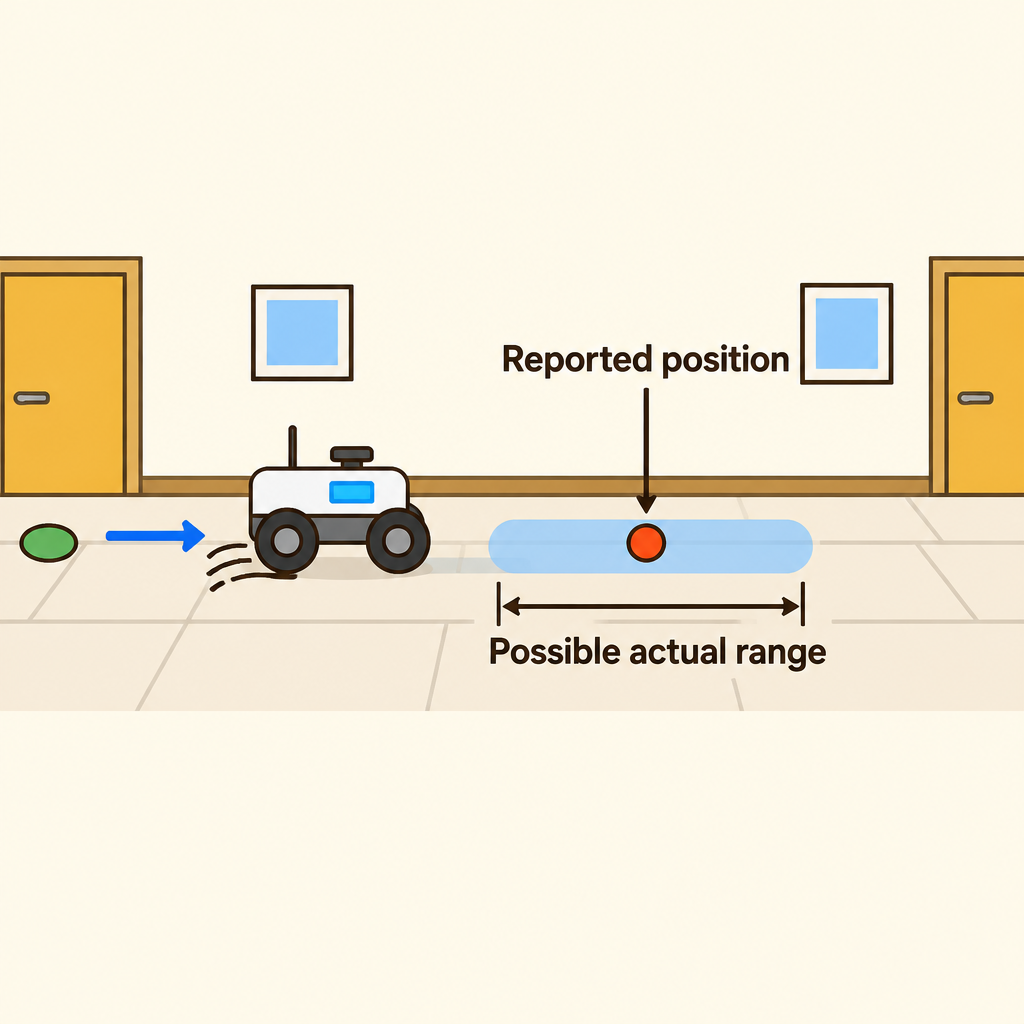
Notice that the reported position is a single point, while the robot could really be anywhere inside the shaded range around it.
The reported number looks exact. The true position is really a range of possibilities.
How Small Errors Pile Up
A deterministic system trusts the reported values as if they were exact.
So the robot believes it moved exactly 10 meters, every time.
Each move adds a small hidden error. The next move starts from that wrong spot and adds another error.
Soon the errors accumulate, and the robot loses track of where it is.
- Trust reading: The robot treats the reported 10 meters as exact.
- Hidden error: Wheel slip makes the true distance slightly different.
- Build on it: The next move starts from that wrong spot.
- Errors accumulate: Small errors add up with every move.
- Lost track: The robot no longer knows where it really is.
Deterministic vs Probabilistic Thinking
Traditional deterministic approaches fail because they cannot represent or reason about uncertainty. They hold one answer and treat it as the truth.
Probabilistic approaches keep track of a range of possibilities and how likely each one is.
For the hallway robot, that means thinking "somewhere between 9.5 and 10.5 meters" instead of "exactly 10."
- Deterministic
- Probabilistic
Admitting doubt makes the robot more robust, not weaker.
Putting It to Work
When a robot behaves strangely, ask which of the five sources is at play.
Is a sensor noisy? Did a motor or wheel not move as commanded? Is the model too simple, the computer too slow, or the world surprising?
Then check how the system handles it. If it trusts every reading as exact, it is deterministic and will drift.
- Find the source
- Noisy sensor?: Readings wobble around the truth.
- Imprecise motor?: Movement differs from the command.
- Simple model or slow computer?: The robot's math cannot capture everything.
- Surprising world?: The environment changed unexpectedly.
- Check the approach
- Trusts readings as exact: Deterministic, so errors accumulate.
- Tracks a range of possibilities: Probabilistic, so it stays robust.
Name the source first, then reason with probabilities.
Reliable robots treat information as uncertain and reason with probabilities.
Check yourself
A deterministic robot system fails under uncertainty mainly because it _____
- cannot represent or reason about uncertainty
- runs too slowly on robot hardware
Answer: cannot represent or reason about uncertainty
Deterministic approaches treat reported values as exact truth. They have no way to represent or reason about uncertainty, so errors go unnoticed and uncorrected.
In robotics, _____ corrupts what the robot perceives, _____ means commanded motions are not executed exactly, and _____ comes from changes in the world around the robot.
Answer: In robotics, sensor noise corrupts what the robot perceives, actuator imprecision means commanded motions are not executed exactly, and environmental unpredictability comes from changes in the world around the robot.
Sensor noise affects perception, actuator imprecision affects motion execution, and environmental unpredictability comes from a changing world. Together with model inaccuracies and computational limitations, these are the five primary sources of uncertainty.
Which of these is NOT one of the five primary sources of uncertainty for real-world robots?
- Programming language choice
- Model inaccuracies
- Computational limitations
- Sensor noise
Answer: Programming language choice
The five sources are sensor noise, actuator imprecision, model inaccuracies, computational limitations, and environmental unpredictability. Programming language choice is not one of them.
Keep going
This is lesson 1 of 36 in Probabilistic Robotics. Next up:
- Probability Basics
- Bayes' Theorem
- The Bayes Filter
- Prediction and Update
- Kalman Filter Basics
Wondering turns any topic into short lessons you can read, watch, or listen to, with practice questions and an AI tutor.