Free sample lesson · Probabilistic Robotics
Why Uncertainty Matters
What if the biggest challenge in robotics isn't building the hardware, but dealing with imperfect information?
Lesson 1 of the Wondering course Probabilistic Robotics
Robots Face Uncertainty
Robots act in the real world, where information is never perfectly reliable.
A sensor may report an imperfect measurement. A motor may move slightly differently than expected.
Uncertainty means the robot cannot know every detail with complete confidence. It must still make decisions and act safely.
Understanding where uncertainty comes from is the first step toward building robots that work reliably outside controlled conditions.
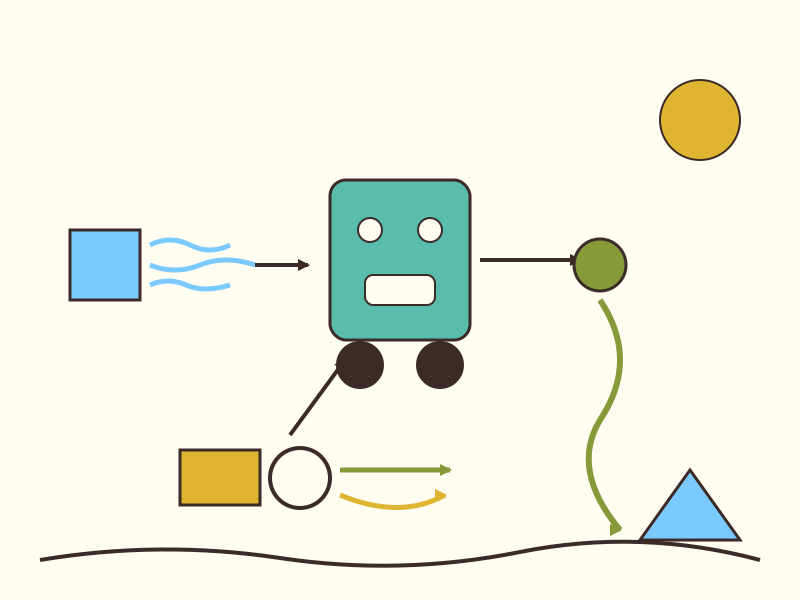
Five Sources of Uncertainty
Sensor noise creates small errors in measurements, such as distance or position readings.
Actuator imprecision means motors and other moving parts do not always produce exactly the intended motion.
Model inaccuracies occur when the robot's description of the world or its own movement is incomplete.
Computational limitations restrict how quickly or precisely the robot can process information.
Environmental unpredictability includes changes the robot cannot fully anticipate.
A Hallway Example
Imagine a mobile robot traveling through a hallway. Its wheel encoders report that it moved 10 meters.
Wheel slip means the actual displacement might range from 9.5 to 10.5 meters. The reported value is useful, but it is not exact.
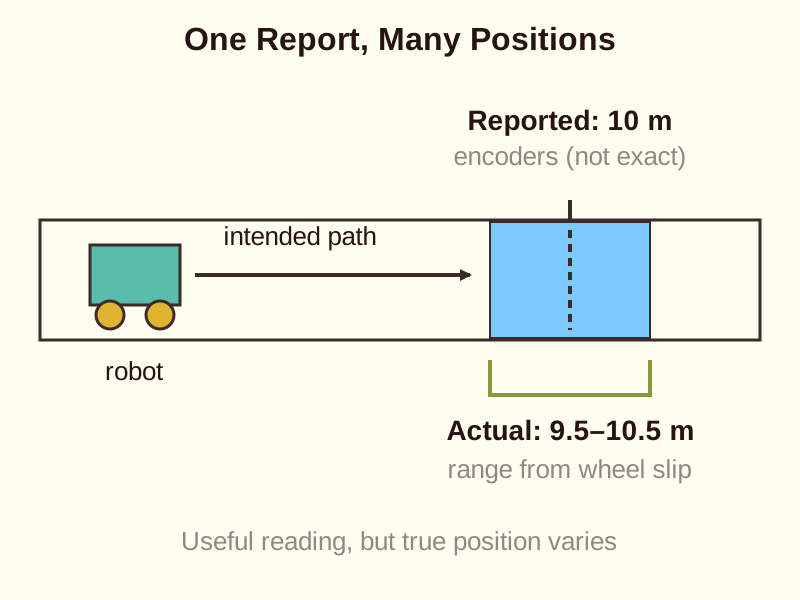
A deterministic system uses only the reported 10 meters. After many movements, small errors accumulate, and the robot can lose track of its position.
This shows why one certain-looking number can produce unreliable results.
From Certain to Probable
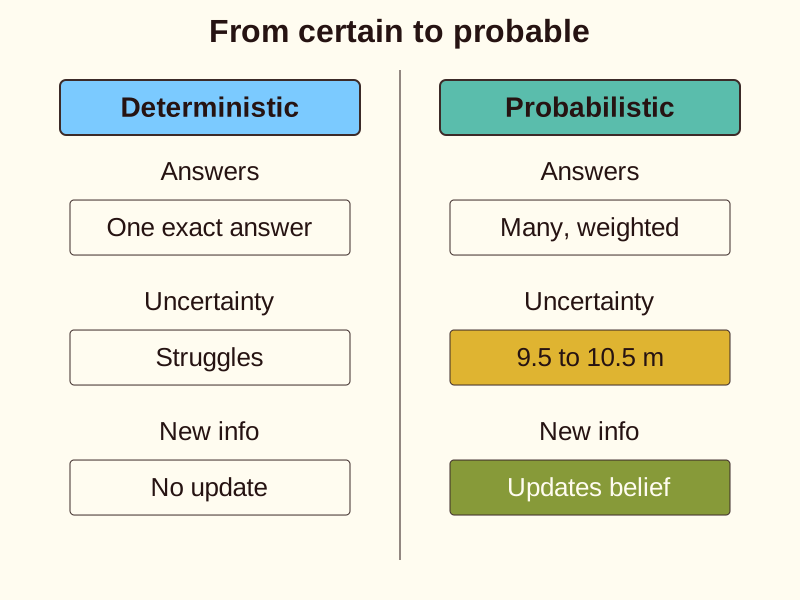
A deterministic approach expects one exact answer from each measurement or action. It struggles when the available information is uncertain.
A probabilistic approach represents several possible answers and how plausible they are. For example, it can account for the possibility that movement was anywhere from 9.5 to 10.5 meters.
This gives the robot a more realistic basis for decisions. It can update its understanding as new information arrives, making its behavior more robust in the real world.
Check yourself
In robotics, uncertainty means the robot cannot know every detail about its world with complete confidence.
- True
- False
Answer: True
Because sensors are imperfect, motors vary, and environments change, robots must operate with uncertain information rather than absolute certainty.
A _____ approach expects one exact answer from each measurement, whereas a _____ approach represents several possible answers and how plausible they are.
Answer: A deterministic approach expects one exact answer from each measurement, whereas a probabilistic approach represents several possible answers and how plausible they are.
Deterministic systems rely on a single precise value, which fails when errors accumulate. Probabilistic systems maintain a spectrum of possible states to stay robust.
A mobile robot's motor turns slightly less than intended due to physical variance in the components. Which source of uncertainty does this represent?
- Actuator imprecision
- Sensor noise
- Computational limitations
- Environmental unpredictability
Answer: Actuator imprecision
Actuator imprecision refers specifically to physical moving parts, like motors, failing to produce the exact motion requested.
Keep going
This is lesson 1 of 36 in Probabilistic Robotics. Next up:
- Probability Basics
- Bayes' Theorem
- The Bayes Filter
- Prediction and Update
- Kalman Filter Basics
Wondering turns any topic into short lessons you can read, watch, or listen to, with practice questions and an AI tutor.