Free sample lesson · Probabilistic Robotics
Why Uncertainty Matters
What if the biggest challenge in robotics isn't building the hardware, but dealing with imperfect information?
Lesson 1 of the Wondering course Probabilistic Robotics
The Real Robotics Challenge
Building a robot arm is hard. Trusting what it tells you is harder.
Every real robot works with imperfect information. Sensors report noisy readings, motors do not move exactly as commanded, and the world keeps changing.
Uncertainty is not a rare failure. It is the normal condition of operating outside a lab.
Five Sources of Uncertainty
Real-world robots face uncertainty from five primary sources.
Sensor noise corrupts measurements. Actuator imprecision means commands are not executed exactly. Model inaccuracies mean the robot's internal picture of the world is wrong in small ways.
Computational limitations force shortcuts and approximations. Environmental unpredictability adds people, obstacles, and changes nobody planned for.
- Sensor noise: Sensor noise corrupts measurements.
- Actuator imprecision: Commands are not executed exactly.
- Model inaccuracies: The internal picture of the world is wrong in small ways.
- Computational limitations: Shortcuts and approximations become necessary.
- Environmental unpredictability: People, obstacles, and unplanned changes appear.
The Hallway Robot
Picture a mobile robot rolling down a hallway.
Its wheel encoders report traveling 10 meters. But the wheels slip, so the actual displacement might be anywhere from 9.5 to 10.5 meters.
One meter of possible error, from a single trip down one corridor.
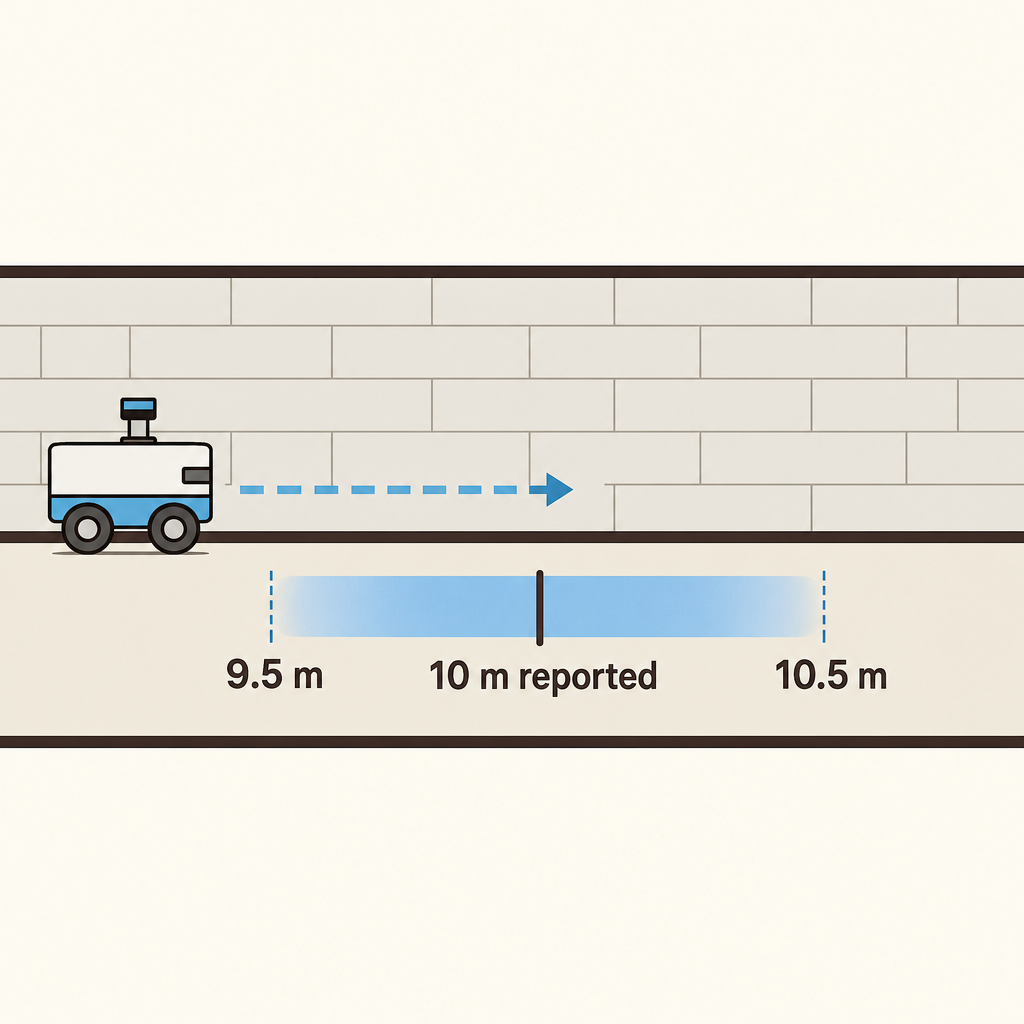
Notice that the single reported point sits inside a wider band of possible true positions, which is exactly the information a robot must not throw away.
Why Deterministic Systems Break
A deterministic system takes the encoder reading as truth. Ten meters means ten meters.
It has no way to represent or reason about the possible error, so each small mistake stacks on the last.
After enough turns and corridors, the robot's belief about where it stands no longer matches reality.
- Deterministic
- Probabilistic
Building for the Real World
Probabilistic methods do not remove uncertainty. They make it something the robot can carry and use.
Instead of one number, the robot holds a range of plausible positions and updates it as new evidence arrives.
Naming your uncertainty sources is the first step toward a robot that works outside the lab.
- Command motion: The robot acts, knowing the command will not be executed exactly.
- Read sensors: Encoders and other sensors report noisy measurements.
- Hold a range: The robot keeps a range of plausible positions instead of one number.
- Update belief: New evidence narrows the range before the next move.
Check yourself
Sensor noise makes a robot's measurements less reliable.
- True
- False
Answer: True
Correct. Sensor noise corrupts measurements, so a reported value may differ from the true value.
Word pool: sensor noise; actuator imprecision; environmental unpredictability. A corrupted measurement shows _____. A motor that does not move exactly as commanded shows _____. An unexpected person or obstacle shows _____.
Answer: Word pool: sensor noise; actuator imprecision; environmental unpredictability. A corrupted measurement shows sensor noise. A motor that does not move exactly as commanded shows actuator imprecision. An unexpected person or obstacle shows environmental unpredictability.
Sensor noise affects measurements, actuator imprecision affects motion, and environmental unpredictability comes from unplanned changes around the robot.
A hallway robot's wheel encoders report 10 meters, but wheel slip means the actual displacement may be 9.5 to 10.5 meters. Why can a deterministic system become increasingly inaccurate?
- It treats each encoder reading as exact
- It automatically removes wheel slip
- It refuses to use encoder readings
- It makes the hallway change length
Answer: It treats each encoder reading as exact
The deterministic system treats 10 meters as exact and ignores the possible error. Errors from later trips and turns can accumulate, causing its estimated position to diverge from reality.
Keep going
This is lesson 1 of 36 in Probabilistic Robotics. Next up:
- Probability Basics
- Bayes' Theorem
- The Bayes Filter
- Prediction and Update
- Kalman Filter Basics
Wondering turns any topic into short lessons you can read, watch, or listen to, with practice questions and an AI tutor.