Free sample lesson · Practical Torah Parenting for Toddlers
Loving Bonds
What creates deep emotional security in early childhood?
Lesson 1 of the Wondering course Practical Torah Parenting for Toddlers
Connection Comes First
Practical Torah parenting begins with connection.
Before a toddler can absorb guidance, limits, routines, or values, the child needs to feel securely loved by the parent.
- Guidance and limits: Includes routines and values you want to teach.
- Feeling securely loved: The foundation that lets a toddler absorb the rest.
Teaching takes hold when it rests on a secure bond.
Think of this bond as the ground floor of chinuch. Everything else you teach rests on it.
For your 4-year-old and your 2-year-old, the loving bond comes first, every single day.
What Secure Attachment Means
Secure attachment is a child's deep sense that the parent is safe, loving, and there for them.
Toddlers learn best when they consistently experience four things from their parents.
Warmth, attention, safety, and calm guidance.
- Four ingredients
- Warmth
- Attention
- Safety
- Calm guidance
Security grows from the repeated pattern, not one perfect day.
The key word is consistently. One warm afternoon helps, but security grows from the pattern your child feels day after day.
You Do Not Have to Be Perfect
Here is a relief for new parents: a secure bond does not mean being perfect or always available.
You will get tired. You will sometimes lose patience.
What matters is that, again and again, you return to the relationship with warmth, patience, and interest.
So the pattern is simple: warm connection, a hard moment, then you come back with warmth and are close again.
- Warm connection: Your child feels close and loved.
- A hard moment: You are tired or lose patience.
- Return with warmth: You come back with patience and interest.
Meet Them at Their Level
Connection with toddlers is often physical and simple.
Get down to each child's level. Kneel so your eyes meet your 2-year-old's eyes, instead of speaking from above.
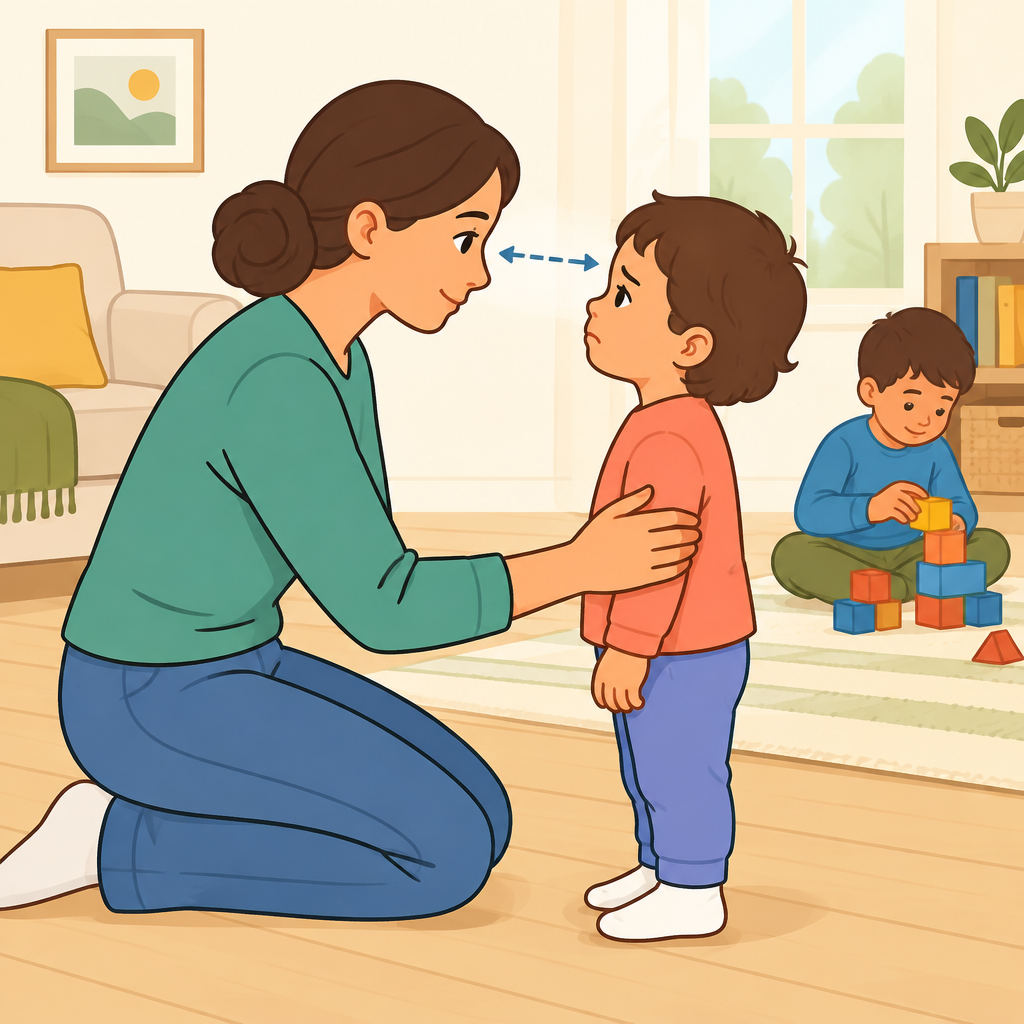
Notice how kneeling puts the parent's face level with the child's, so listening feels safe instead of looming.
Listen to feelings. When your 4-year-old is upset, hear what they feel before you correct anything.
These small acts tell a child: you matter to me.
Hugs and One-on-One Time
Two more everyday tools build the bond.
A hug after a hard moment. After a tantrum or a tearful goodbye, a hug shows your child the relationship is still safe.
Small moments of individual attention. With two little ones, each child needs a bit of time that is just theirs.
- Hug after hardship
- Individual attention
It might be a short story with your 4-year-old while the 2-year-old naps.
Why Trust Makes Discipline Work
A loving bond gives children emotional safety.
That safety helps them trust the adults who guide them.
In Torah chinuch, discipline is most effective when it grows from a relationship where the child feels valued, understood, and cherished.
Connection does not replace limits. It is what lets limits take root.
Putting It Into Practice
The whole lesson in one line: connection comes before guidance.
Secure attachment grows when your children consistently feel warmth, attention, safety, and calm guidance.
You do not need perfection. You need to keep returning with warmth, patience, and interest.
Talk together as spouses: which of these small habits can each of you add this week?
Check yourself
True or false: To build secure attachment, parents must be perfect and always available to their toddler.
- True
- False
Answer: False
False. Secure attachment does not depend on perfection. What matters is that parents return to the relationship again and again with warmth, patience, and interest, even after hard or distracted moments.
A loving bond gives toddlers emotional _____. Feeling secure helps them _____ the adults who guide them.
Answer: A loving bond gives toddlers emotional safety. Feeling secure helps them trust the adults who guide them.
When a child feels securely loved, they feel emotionally safe. That safety leads them to trust their parents, which makes guidance easier to accept.
Which set of experiences, given consistently by parents, helps toddlers learn best?
- Warmth, attention, safety, and calm guidance
- Strict rules, quick punishment, and silence
- Constant praise, gifts, and entertainment
- Independence, distance, and firm deadlines
Answer: Warmth, attention, safety, and calm guidance
Toddlers learn best when they consistently experience warmth, attention, safety, and calm guidance. Strict rules, quick punishment, or constant entertainment do not build the secure bond that learning grows from.
Keep going
This is lesson 1 of 8 in Practical Torah Parenting for Toddlers. Next up:
- Spousal Unity
- Sensory Triggers
- Daily Rhythms
- Clear Boundaries
- Practical Scripts
Wondering turns any topic into short lessons you can read, watch, or listen to, with practice questions and an AI tutor.