Free sample lesson · Practical AI for Creative Designers
Predicting Tokens and Prompts
You ask ChatGPT to write UI microcopy, and it suggests words one chunk at a time based on mathematical probability rather than conscious thought.
Lesson 1 of the Wondering course Practical AI for Creative Designers
Your Copy Arrives Token by Token
You ask ChatGPT for a button label. The words appear in small chunks, chosen by probability, not by conscious thought.
Each chunk is a token: a word, part of a word, a punctuation mark, or a space.
On September 10, 2026, DeepSeek released DeepSeek-V4.1-Flash. Its text output is autoregressive: it picks one next token, then the next, then the next.
Careful: this token is model input and output, not a design token like a color variable.
- Model token
- Design token
The Predict, Add, Repeat Loop
The model does not start with a finished sentence and translate it into words.
It turns your request into tokens and represents them as numbers. Then it estimates a probability for every possible next token and selects one.
That token joins the running text, and the cycle starts again.
- Read as tokens: Your prompt and the draft so far become tokens.
- Turn into numbers: Each token is represented numerically.
- Estimate odds: Every possible next token gets a probability.
- Select one: One continuation is chosen.
- Add to text: The new token joins the running draft.
So each new choice is shaped by your prompt and by everything the model has already written. A shaky early word can steer the rest.
Embeddings: Meaning as Numbers
Those numbers are called embeddings. They let the model treat related ideas as connected, even when the exact words differ.
Picture a map. Calm, gentle, and reassuring land near each other, while declined sits in a different area.
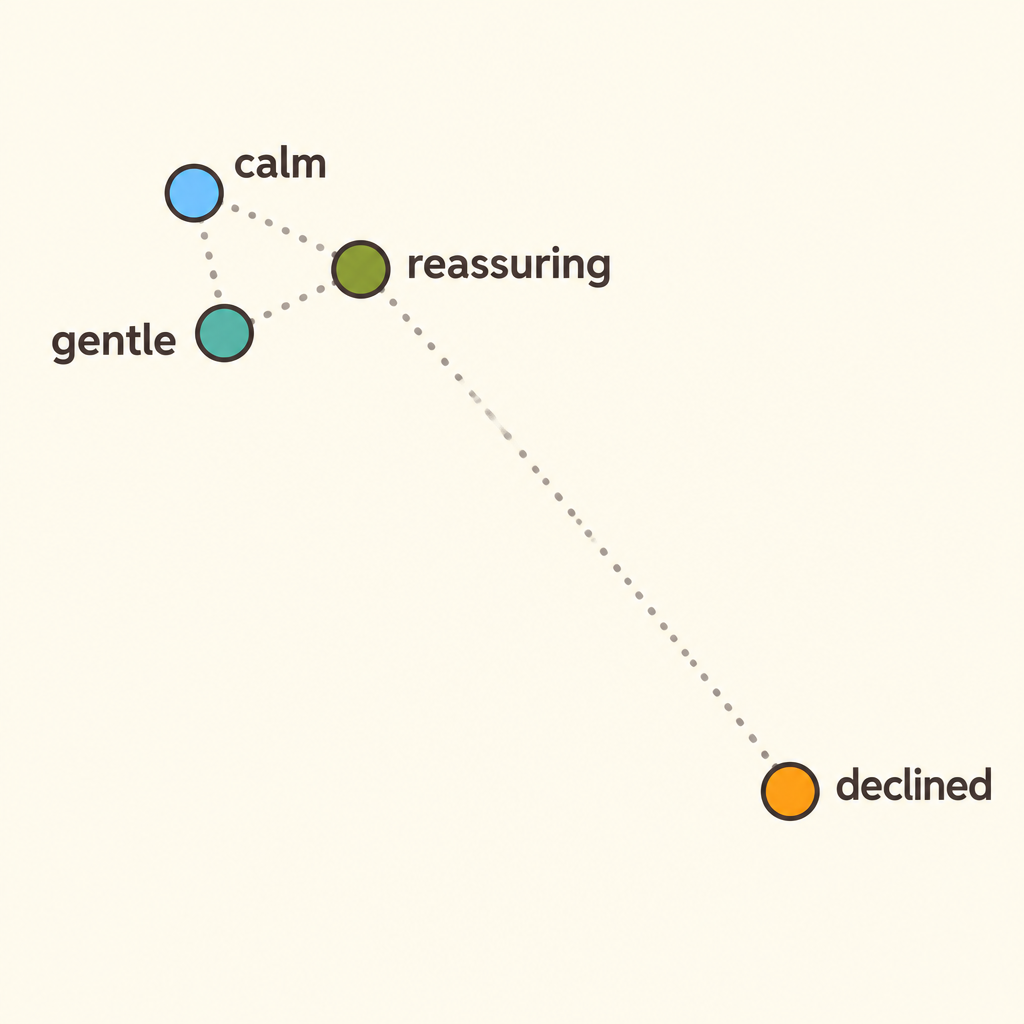
Notice how the three tone words cluster while declined sits far away; nearness in this number space is how the model treats ideas as related.
That closeness helps a model link your tone rule to new copy it has never seen.
But an embedding is a learned pattern, not a stored definition. It does not guarantee the model understands your brand rule.
Attention Picks What Matters
Attention is the mechanism that weighs which parts of the prompt and earlier output matter most for the next token.
It traces back to the June 2017 paper Attention Is All You Need by Vaswani et al.
At Anthropic's Claude Design webinar on September 3, 2026, designers imported brand guidance to keep deliverables on brand.
That works when attention links a product name, tone rule, and component label. In a crowded or vague prompt, those links can break.
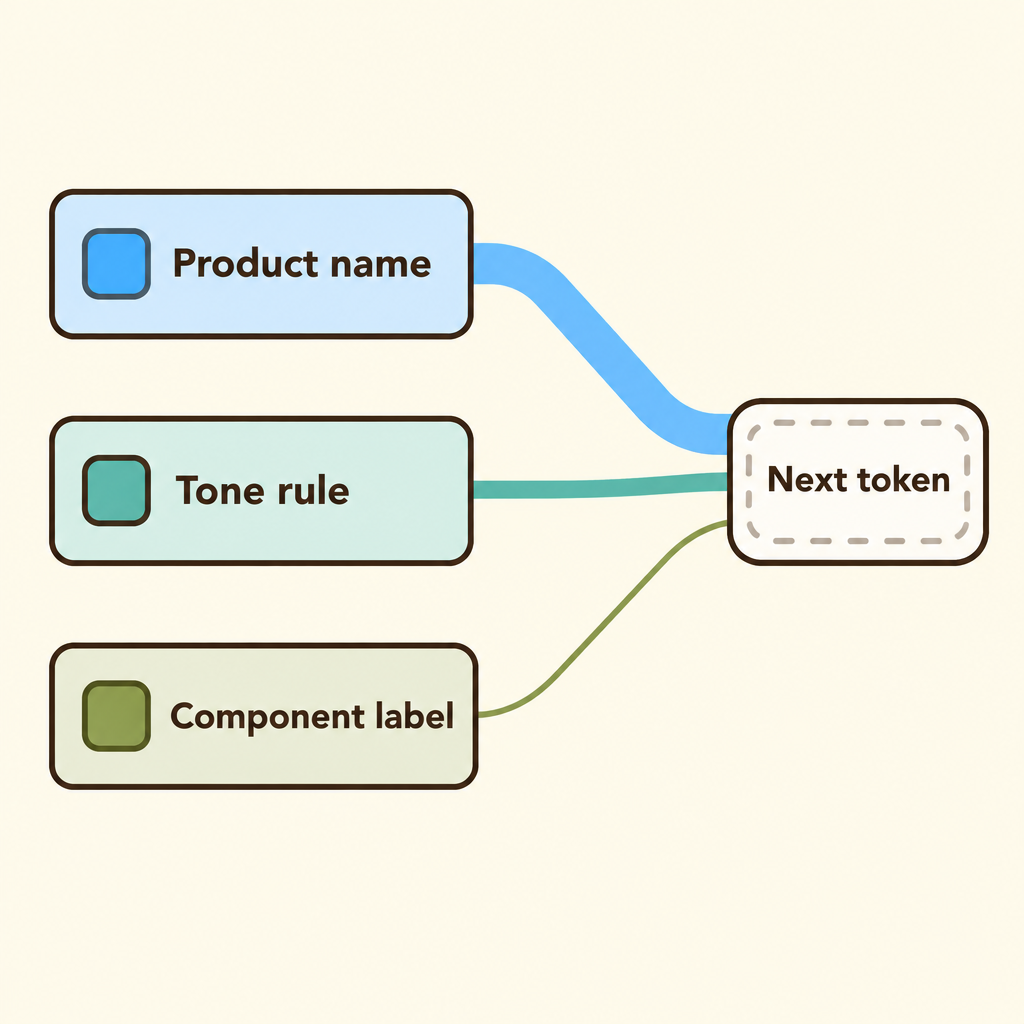
The lines differ in thickness because attention gives some parts of your context more weight than others when choosing the next token.
Specific Prompts Narrow the Odds
Compare two requests for a payment error.
Write a friendly error message leaves the model on broad defaults. Many continuations stay likely, so you get generic copy.
Now try: one sentence, 8 to 12 words, calm and direct, explain that the card was declined, do not blame the customer.
- Vague prompt
- Specific prompt
Each constraint removes unlikely paths. Adding two approved examples helps too, because attention can compare their wording and structure with your request.
Context Has Limits and Costs
More context is not always better.
In September 2025, Anthropic's essay on context engineering argued every added token uses a finite budget. Pasting everything can dilute your signal.
On September 18, 2026, Ethan Mollick's The Overhang argued that knowledge, taste, and agency still give people an edge. For designers: supply real source material.
OpenAI improved GPT-6 prompt caching on September 22, 2026, reusing repeated instructions. On September 29, it added co-editable slides in ChatGPT.
- Finite context budget: Anthropic argues every added token uses a limited budget.
- Mollick's The Overhang: Knowledge, taste, and agency remain human advantages.
- GPT-6 prompt caching: Repeated instructions are reused instead of reprocessed.
- ChatGPT collaborative slides: Teams co-edit slides that start from a conversation.
Smart Prediction, Not a Mind
Next-token prediction is not trivial autocomplete. With embeddings and attention, it can produce useful, structured copy.
It also does not prove intent, stable understanding, or fact checking. You still review every draft.
Try this week: run one microcopy task twice.
First, use a vague request. Then add audience, tone, length, banned phrases, and two approved examples. Compare which draft is easier to edit and more on brand.
- Pick a task: Choose one real piece of microcopy, like an error message.
- Vague run: Ask for it with a short, general request.
- Scoped run: Add audience, tone, length, banned phrases, and two approved examples.
- Compare drafts: Judge which draft is easier to edit and more on brand.
Check yourself
When writing a prompt for an LLM, the word "token" refers to _____
- a small piece of text, like a word part or punctuation
- a reusable design variable, like a brand color value
Answer: a small piece of text, like a word part or punctuation
In language models, a token is a small piece of text, such as a word, part of a word, punctuation mark, or space. It is the model's input/output currency, unrelated to design tokens like color or spacing variables in a design system.
In a language model, _____ turn tokens into numbers so related ideas can be connected, while _____ weighs which parts of the prompt and prior output matter most for the next token.
Answer: In a language model, embeddings turn tokens into numbers so related ideas can be connected, while attention weighs which parts of the prompt and prior output matter most for the next token.
Embeddings are numerical representations that let a model treat related ideas (like a product name and its tone rule) as meaningfully connected rather than as identical strings. Attention decides which parts of the available context to weigh most when predicting the next token.
A designer imports a long brand guide into an AI design tool, along with several unrelated documents and a vague request. The output ignores a key tone rule. What is the best explanation?
- Crowded, vague context can dilute the signal, so the rule's pattern gets underweighted
- The tone rule was not saved as a stored definition in the model's embeddings
- Models only match exact words, so the rule needed identical wording to the output
- Importing brand guidance always guarantees compliance unless the tool has a bug
Answer: Crowded, vague context can dilute the signal, so the rule's pattern gets underweighted
Embeddings are learned numerical patterns, not stored definitions or guarantees of understanding. When the prompt is crowded or vague, attention may weigh the wrong material, so relevant-looking rules can be ignored or connected incorrectly. Trimming irrelevant material and being specific helps.
Keep going
This is lesson 1 of 16 in Practical AI for Creative Designers. Next up:
- Pretraining to Human Feedback
- Reinforcement Learning and Reasoning
- Hallucinations and Scaling Limits
- Mapping the Creative Process
- Overcoming Generic Output
Wondering turns any topic into short lessons you can read, watch, or listen to, with practice questions and an AI tutor.