Free sample lesson · Physics Behind Black Hole Headlines
Event Horizon
What actually happens at the point of no return?
Lesson 1 of the Wondering course Physics Behind Black Hole Headlines
A Boundary, Not a Surface
Documentaries often picture a black hole as a cosmic vacuum cleaner with a hard edge. That picture is misleading.
A black hole is an extremely compact mass. Around it sits a boundary in space called the event horizon.
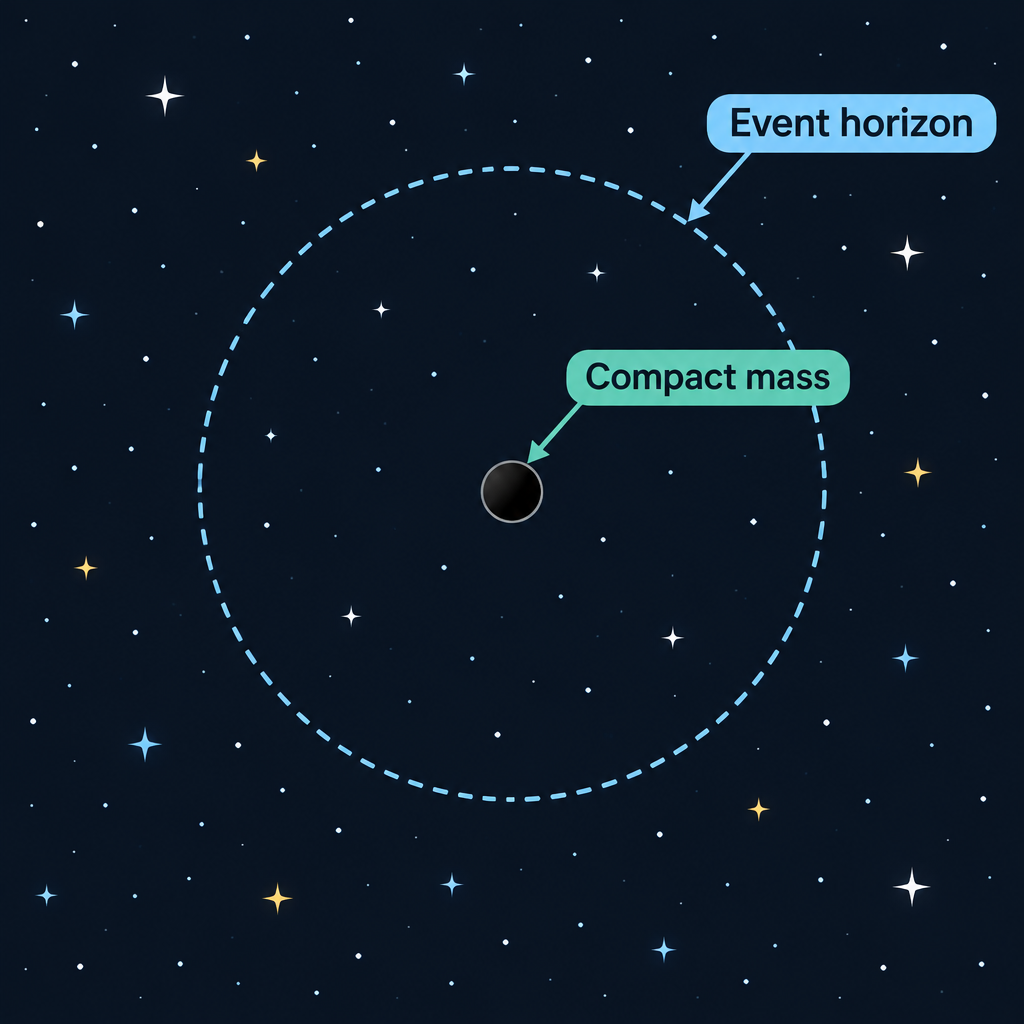
Notice that the horizon is drawn as a see-through boundary around the mass, with no hard shell to touch.
There is no solid surface at this boundary. It is defined by gravity and by the paths that light can take.
This invisible boundary is what headlines mean by the point of no return.
Escape Speed Explained
Throw a ball upward and it falls back. Throw it fast enough and it could leave for good. That speed is the escape speed.
Outside the event horizon, an object can still move away from a black hole if it has enough speed.
At the event horizon, however, the escape speed would have to be faster than light.
- Outside the horizon: An object can still move away if it has enough speed.
- Event horizon: Escape speed would have to be faster than light.
- Inside the horizon: Anything that crosses has no way back out.
- Compact mass: The extremely compact mass at the center.
Each region sits inside the one before it.
Anything that crosses it has no way back out.
Why Even Light Is Trapped
Here is the key rule: nothing can travel faster than light.
At the horizon, escape would require beating light. That makes escape impossible for every object, every particle, and light itself.
It also means no signal can get out. A flash or a message sent from inside never reaches the outside universe.
- Horizon rule: At the horizon, escape would need a speed faster than light.
- Speed limit: Nothing can travel faster than light.
- No escape: So no object, particle, or light can return.
- No signal: No message from inside reaches the outside universe.
That chain of logic is why we call it the point of no return.
The View From Far Away
Imagine watching gas fall toward a black hole from a safe distance.
As the material nears the horizon, it appears to slow down and fade.
Gravity stretches and weakens the light leaving it. Less light reaches you, so the falling material looks dimmer and slower.
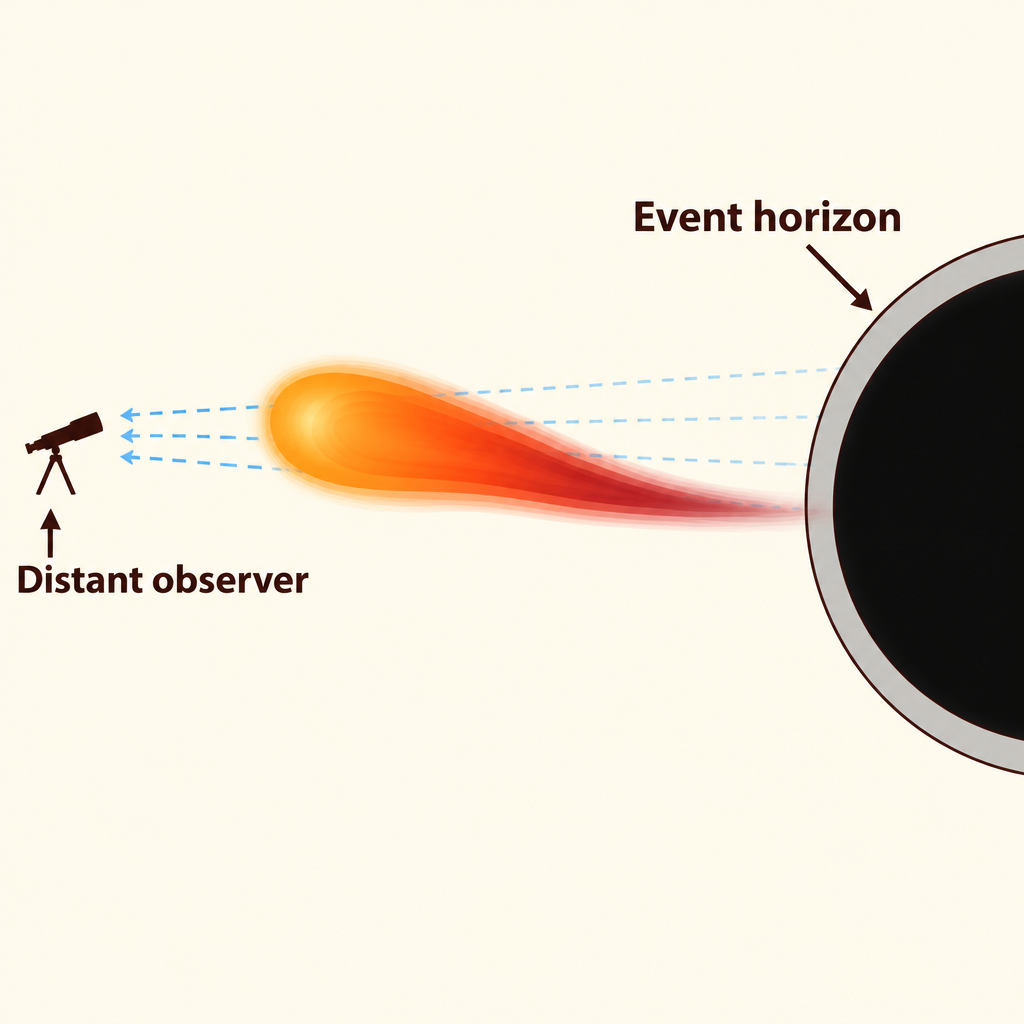
Follow the gas inward: its light grows weaker and more stretched near the horizon, so a distant viewer sees it slow and fade.
This is what a distant observer sees, not what the material itself experiences.
Crossing From the Inside
Now switch viewpoints to someone falling in.
For them, crossing the horizon would not necessarily feel like hitting a wall. There is no surface to strike.
The boundary is set by gravity and the paths light can take, so it is not a physical object.
The big change is invisible: after crossing, they can no longer send any signal back out.
- Distant observer
- Someone falling in
Reading Headlines About Horizons
When news says something has crossed an event horizon, it means that thing passed the point where escape is impossible.
Picture a boundary in space, not a wall. Outside, enough speed lets you leave. At the horizon, you would need to beat light.
Use these four ideas to explain the event horizon to a friend in plain words.
Check yourself
Light that crosses inside a black hole's event horizon can _____ to the outside universe.
- never return
- still escape
Answer: never return
The event horizon is the point of no return. Once anything crosses it, even light, it cannot escape back to the outside universe.
Just _____ the event horizon, a fast enough object can still escape. At the horizon itself, the escape speed would need to be _____ than light.
Answer: Just outside the event horizon, a fast enough object can still escape. At the horizon itself, the escape speed would need to be faster than light.
Outside the horizon, escape is still possible with enough speed. At the horizon, the required escape speed would exceed the speed of light, which nothing can reach.
Why can't a space probe that has crossed a black hole's event horizon send a radio message back to Earth?
- Escaping would require moving faster than light, which is impossible
- The probe's radio is crushed by hitting the horizon's solid surface
- Radio waves are too weak, but a laser beam could get out
- Space inside the horizon is empty, so signals have nothing to travel through
Answer: Escaping would require moving faster than light, which is impossible
Radio waves are a form of light. Escaping from inside the horizon would require moving faster than light, and nothing can do that, so no signal gets out.
Keep going
This is lesson 1 of 6 in Physics Behind Black Hole Headlines. Next up:
- Singularity
- Shadow Imaging
- Accretion Disks
- Gravitational Waves
- Hawking Radiation
Wondering turns any topic into short lessons you can read, watch, or listen to, with practice questions and an AI tutor.