Free sample lesson · Photonics for Neural Network Inference
What's Photonics?
What if the next computer chip ran on light instead of electricity?
Lesson 1 of the Wondering course Photonics for Neural Network Inference
A Chip That Runs on Light
What if the next computer chip ran on light instead of electricity? That question drives a whole field called photonics.
Electronics moves electrons through wires. Photonics works with light, made of tiny particles called photons, in the same way.
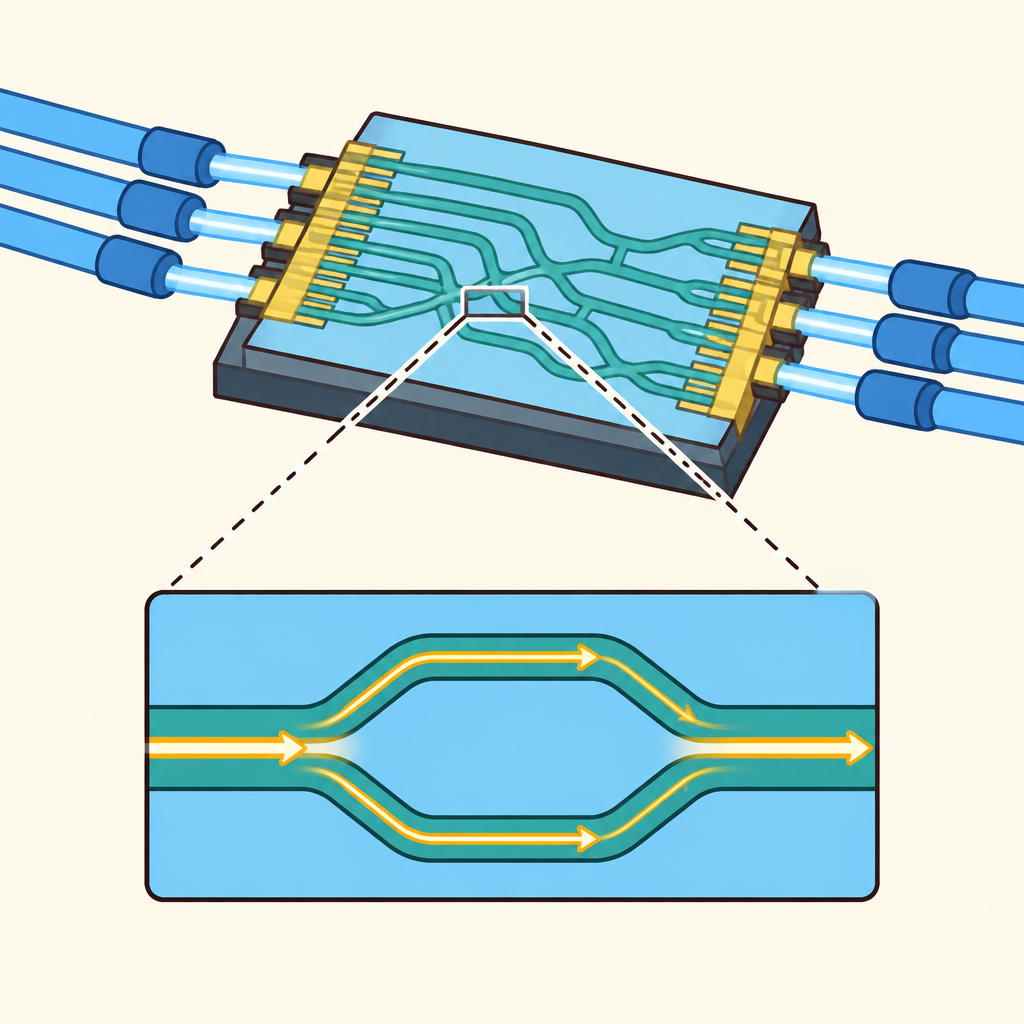
A real chip built to guide light
Photonics already carries most long-distance internet traffic over fiber. Now researchers want to put light inside chips.
The goal this course explores: using light for neural network inference, the math a trained model runs to produce its outputs.
Four Jobs Photonics Does
Photonics covers the full life of a light signal. Think of it as four jobs.
- Generate: A laser creates the light.
- Guide: Optical fibers or on-chip waveguides steer it.
- Control: Modulators, splitters, and interferometers shape and route it.
- Detect: Photodetectors turn light back into electrical signals.
Generate: lasers create the light. Guide: optical fibers or tiny on-chip waveguides steer it where it needs to go.
Control: modulators, splitters, and interferometers shape and route it. A modulator changes the light so it carries data.
Detect: photodetectors turn light back into electrical signals, so the rest of the system can use the result.
Why Light Suits Computing
Light has three traits that make it attractive for chips.
Speed. Light moves at very high speed.
Little heat. Moving light through a waveguide produces little resistive heat. Electrical wires lose energy as heat, and that loss grows at high speeds.
Shared paths. Several independent signals can share one channel if each uses a different wavelength. This is called wavelength-division multiplexing (WDM).
- Why light helps
- Very high speed: Signals cross the chip fast.
- Little resistive heat: Moving light through a waveguide wastes little energy as heat.
- Shared channels: Different wavelengths share one path (WDM).
These traits are why photonics is being explored for neural network inference.
Suppose: Four Data Streams
Imagine a chip designer who must send 4 separate data streams across a processor. Each runs at a hypothetical 100 gigabits per second (Gb/s).
The choice is copper wires or an optical waveguide. It affects both chip space and heat.
With copper, the designer needs about 4 separate wire channels. Each one loses energy as heat, because electrical resistance grows at high speeds.
With photonics, all 4 streams ride through one waveguide, with lower transport heat. The next page shows how.
- Copper wires
- Optical waveguide
One Waveguide, Many Colors
Here is the trick. Each stream is encoded on a different color of light, meaning a different wavelength.
Suppose the designer picks 4 hypothetical wavelengths near 1550 nm. All 4 travel through one waveguide without interfering with each other.
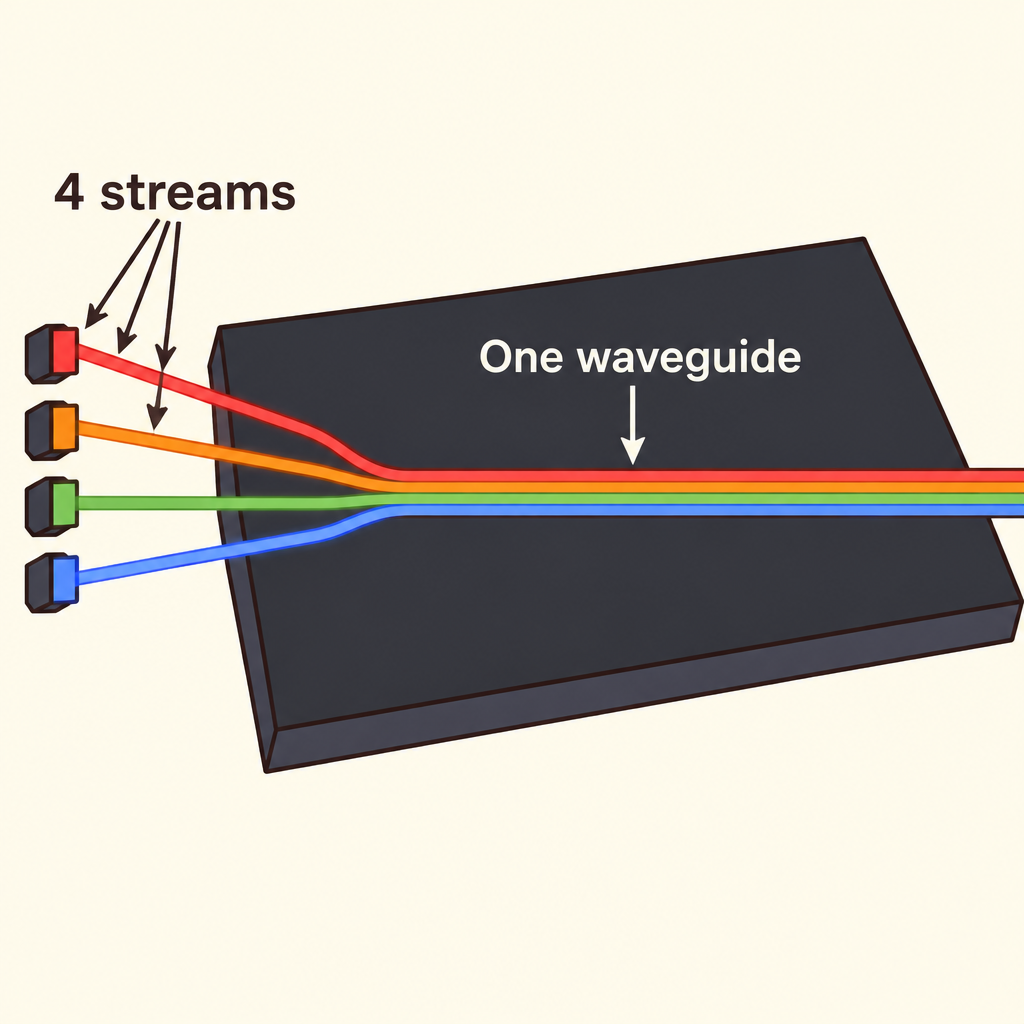
Notice that four separate light beams merge into one narrow path and stay distinct, which is how one waveguide carries all 4 streams.
The math: $$4 \times 100\text{ Gb/s} = 400\text{ Gb/s}$$ on a single optical path.
Result: more data in less space, with lower transport heat. That makes photonics a strong option for moving data inside AI chips.
From Internet Cables to AI Chips
Photonics is not new. It already carries most long-distance internet traffic over optical fiber.
The new question is whether the same principles work inside chips. Researchers and companies are exploring two uses.
First, moving data between parts of a chip, like the waveguide example. Second, performing the math neural networks need during inference.
- Photonics
- Long-distance fiber: Already carries most internet traffic.
- Inside chips: Being explored now.
- Moving data: Like 4 streams in one waveguide.
- Inference math: The math neural networks need.
Later lessons sort out which inference operations light handles easily, which are still hard at scale, and what roadblocks slow adoption.
Your Photonics Vocabulary
You now have the five core terms this course builds on.
When you read about an optical AI chip, trace the light: what makes it, what guides it, what controls it, and what detects it.
If you can explain each term to a colleague in one plain sentence, you are ready for the next lesson.
Check yourself
In photonics, information is carried by _____
- photons
- electrons
Answer: photons
Photonics moves information as light, which is made of photons. Electronics moves information as electrons flowing through wires. Photonics is to light what electronics is to electrons.
In a photonic system, a _____ generates the light, a _____ controls it to encode data, and a _____ turns the light back into an electrical signal.
Answer: In a photonic system, a laser generates the light, a modulator controls it to encode data, and a photodetector turns the light back into an electrical signal.
Each component handles one job. Lasers are light sources. Modulators control the light, for example to encode data onto it. Photodetectors sit at the receiving end and convert light back into electrical signals that electronics can use.
An optical fiber carries 8 independent data signals at the same time, and each signal uses a different wavelength of light. Why don't the signals interfere with each other?
- Each signal uses its own wavelength, so all of them can share one channel
- The signals take turns, so only one is in the fiber at a time
- The fiber splits into 8 separate strands inside, one per signal
- Light moves so fast that the signals never meet inside the fiber
Answer: Each signal uses its own wavelength, so all of them can share one channel
This is wavelength-division multiplexing. Each signal is placed on its own wavelength (color) of light, so the signals stay separate while sharing one physical channel. They travel simultaneously, not in turns. They also share one fiber rather than splitting into separate fibers. Higher speed alone does not keep the signals apart.
Keep going
This is lesson 1 of 15 in Photonics for Neural Network Inference. Next up:
- Light Properties
- Optical Components
- Inference Refresher
- Matrix Multiplication
- Interference Math
Wondering turns any topic into short lessons you can read, watch, or listen to, with practice questions and an AI tutor.