Free sample lesson · Philosophical Investigations
The Augustinian Picture
What if our most basic assumption about how words work is completely wrong?
Lesson 1 of the Wondering course Philosophical Investigations
A Child Learning Words
What if our most basic assumption about how words work is completely wrong?
Wittgenstein opens his Philosophical Investigations with a passage from Augustine's Confessions. In it, Augustine describes how he learned language as a child.
Adults pointed to objects and said their names. Bit by bit, the child linked each word to a thing.
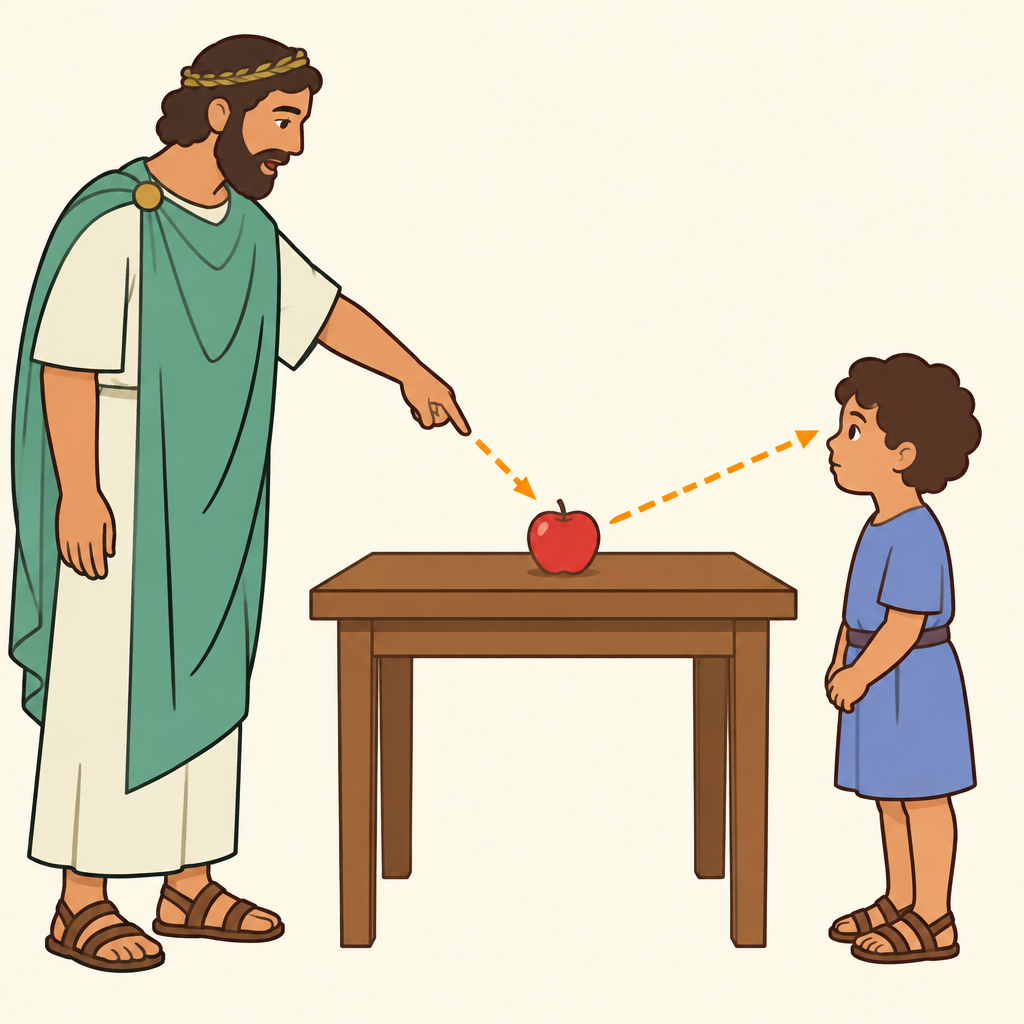
Notice the straight line from the pointing finger to the object: the picture assumes every word is learned by linking it to a thing.
This simple scene has a name: the Augustinian picture of language.
The Naming Theory
Inside the Augustinian picture sits a big idea about meaning. We can call it the naming theory.
It says every word works by naming an object. The meaning of a word is the thing it stands for.
Sentences, on this view, are just combinations of names.
Take "the apple is on the table." Here "apple" names a fruit and "table" names a piece of furniture. The sentence strings those names together.
- Sentence: A combination of names.
- Name: apple: A word standing for a thing.
- Object: a fruit: The meaning is this thing.
- Name: table: A word standing for a thing.
- Object: furniture: The meaning is this thing.
Why the Picture Feels Right
Wittgenstein admits the picture is seductive. It matches how we often teach small children.
For many words, it seems to work. "Dog," "chair," and "apple" really do point to things you can show someone.
That is the trap. Because naming works for some words, we assume it explains every word, even a word like "but."
- Words like dog
- Words like but
Wittgenstein calls the picture fundamentally misleading. It ignores the vast variety of ways language actually functions.
Four Words With No Object
Now test the picture on four ordinary words: but, perhaps, ouch, and hello.
Try pointing to a "but." There is nothing there. The word links two ideas and signals a contrast.
"Perhaps" marks uncertainty. "Ouch" expresses pain. "Hello" greets someone.
- but
- perhaps
- ouch
- hello
Each word does a real job. None of them names an object, so the naming theory cannot account for them.
Testing Any Word
You can turn this critique into a quick check for any word.
Ask first: does this word name an object I could point to? If yes, the naming picture may fit.
If no, do not force it. Ask instead what the word is doing: linking, hedging, expressing, or greeting.
- Pick a word
- Names an object?: Could you point to the thing it stands for?
- Naming may fit: Words like apple or dog.
- Ask what it does: Linking, hedging, expressing, or greeting.
- Focus on function: Words like but, perhaps, ouch, hello.
This shifts attention from what a word names to how a word functions.
Key Takeaways
The Augustinian picture treats every word as a name and every sentence as a combination of names.
It appeals to us because it fits words like "apple" and matches how children are often taught.
It fails for words like "but," "perhaps," "ouch," and "hello." They do real work without naming anything.
Wittgenstein's lesson: language works in a vast variety of ways, and naming is only one of them.
Check yourself
The naming picture of language explains the word _____ easily, because you can point to the thing it stands for.
- "table"
- "hello"
Answer: "table"
You can point to a table and say "table," so that word fits the naming picture. "Hello" is a greeting. There is no object that "hello" names.
In the naming theory of language, every word is a _____ for an _____, and every sentence is a _____ of these names.
Answer: In the naming theory of language, every word is a name for an object, and every sentence is a combination of these names.
The naming theory treats each word as a name that points to a thing. It treats a sentence as just several names put together.
In the Augustinian picture of language, how does every word get its meaning?
- By naming an object that it stands for
- By the feeling the speaker has when saying it
- By the way it sounds when spoken aloud
- By the grammar rules of the sentence it is in
Answer: By naming an object that it stands for
The Augustinian picture says every word works by naming an object. The other options describe sound, feelings, or grammar, and the naming picture does not rest on any of these.
Keep going
This is lesson 1 of 27 in Philosophical Investigations. Next up:
- The Builder's Game
- Ostensive Definition
- Language Games
- Meaning as Use
- Against Essentialism
Wondering turns any topic into short lessons you can read, watch, or listen to, with practice questions and an AI tutor.