Free sample lesson · Origins of the Genetic Code
RNA World
What if RNA acted as both the blueprint and the builder before proteins existed?
Lesson 1 of the Wondering course Origins of the Genetic Code
Before DNA and Proteins
Modern cells split the work: DNA stores information, proteins do the chemistry.
The RNA world hypothesis proposes that early life ran mainly on RNA, before separate DNA genomes and protein enzymes evolved.
- Modern cells
- Early RNA system
One molecule family may have held both roles at once.
RNA's Double Job
Like DNA, RNA carries information in a sequence of nucleotides.
Unlike DNA, some RNA molecules fold into shapes that catalyze chemical reactions. These catalytic RNAs are called ribozymes.
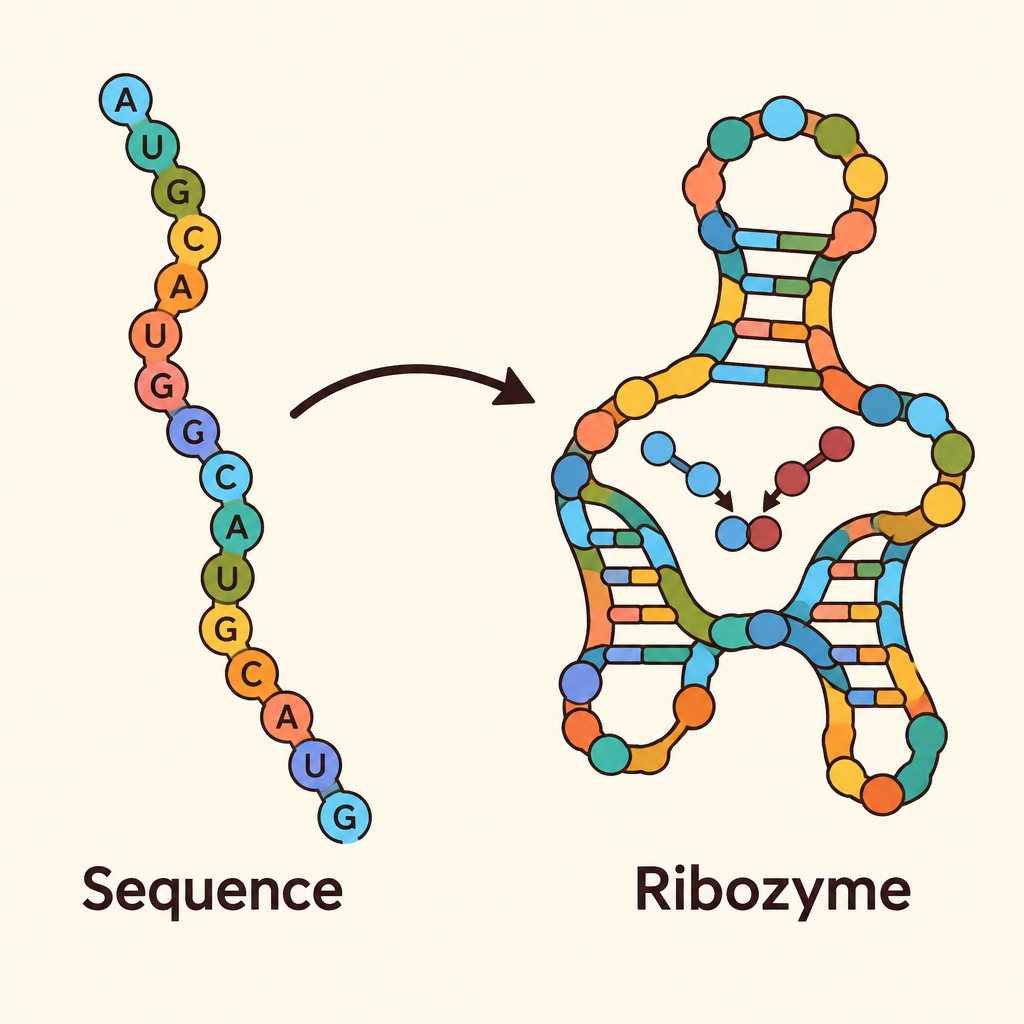
The same nucleotide sequence on the left folds into the compact shape on the right, where a reaction is being catalyzed.
So RNA could act as a genetic blueprint and a chemical worker in the same system.
Selection Acts on RNA
With copying and chemistry in one molecule, natural selection has something to work on.
Molecules that copied more accurately, persisted longer, or helped produce useful molecules would become more common.
- RNA sequence: Information sits in a sequence of nucleotides.
- Folding and catalysis: Some folds catalyze reactions or help produce useful molecules.
- Copying: Copies are made with varying accuracy.
- Persistence: Molecules that copy accurately and persist longer become more common.
No proteins needed. Chemical evolution could begin with RNA alone.
The Road to Translation
Over time, interactions between RNA and small peptides may have created a primitive translation system.
That opened the door for proteins, which perform a wider range of chemical tasks, to take over as the central catalysts.
- RNA alone: RNA serves as both genetic blueprint and chemical worker.
- RNA plus peptides: Interactions between RNA and small peptides begin to build chemistry together.
- Primitive translation: A rudimentary translation system links RNA sequences to peptides.
- Proteins take over: Proteins become central catalysts because they perform a wider range of tasks.
- DNA stores: DNA becomes the more stable long-term store of genetic information.
DNA then became the more stable long-term store of genetic information.
Why It Still Matters
The hypothesis explains how genetic information could be managed before modern translation existed.
Its key claim is simple: information and catalysis do not have to live in separate molecules.
Ribozymes still survive in cells today, which is part of why the idea remains plausible.
Check yourself
Can RNA both carry genetic information and catalyze chemical reactions?
- Yes
- No
Answer: Yes
Yes. RNA can store information in its nucleotide sequence, and some RNA molecules fold into catalytic ribozymes.
In modern cells, _____ mainly stores genetic information, _____ perform most chemical work, and catalytic RNAs are called _____.
Answer: In modern cells, DNA mainly stores genetic information, proteins perform most chemical work, and catalytic RNAs are called ribozymes.
Modern cells usually separate information storage and chemical work: DNA stores information, proteins perform most chemistry, and ribozymes are catalytic RNAs.
Why does RNA provide a plausible starting point for early chemical evolution?
- It could store information and catalyze reactions in the same system.
- It was more chemically stable than DNA and more versatile than proteins.
- It could produce proteins without any copying or selection.
- It eliminated the need for nucleotide sequences to carry information.
Answer: It could store information and catalyze reactions in the same system.
RNA could combine two essential roles in one molecule: storing heritable information and catalyzing reactions. This would allow selection to act on molecules without requiring proteins.
Keep going
This is lesson 1 of 6 in Origins of the Genetic Code. Next up:
- First Peptides
- Code Emergence
- Proto Adapters
- Synthetase Origins
- Translation Assembly
Wondering turns any topic into short lessons you can read, watch, or listen to, with practice questions and an AI tutor.