Free sample lesson · Organizational Psychology Exam Essentials
What OP Is
Why do some workplaces bring out people's best while others drain them?
Lesson 1 of the Wondering course Organizational Psychology Exam Essentials
Same pay, so why different effort?
Imagine two call centers that pay exactly the same wage.
In Center A, staff follow strict scripts and supervisors monitor them closely. In Center B, staff solve customer problems their own way, get regular feedback, and have supportive team leaders.
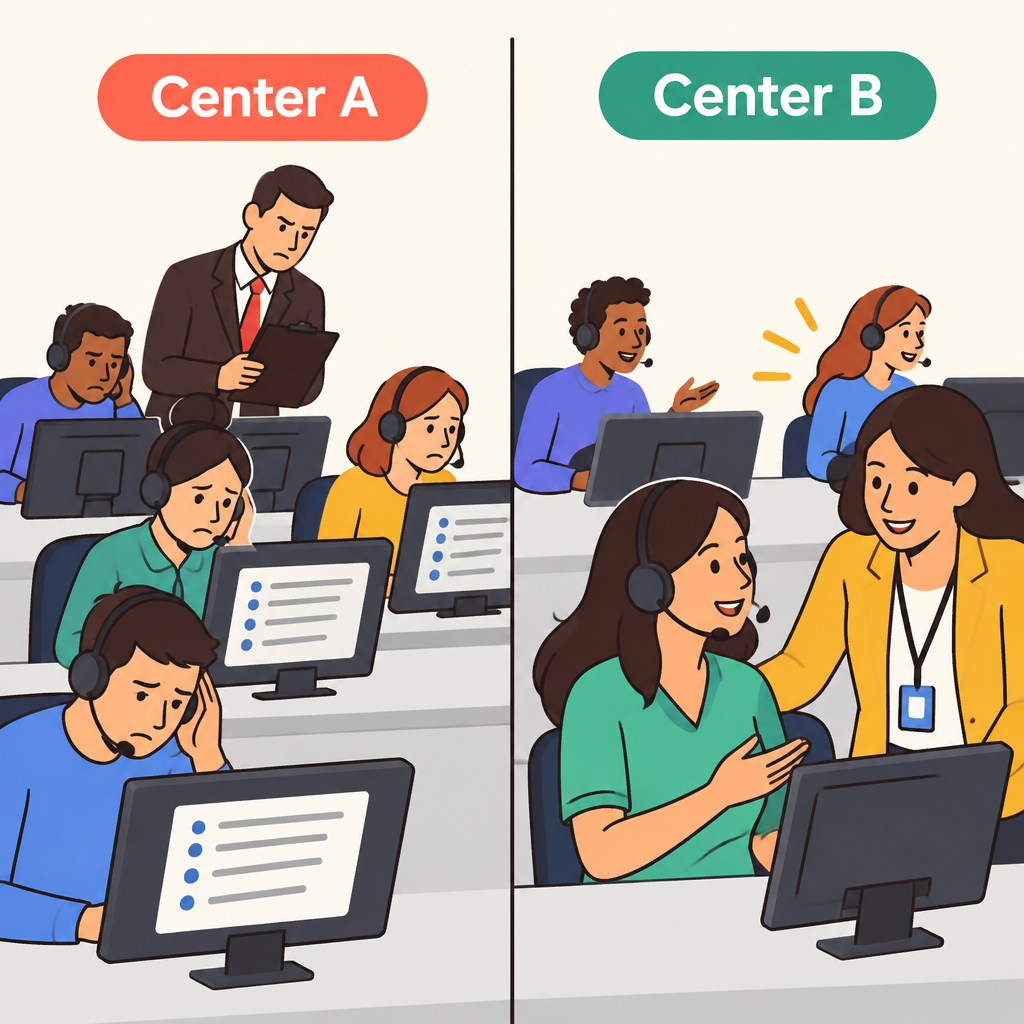
Notice that pay is identical on both sides, so the only visible differences are control, freedom, and support.
Management at each center wants to know why its people perform the way they do.
If the paychecks match, why would people in one place give their best while people in the other feel drained?
A whole field exists to answer that. So what does that field study?
OP studies people at work, then helps
That field is organizational psychology, often shortened to OP.
The course study guide, Organizational Psychology: The 80/20 Study Guide, calls it a scientific and practical discipline. It studies human behavior in workplace settings.
Scientific means it gathers evidence about behavior. Practical means it uses those insights to change things.
- What OP does
- Studies behavior at work: The scientific side: gathering evidence.
- Applies psychological insights: The practical side: changing things.
- What it improves
- Employee satisfaction
- Performance
- Organizational effectiveness
OP applies psychology to improve employee satisfaction, performance, and organizational effectiveness.
But to improve people's work, you first need a picture of what drives them. Which picture is right?
Do people work mainly for money?
Many newcomers think so. Pay is the most visible reason anyone takes a job, so better pay and tighter supervision seem like the fix for weak performance.
That belief has a famous root. Frederick Taylor's Scientific Management saw workers as "economic persons" driven only by money and strict control.
Apply it to our call centers. Pay is identical, so Taylor's view predicts no difference at all.
- Economic person
- Complex individual
Yet management sees a difference, so pay alone cannot explain it.
Modern OP replaces Taylor's picture with workers as complex individuals. What shapes them?
Five forces shape how people work
Modern OP treats employees as complex individuals. Their behavior is shaped by five forces.
Internal motives: what the person wants from the work. Job design: how tasks are built. Leadership: how managers guide them.
Group dynamics: how the team around them behaves. Organizational culture: the shared way things are done.
- Internal motives: What the person wants from the work.
- Job design: How tasks are built.
- Leadership: How managers guide people.
- Group dynamics: How the team around them behaves.
- Organizational culture: The shared way things are done.
Pay still matters, but it is one input among many.
So what happens when we run both call centers through all five forces?
Center B wins without paying more
Let us work through the example step by step.
Step 1: Taylor's view checks only pay. Pay is identical, so it predicts no difference.
Step 2: OP also checks internal motives, job design, leadership, group dynamics, and culture.
Step 3: Center B scores better on autonomy, feedback, and leadership. Center A relies on strict control.
- Center A
- Center B
Center B is likely to get more effort and satisfaction even though nobody earns more.
Why does that pattern matter beyond call centers?
A few ideas explain most behavior
The study guide's core principle: roughly 20% of OP's core concepts explain about 80% of how people behave, get motivated, and perform.
It names four pillars. Job analysis and design defines tasks and conditions. Intrinsic vs. extrinsic motivation balances pay with autonomy, mastery, purpose, and recognition.
Job characteristics and goal setting builds meaningful roles with clear goals and feedback. Fairness and social context covers peer comparisons, group norms, and leadership.
- OP's core concepts: About 20% explain about 80% of behavior.
- Job analysis & design: Defines tasks and conditions.
- Intrinsic vs. extrinsic: Balances pay with autonomy, mastery, purpose, recognition.
- Job characteristics & goals: Meaningful roles, clear goals, feedback.
- Fairness & social context: Peer comparisons, group norms, leadership.
Each pillar names something beyond the paycheck.
So what is the answer to our opening question?
Fair pay opens the door, design does the rest
Back to the two call centers with the same wage.
Pay matters a lot when it is too low or unfair. But the study guide notes money buys attendance and compliance, not loyalty or voluntary creativity.
Once pay is fair, job design, leadership, the team, and culture largely decide whether people thrive or burn out.
That is why Center B's staff give their best while Center A's feel drained. OP is the field that studies those forces and uses them to improve work.
Check yourself
A manager believes workers are driven only by money and strict control. This view matches _____
- Frederick Taylor's Scientific Management
- modern organizational psychology
Answer: Frederick Taylor's Scientific Management
Taylor's Scientific Management saw workers as "economic persons" moved only by pay and control. Modern organizational psychology rejects that view. It treats workers as complex people shaped by their own motives, job design, leadership, their group, and culture.
Place the missing core pillars of organizational psychology into the diagram.
Answer: Intrinsic vs. extrinsic, Fairness & social context
Modern organizational psychology focuses on intrinsic versus extrinsic motivation as well as fairness and social context, rejecting the outdated idea that pay and control are the only drivers of work behavior.
Before hiring, a company uses _____ to define tasks, duties, and needed skills. When a worker feels unfair after comparing her rewards with a coworker's, _____ explains her reaction. Her wish for autonomy and purpose is _____ motivation.
Answer: Before hiring, a company uses job analysis to define tasks, duties, and needed skills. When a worker feels unfair after comparing her rewards with a coworker's, Equity Theory explains her reaction. Her wish for autonomy and purpose is intrinsic motivation.
Job analysis defines a role's tasks and skills before hiring or evaluating. Equity Theory covers fairness judged by comparing yourself with others. Autonomy and purpose are internal drives, so they are intrinsic motivation.
Keep going
This is lesson 1 of 15 in Organizational Psychology Exam Essentials. Next up:
- Worker Views
- Inner Drive
- Needs Theories
- Two Factors
- Manager Beliefs
Wondering turns any topic into short lessons you can read, watch, or listen to, with practice questions and an AI tutor.