Free sample lesson · Operating Systems and Kernel Engineering
Kernel Basics
What if you could control exactly how your computer talks to its hardware?
Lesson 1 of the Wondering course Operating Systems and Kernel Engineering
The Core of the Operating System
The kernel is the central heart of every operating system. It acts as a bridge between your software and the physical hardware.
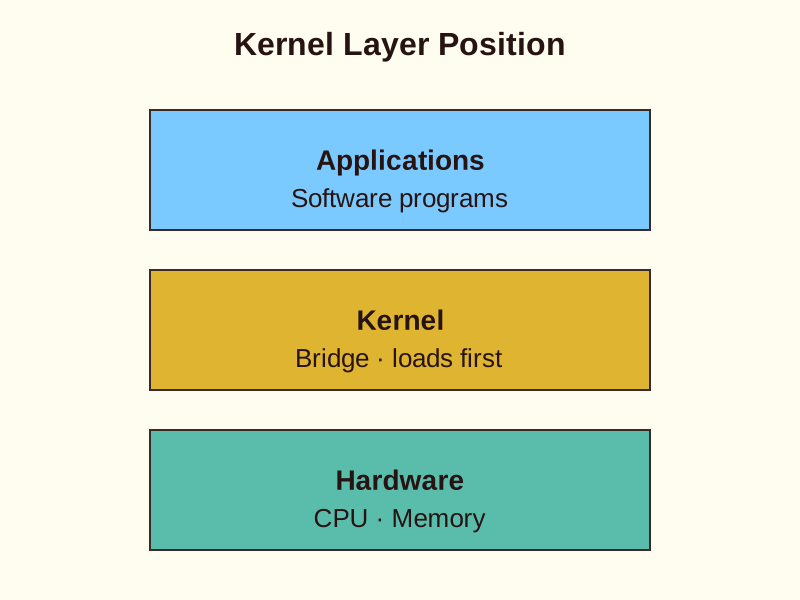
Software cannot talk to the CPU or memory directly. The kernel manages these interactions to keep the system stable.
As a systems programmer, you must understand how the kernel controls resources. It is the first layer that loads when the computer starts up.
Managing Hardware Resources
The kernel decides which program gets to use the CPU and for how long. It also allocates blocks of RAM to different processes.
- CPU
- RAM
Without this management, two programs might try to use the same memory at once. This would cause the entire system to crash.
Think of the kernel as a traffic controller. It ensures that data flows smoothly between the disk, memory, and processor.
System Calls and Security
Applications interact with the kernel through system calls. These are formal requests for hardware access.
When a program wants to write a file, it asks the kernel to do it. The kernel checks if the program has permission first.
- File Request: An application requests to write a file via a system call.
- Permission Check: The kernel checks if the application has proper permissions.
- Hardware Access: The kernel safely interacts with the hardware to protect the system.
This separation protects the hardware. It prevents malicious or buggy code from destroying the system or accessing private data.
Why Kernel Basics Matter
Building your own OS requires a deep grasp of kernel design. You will learn to write code that talks to the bare metal.
Mastering these concepts helps you write more efficient software. You will understand how your code impacts system performance and resource usage.
This knowledge is essential for advanced systems programming and low level development projects.
Kernel Mastery Summary
Check yourself
The _____ acts as the core bridge between physical hardware and application software.
- kernel
- compiler
Answer: kernel
The kernel is the central component of an operating system that manages interactions between software and physical hardware components.
To manage system resources, the kernel assigns CPU time to processes and allocates blocks of _____ to programs, preventing memory collisions that cause a system _____.
Answer: To manage system resources, the kernel assigns CPU time to processes and allocates blocks of RAM to programs, preventing memory collisions that cause a system crash.
The kernel controls hardware allocation by distributing processor time and memory blocks, ensuring stability by preventing programs from overwriting shared memory spaces.
Why must user applications issue system calls instead of accessing memory and storage directly?
- To allow the kernel to verify permissions and protect system security
- To speed up code execution by bypassing CPU scheduling entirely
- To compile source code into bare-metal machine instructions at runtime
- To convert memory blocks automatically into physical disk space
Answer: To allow the kernel to verify permissions and protect system security
System calls pass control to the kernel, which checks permissions before allowing hardware access. This separation prevents buggy or malicious applications from compromising system stability.
Keep going
This is lesson 1 of 6 in Operating Systems and Kernel Engineering. Next up:
- Privilege Levels
- Process Scheduling
- Memory Mapping
- System Calls
- Interrupt Handling
Wondering turns any topic into short lessons you can read, watch, or listen to, with practice questions and an AI tutor.