Free sample lesson · Nudge: The Final Edition
Every Design Is a Nudge
Why did Thaler's students keep pulling doors that only opened outward?
Lesson 1 of the Wondering course Nudge: The Final Edition
The Door Already Spoke
Why did Thaler’s students keep pulling doors that opened outward?
The doors had vertical handles, cues that hands read as “pull.” Thaler then pointed out the problem to the class, and classmates began watching each student who got up to leave. Even so, most still pulled.[[2]](https://faculty.chicagobooth.edu/-/media/faculty/richard-thaler/assets/files/choice-architecture.pdf)
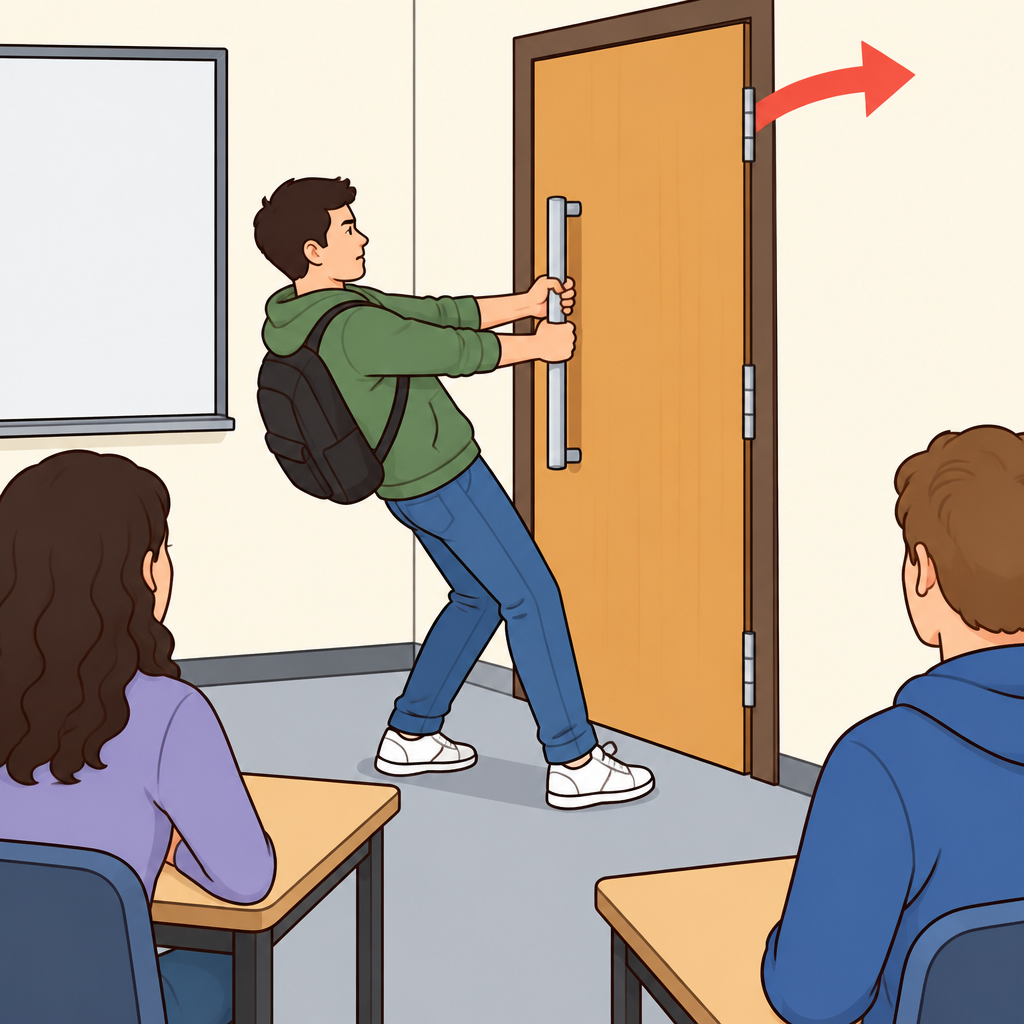
Notice how the grippable vertical handle invites a pull even though the door can only be pushed outward, so the design speaks before the person thinks.
Choice architecture is the environment in which people decide, such as a menu or smartphone interface.[[1]](https://www.nobelprize.org/uploads/2018/01/thaler-lecture.pdf)
Anyone shaping that environment is already steering choices.
What Counts as a Nudge
Not every influence is a nudge.
A nudge changes what people do in a predictable way. It still leaves every option open, at about the same price. It neither forbids choices nor significantly changes incentives.
A GPS suggests a route to your chosen destination, but you may reject it at any turn.[[1]](https://www.nobelprize.org/uploads/2018/01/thaler-lecture.pdf)
A ban is a mandate. A large tax changes incentives.
- Nudge
- Mandate
- Incentive change
Humans React Before Reflecting
Why can knowing the correct action still fail?
Econs, the imagined textbook decision makers, have perfect memory and willpower. Humans make mistakes and rely on cues.[[2]](https://faculty.chicagobooth.edu/-/media/faculty/richard-thaler/assets/files/choice-architecture.pdf)
The fast automatic system reacts first. The slower reflective system weighs things deliberately.[[2]](https://faculty.chicagobooth.edu/-/media/faculty/richard-thaler/assets/files/choice-architecture.pdf)
That explains the door error: the automatic system read the big handle as “pull” and moved the hand before the reflective system’s knowledge, “this door pushes,” could step in. The handle’s signal simply could not be screened out.
- Automatic system
- Reflective system
Fix the Cue Itself
Which door design would stop the pulling mistake?
Picture three illustrative designs. Design A has a vertical bar on a door that must be pushed. Design B adds a small PUSH sign, but the grippable bar still signals pull.
Design C replaces the bar with a flat plate. With nothing to grip, the automatic action becomes pushing.
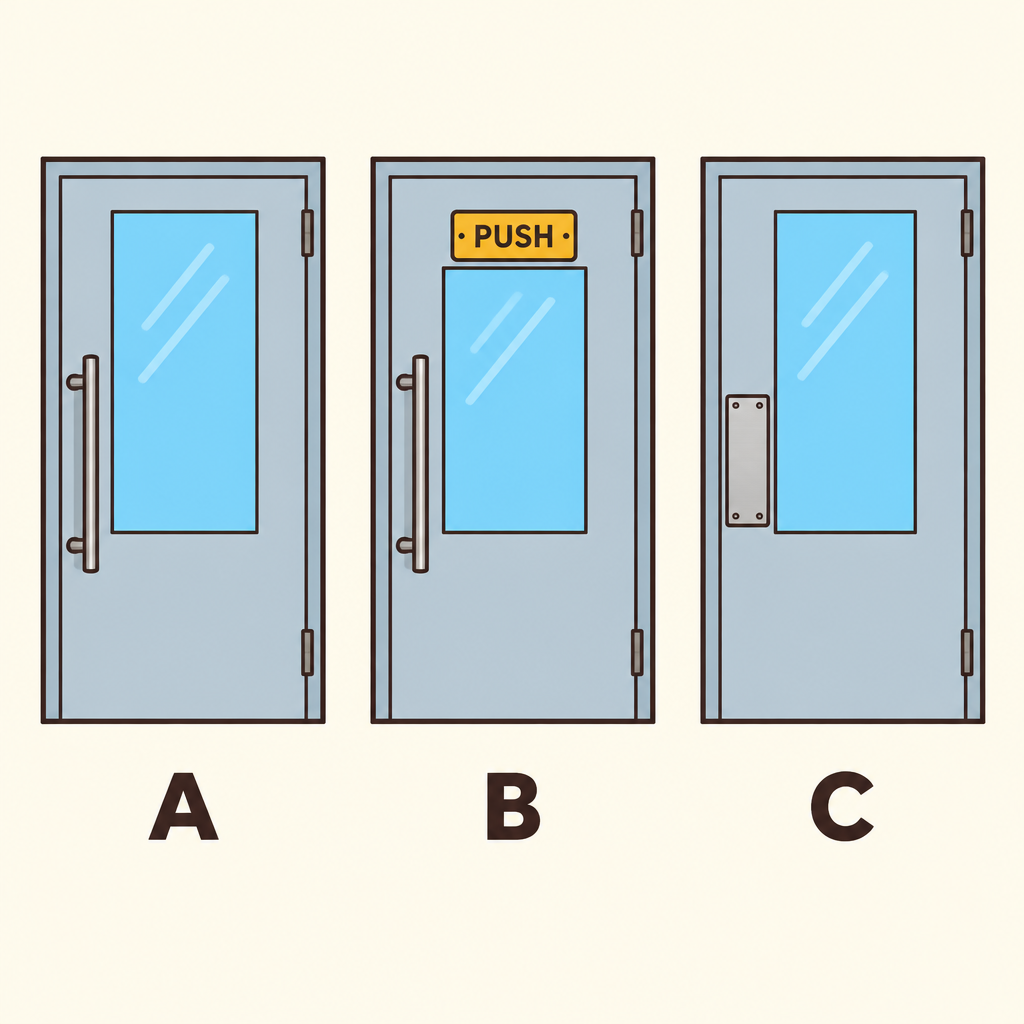
Compare the hardware: only the flat plate removes anything to grip, so the hand's automatic action matches the push the door requires.
The principle behind this is stimulus response compatibility: the signal a person receives should be consistent with the action they are meant to take.[[2]](https://faculty.chicagobooth.edu/-/media/faculty/richard-thaler/assets/files/choice-architecture.pdf)
A Tiny Target Steers
What can a painted fly change?
The authors report that flies painted inside Schiphol Airport urinals cut spillage by 80 percent.[[3]](https://penguinrandomhousehighereducation.com/book/?isbn=9780143137009) Treat that as the authors’ figure, not an independently verified measurement.
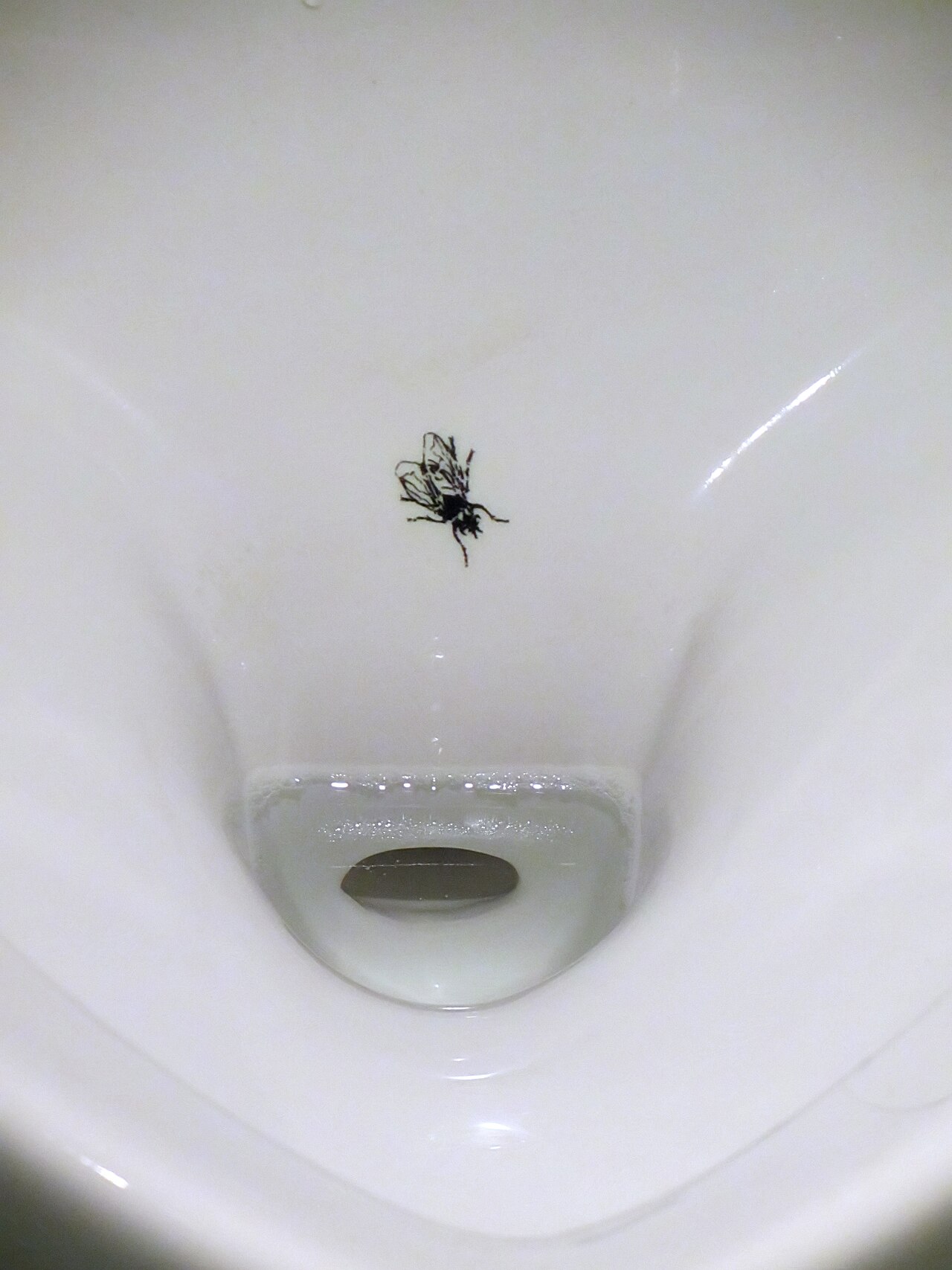
A fly printed inside a urinal, here in a hospital in Göttingen, Germany: nothing is banned or priced, yet aim changes. · Photo: Stefan Bellini, via Wikimedia Commons (CC0) · CC0

The pictured fly gives the automatic system a target without banning or pricing anything.[[4]](https://commons.wikimedia.org/wiki/File:Urinal_FLy2.jpg)
Order and Position Matter
Which food gets chosen when several options remain available?
The authors offer a hypothetical example: a school food director experiments with displays and finds that food placed at eye level or at the beginning or end of the line is more likely to be eaten.[[2]](https://faculty.chicagobooth.edu/-/media/faculty/richard-thaler/assets/files/choice-architecture.pdf)
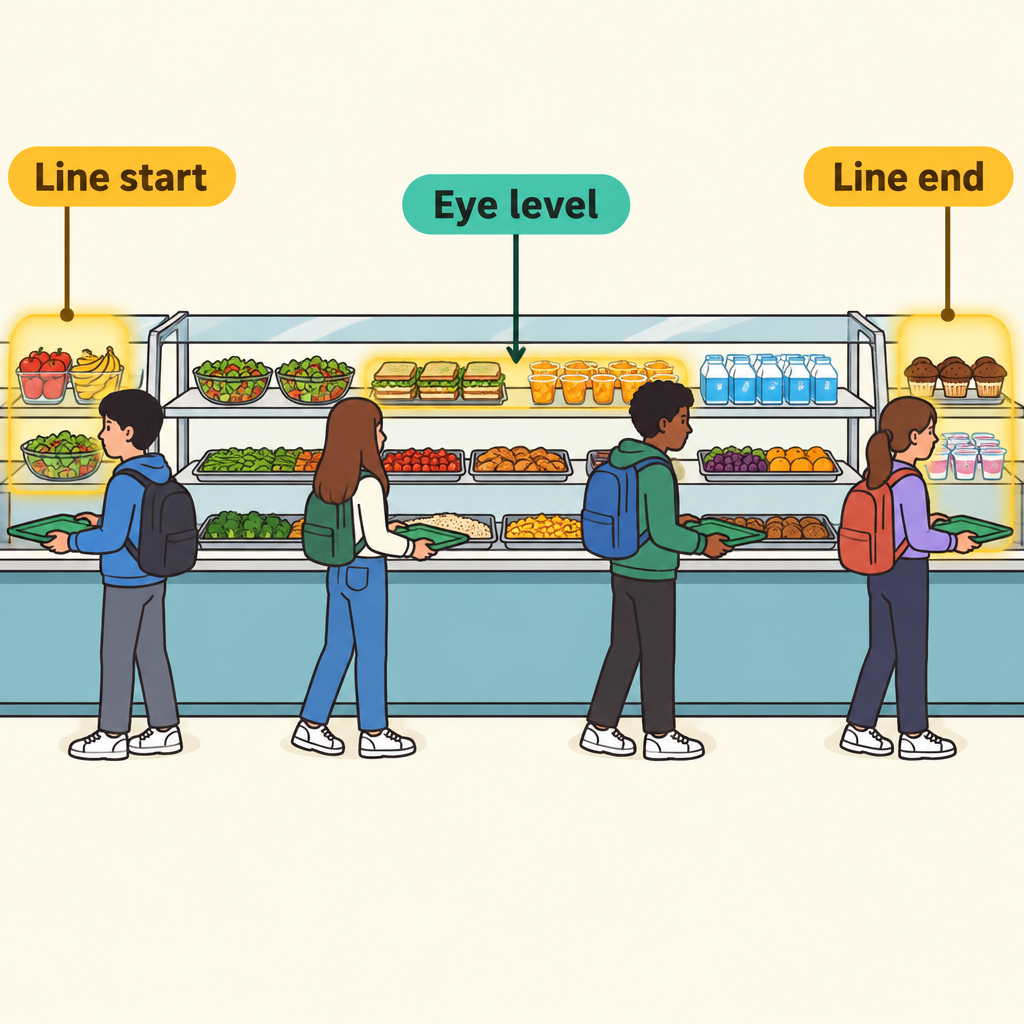
In this thought experiment, every food stays available, yet the items at eye level and at either end of the line are the ones students reach for more often.
The lever here is simply order, or position.
When prices and options stay similar, reordered choices can qualify as nudges.
Audit the Choice
Faced with a form, menu, or app, ask two questions.
Does the design remove an option? That is a mandate. Does it meaningfully change costs? That is an incentive change. If neither applies, a predictable shift may be a nudge.
Then inspect four kinds of cues:
- Handles: the shape of what you touch, like the door bar or plate.
- Defaults: what happens if you do nothing. Most computers come with a default screen saver, and most people still have it.
- Order: which option comes first, at eye level, or at the end of the line.
- Wording, also called framing: how the same facts are described. Patients told “90 percent are still alive after five years” are far more likely to agree to a procedure than those told “10 percent are dead after five years,” though the facts are the same. Framing changes the words; order changes the position.
If a cue clashes with the intended action, redesign the cue before adding instructions.
- Form, menu, or app
- Removes an option?
- Mandate
- Meaningfully changes costs?
- Incentive change
- Inspect cues: Check handles, defaults (what happens if you do nothing), order (position), and wording (framing); a predictable shift may be a nudge.
- Cue clashes with action?
- Redesign the cue: Fix the cue before adding instructions.
Build for Humans, not imaginary Econs.
Check yourself
An option already selected before anyone acts is a _____. Describing the same facts in different words is _____.
Answer: An option already selected before anyone acts is a default. Describing the same facts in different words is framing.
A default is the option already in place, while framing is how the same facts are worded, like “90 percent alive” versus “10 percent dead.”
A cafeteria moves fruit to eye level but keeps every food available at the same price. What is this?
- A nudge
- A mandate
- An incentive change
Answer: A nudge
This is a nudge: changing placement can predictably influence choices without removing options or changing prices. It is not a mandate or an incentive change.
A door opens outward, but its vertical bar invites people to pull. Which change best fixes the problem?
- Replace the bar with a flat plate
- Add a larger PUSH sign beside the bar
- Add a fine for pulling the door
- Lock the door until someone gives instructions
Answer: Replace the bar with a flat plate
Replacing the bar with a flat plate changes the cue itself, so the automatic action matches the door’s required push. A PUSH sign leaves the conflicting cue in place.
Keep going
This is lesson 1 of 11 in Nudge: The Final Edition. Next up:
- There Is No Neutral Cafeteria
- Why Defaults Stick
- Organ Donors by Default
- How Long Nudges Last
- Framing, Menus, and Mappings
Wondering turns any topic into short lessons you can read, watch, or listen to, with practice questions and an AI tutor.