Free sample lesson · Northern Italy WSET Wine Guide
Valpolicella Appassimento
How do dried grapes transform fresh red fruit into intense Amarone?
Lesson 1 of the Wondering course Northern Italy WSET Wine Guide
Drying Grapes On Purpose
Valpolicella sits in the Veneto, in northern Italy. Its fresh style shows light red cherry fruit and low tannin.
Then the region does something unusual. Selected grapes are dried after harvest before fermentation begins.
This drying process is called appassimento.
The result is a completely different wine family, led by Amarone della Valpolicella.
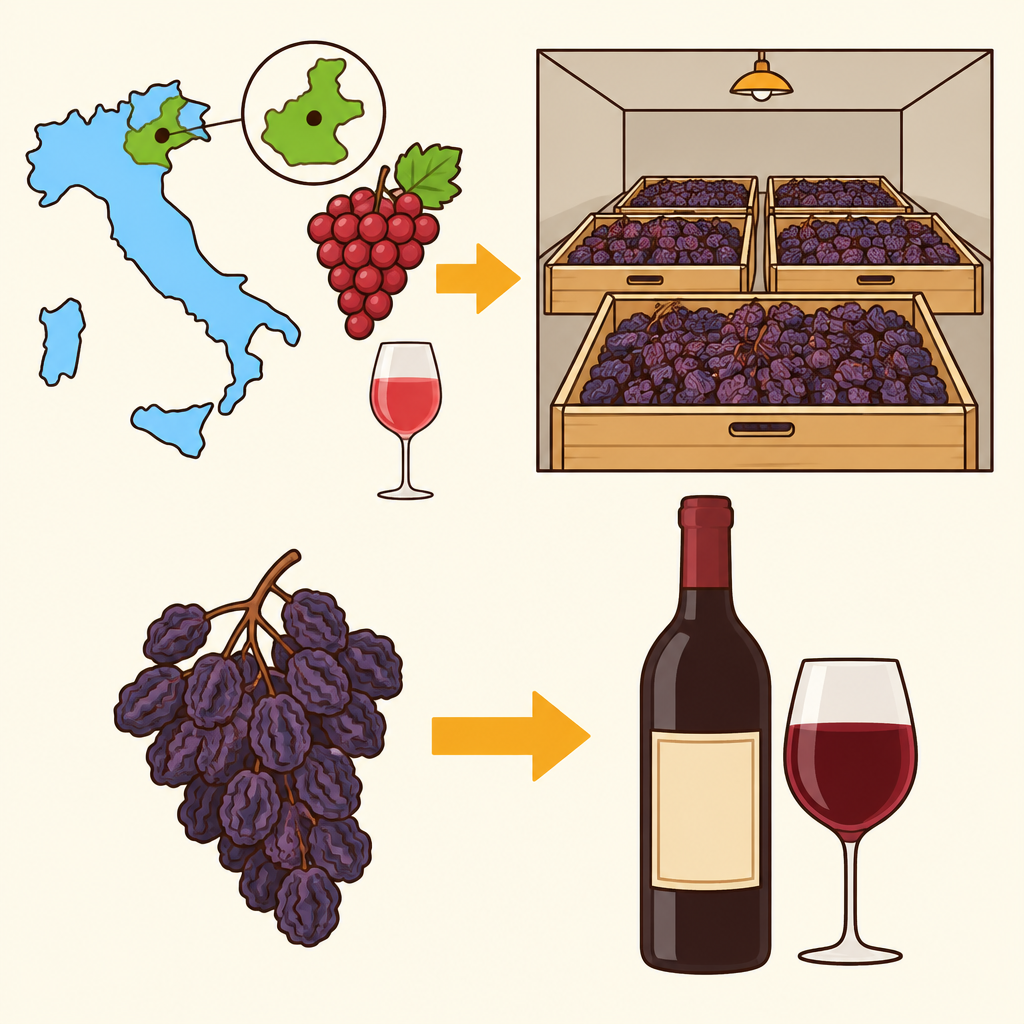
Grapes drying after harvest in Valpolicella
What Appassimento Actually Does
Appassimento is the drying of harvested grapes before fermentation.
As the grapes lose water, what remains becomes concentrated. Sugar, flavour, colour and tannin all rise in intensity.
Nothing is added. The components simply sit in less liquid.
- Concentrated
- Sugar: Higher sugar supplies the potential alcohol in the finished wine.
- Flavour: Fresh red fruit shifts toward deeper, more intense character.
- Colour: Pigment sits in less liquid, so the wine looks deeper.
- Tannin: Structure builds alongside the other concentrated components.
Nothing is added; water is removed before fermentation.
That single idea explains almost everything about Amarone's style.
From Harvest To Fermentation
Order matters for exam answers.
Grapes are harvested, then selected, then dried, and only afterwards fermented. Drying happens before fermentation, not after.
A common error is describing Amarone as concentrated by long ageing or by drying the finished wine.
The concentration is already in the fruit when fermentation starts.
- Harvest: Grapes are picked in Valpolicella.
- Select: Selected grapes are set aside for drying.
- Dry: The grapes are dried to concentrate sugar, flavour, colour and tannin.
- Ferment: Fermentation begins with already concentrated fruit.
Sugar Becomes Alcohol
Concentrated sugar has a direct consequence.
More sugar in the must means more alcohol once fermentation is complete. This is why Amarone is markedly higher in alcohol than simple Valpolicella.
Higher alcohol also adds weight on the palate, reinforcing the fuller body.
So one production choice drives several tasting descriptors at once.
Fresh Fruit Versus Dried Fruit
The flavour shift is the part students most often miss.
Simple Valpolicella shows fresh red cherry character. It is light, high in acidity and easy to drink young.
Amarone, built from dried grapes, is fuller-bodied, more concentrated and more complex.
Same region, same starting fruit, two very different wines.
- Valpolicella
- Amarone
Quality Tiers Explained
Appassimento is the mechanism behind Valpolicella's quality ladder.
At the base sits simple Valpolicella, made from fresh grapes. Above it sits Amarone della Valpolicella, made from dried grapes.
Each step up demands more selected fruit, more time and more handling before fermentation.
That is why the tiers exist at all.
- Amarone: Made from dried grapes; fuller-bodied, higher in alcohol and more complex.
- Valpolicella: Made from fresh grapes; lighter and simpler in style.
The upper tier rests on selection and drying of the base fruit.
Why Amarone Costs More
Commercial positioning follows directly from production.
Drying takes space, time and careful selection. Water loss also means less wine from the same picked fruit.
Higher cost plus greater concentration places Amarone at a premium price point.
For retail, that is the honest justification to give a customer.
- Appassimento: Drying selected grapes before fermentation.
- Production cost: Drying takes space, time and careful selection.
- Premium price: Higher cost supports a premium price point.
- Lower volume: Water loss means less wine from the same picked fruit.
- Concentration: Greater concentration and complexity justify the positioning.
Answering The Exam Question
Exam questions rarely ask you to define appassimento alone.
They ask you to link method to style. Name the drying, name what concentrates, then name the resulting characteristics.
A strong answer runs: grapes dried before fermentation, concentrating sugar, flavour, colour and tannin, giving a fuller-bodied, higher-alcohol, more complex wine.
Method, then consequence, every time.
Putting It To Work
Recognize appassimento whenever a wine shows unusual concentration from a region known for lighter styles.
Explain it in one line: the grapes were dried before fermentation, so everything in them became more concentrated.
In retail, sell the labour and the volume loss, not just the flavour.
In the exam, always close the loop from method to tasting profile.
- Drying grapes: Selected grapes are dried after harvest.
- Concentration: Sugar, flavour, colour and tannin all intensify.
- Amarone: Fuller-bodied, higher in alcohol and more complex.
- Quality tier: Sits above simple Valpolicella on the ladder.
- Premium price: Cost and volume loss support the positioning.
Check yourself
Appassimento dries harvested grapes before fermentation.
- True
- False
Answer: True
This is correct. Appassimento is the drying of grapes before fermentation, which concentrates what remains in the fruit.
Simple Valpolicella shows _____ character and is light-bodied, while Amarone is _____ and more concentrated.
Answer: Simple Valpolicella shows fresh red cherry character and is light-bodied, while Amarone is fuller-bodied and more concentrated.
Fresh Valpolicella is associated with fresh red cherry and a lighter style. Amarone is made from dried grapes, producing a fuller-bodied, more concentrated wine.
Why is Amarone della Valpolicella usually higher in alcohol than simple Valpolicella?
- Its grapes contain more concentrated sugar before fermentation
- The finished wine is dried after fermentation
- Long ageing adds alcohol to the wine
- Water is added to increase the alcohol level
Answer: Its grapes contain more concentrated sugar before fermentation
Drying grapes removes water and concentrates their sugar. More sugar in the must can produce more alcohol during fermentation.
Keep going
This is lesson 1 of 10 in Northern Italy WSET Wine Guide. Next up:
- Soave Garganega
- Prosecco Production
- Barolo Barbaresco
- Barbera Dolcetto
- Asti Gavi
Wondering turns any topic into short lessons you can read, watch, or listen to, with practice questions and an AI tutor.