Free sample lesson · No-Code AI Automation for Business
Spotting Work Worth Automating
Google's reliability engineers average a third of their time on repetitive work. What's your share?
Lesson 1 of the Wondering course No-Code AI Automation for Business
A Third of the Week, Repeated
Google's reliability engineers have a name for repetitive operational work: toil.
Their surveys found toil averaged about 33% of an engineer's time, with individuals reporting anywhere from 0% to 80%.[[1]](https://sre.google/sre-book/eliminating-toil/)
Google aims to keep it below 50% for each person.[[1]](https://sre.google/sre-book/eliminating-toil/)
- Survey average: About a third of the week, on average.
- Google's ceiling: The target is to stay under this line.
- Highest reported: Some individuals spent most of their time on it.
The test they use was written for engineers, but its ideas carry over to office work. So how do you spot toil in your own week?
Six Signs of Machine-Ready Work
Picture copying every web-order email into a spreadsheet, then sending the same confirmation.
That task is manual, repetitive, and follows rules a machine could follow. It is also tactical, leaves no lasting value, and grows as the business grows.[[1]](https://sre.google/sre-book/eliminating-toil/)
- How it is done
- Manual: A person does it by hand.
- Repetitive: The same steps come back again and again.
- Rules a machine could follow: No fresh judgment needed each time.
- What it leaves
- Tactical: Handles today, not the long term.
- No lasting value: Nothing is better once it is done.
- Grows with the business: More orders mean more of it.
More matches mean a stronger case. Disliking a task is not a sign.
The more of these six signs a task matches, the stronger the case for automating it.[[1]](https://sre.google/sre-book/eliminating-toil/)
Notice what is missing from the list: whether you dislike the task.
Three Tasks From One Shop
A small online shop has three jobs on its list.
Order emails to spreadsheet: matches nearly every sign and multiplies with each order. Strong candidate.
Pitching a new wholesale partner: novel, needs judgment, and the result has lasting value. Weak candidate.
Approving refunds one by one: it looks like judgment. But there is no refund policy, so every case is decided from scratch.
- Order emails
- Wholesale pitch
- Refund approvals
That third one deserves a closer look.
Boring Is Not the Test
Your monthly team meeting may feel like a chore. It is still not toil.
The SRE book calls meetings and HR paperwork overhead: tedious, but not repetitive rule-following work. Cleanup with lasting value is not toil either.[[1]](https://sre.google/sre-book/eliminating-toil/)
Doing a task for the first or second time does not count, because nothing has repeated yet.[[1]](https://sre.google/sre-book/eliminating-toil/)
Repetition is not always bad. Predictable tasks "can be quite calming" and only become harmful in large amounts.[[1]](https://sre.google/sre-book/eliminating-toil/)
Judgment or a Missing Rule?
Back to the refunds. Each one feels like a judgment call.
The SRE book warns: "If human judgment is essential for the task, there's a good chance it's not toil." Yet some work only seems to need judgment because the process is badly designed.[[1]](https://sre.google/sre-book/eliminating-toil/)
Write a refund policy, and most cases become a rule.
So fix the process first, then automate it. Run the task through the six signs again once the rule exists.
- Feels like judgment
- Is a rule missing?: For example, no refund policy exists.
- Write the rule: Most cases now follow the policy.
- Re-run six signs
- Keep it human: Judgment is essential, so it is likely not toil.
- Possible candidate
- Yes
- No
- Signs match
AI Help Has Jagged Edges
Passing the test answers one question. Whether AI should do the step is a second, separate check.
In an experiment with 758 knowledge workers, run with Boston Consulting Group, GPT-4 users on tasks inside AI's capability finished 12.2% more tasks, 25.1% faster, at higher quality.[[2]](https://www.hbs.edu/faculty/Pages/item.aspx?num=64700)
On one task just outside it, they were 19% less likely to get the right answer.[[2]](https://www.hbs.edu/faculty/Pages/item.aspx?num=64700)
The authors call this a jagged technology frontier. Two tasks can look equally hard while AI helps on one and hurts on the other.[[2]](https://www.hbs.edu/faculty/Pages/item.aspx?num=64700)
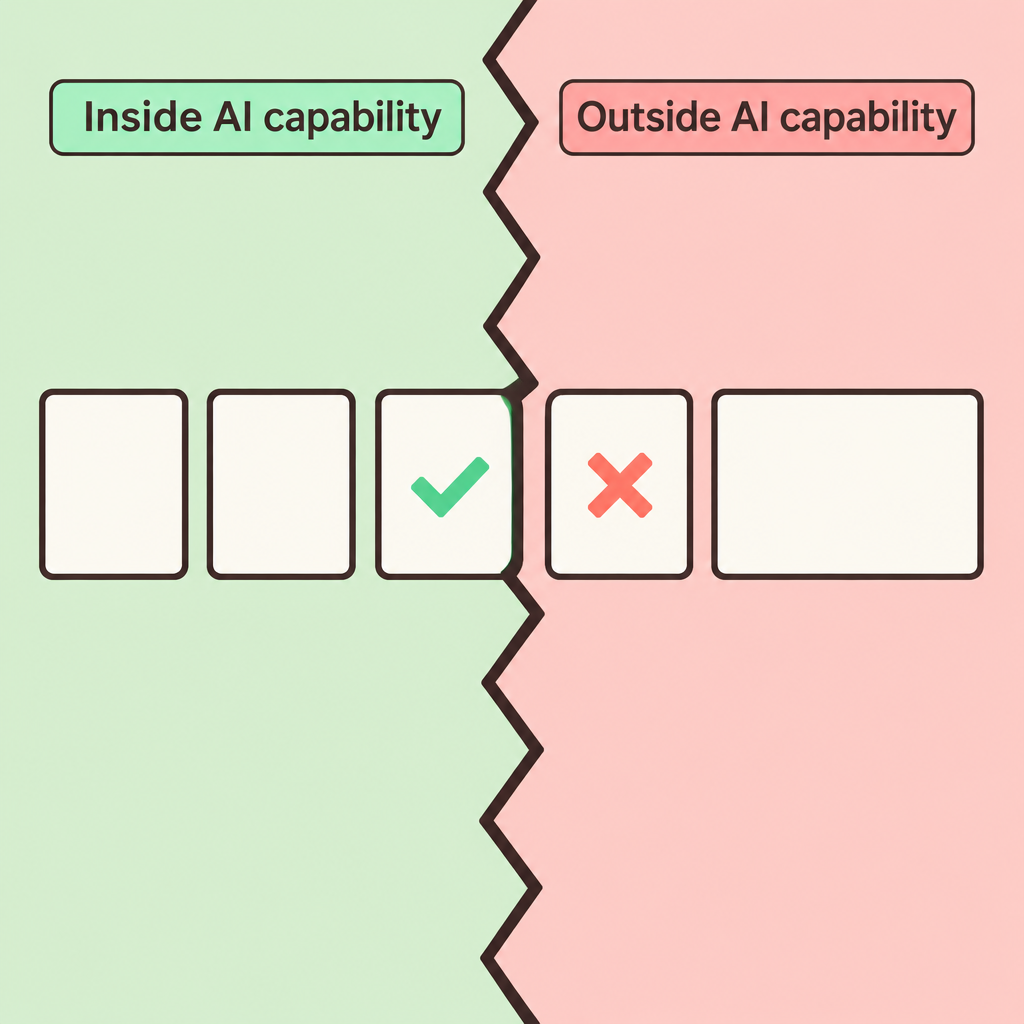
The boundary zigzags, so two task cards of the same apparent difficulty can land on opposite sides: one where AI helps, one where it hurts.
Building Your Shortlist
Now list the tasks in your own week.
Score each against the six signs. Drop anything done only once or twice, and anything that is overhead.
Where a task seems to need judgment, ask whether a written rule would settle it.
Then check AI fit separately. How hard a task looks will not tell you whether AI helps, so check what it actually produces. Pick a handful of real past cases where you already know the right answer, such as last month's order emails, run the AI step on them, and compare every output with what actually happened. Where an output is wrong, keep that step with a person for now.
What survives is your shortlist. The next lesson tests which of those tasks actually pay back.
- List tasks: Write down the tasks in your own week.
- Score signs: Check each task against the six signs.
- Drop non-toil: Remove overhead and tasks done only once or twice.
- Find missing rules: Ask whether a written rule would settle apparent judgment calls.
- Check AI fit: Looking hard does not decide it. Run the AI step on a few past cases with known answers and check every output; keep any step it gets wrong with a person.
Check yourself
Is a monthly team meeting automatically a strong automation candidate just because it feels tedious?
- Yes
- No
Answer: No
No. Tedium or dislike is not one of the six signs. Meetings may be overhead without being repetitive, rule-based work.
Approving refunds one by one can feel like _____, but the real gap is that no written _____ exists yet. The monthly team meeting is tedious, yet it falls under _____ rather than toil. And because two tasks that look equally hard can land on opposite sides of the frontier, apparent difficulty does not predict a task's AI _____.
Answer: Approving refunds one by one can feel like judgment, but the real gap is that no written policy exists yet. The monthly team meeting is tedious, yet it falls under overhead rather than toil. And because two tasks that look equally hard can land on opposite sides of the frontier, apparent difficulty does not predict a task's AI fit.
The refund cases only seem to need judgment because the process lacks a rule. Once a policy is written, most cases follow it. So the missing piece is the policy, not judgment. Meetings are tedious but not repetitive rule-following work, so the SRE book classes them as overhead rather than toil. The jagged frontier shows that AI can help on one task and hurt on another that looks just as hard. That means AI fit has to be checked on real past cases, not guessed from how difficult a task seems.
Which task is the strongest automation candidate under the repetitive-work test?
- Copying each order email into a spreadsheet and sending the same confirmation
- Writing a new pitch for a potential wholesale partner
- Leading a monthly team meeting with changing discussion topics
- Cleaning a customer database to improve its long-term accuracy
Answer: Copying each order email into a spreadsheet and sending the same confirmation
Copying every order email into a spreadsheet and sending the same confirmation is manual, repetitive, rule-based, tactical, produces no lasting value, and grows with order volume.
Keep going
This is lesson 1 of 6 in No-Code AI Automation for Business. Next up:
- Will This Automation Pay Back?
- How an Automation Starts and Runs
- Giving the AI Step a Clear Job
- Putting a Person in the Loop
- Planning for Failed and Tricked Runs
Wondering turns any topic into short lessons you can read, watch, or listen to, with practice questions and an AI tutor.