Free sample lesson · Neuroplasticity: How the Brain Changes
Plasticity Is Physical Change
William James said nervous tissue yields to influence. What physically yields?
Lesson 1 of the Wondering course Neuroplasticity: How the Brain Changes
What Physically Yields?
In 1890, William James described plasticity as “the possession of a structure weak enough to yield to an influence, but strong enough not to yield all at once.”[[3]](https://psychclassics.yorku.ca/James/Principles/prin4.htm)
He used this idea to explain habit.
A 2011 NIH workshop review gave the modern version: the nervous system's ability to respond to stimuli by reorganizing its structure, function and connections.[[1]](https://pubmed.ncbi.nlm.nih.gov/21482550/)
In 2005, Pascual-Leone and colleagues called plasticity “an intrinsic property of the human brain.”[[2]](https://pubmed.ncbi.nlm.nih.gov/16022601/) Every brain has it. No app or supplement switches it on.
- James defines plasticity: A structure that yields, but not all at once, explains habit.
- An intrinsic property: Pascual-Leone and colleagues say every human brain has it.
- NIH review definition: Reorganizing structure, function and connections in response to stimuli.
A Path Across the Lawn
Picture a path worn across a lawn. Repeated walking makes a path, and a new route can wear a new one.
One step leaves no mark.
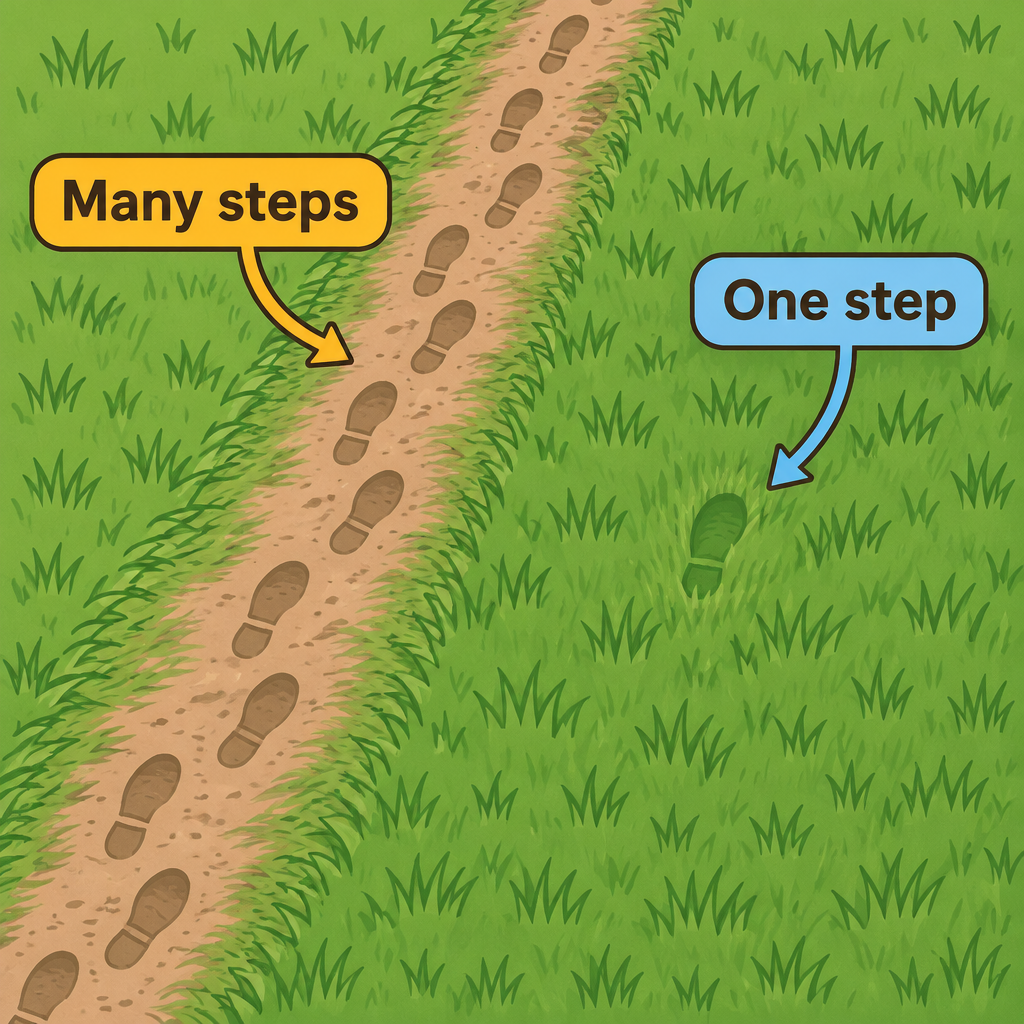
Notice that only repeated walking wears a visible path, while a single step leaves the grass unchanged, like the balance James described.
That is James's balance. A structure that yields to everything keeps nothing. One that never yields learns nothing.
James wrote of incoming currents making “paths which do not easily disappear.”[[3]](https://psychclassics.yorku.ca/James/Principles/prin4.htm)
The picture breaks down in one way. A lawn is passive, but the brain actively prunes, so most new connections vanish and only a few are kept.
Activity Versus Lasting Change
Plasticity means a lasting physical change in the nervous system.
The firing pattern in your brain as you read this sentence is activity. It counts as plasticity only if it leaves a lasting trace.
A mood lift from caffeine is not, by itself, plasticity.
A new memory is. So is a lasting pain loop. Pascual-Leone calls plasticity the mechanism for learning “as much as a cause of pathology.”[[2]](https://pubmed.ncbi.nlm.nih.gov/16022601/) It is not always helpful.
- Activity
- Lasting change
Four Levels of Change
When the brain changes with experience, it can change at several physical levels.
Synapses, the junctions between neurons, get stronger or weaker. Dendritic spines, tiny bumps on neurons that host synapses, appear and disappear.
Myelin, the insulating wrap around axons, can be added. Cortical maps of the body or of sounds can shift.
A change at one level does not imply change at the others. None of them requires growing new neurons.
Spines Come and Go
Researchers imaged the same patch of adult mouse cortex again and again.
About 50% of dendritic spines persisted at least a month. The rest lasted a few days or less.[[4]](https://pubmed.ncbi.nlm.nih.gov/12490942/) Spine gain and loss matched synapses forming and being removed.[[4]](https://pubmed.ncbi.nlm.nih.gov/12490942/)
Learning adds spines, but few stay. After mice trained on a rotating rod, only about 4–5% of newly formed spines persisted at least 3 months.[[5]](https://pmc.ncbi.nlm.nih.gov/articles/PMC4724802/)
- Spines lasting at least a month: The rest lasted a few days or less.
- New spines from training lasting at least 3 months: Most spines formed during learning were pruned away.
Both findings measure the spine level of plasticity.
This is the pruning the lawn picture misses.
Myelin Matters for Skill
Myelin is made by special cells that wrap axons, the long cables neurons use to send signals.
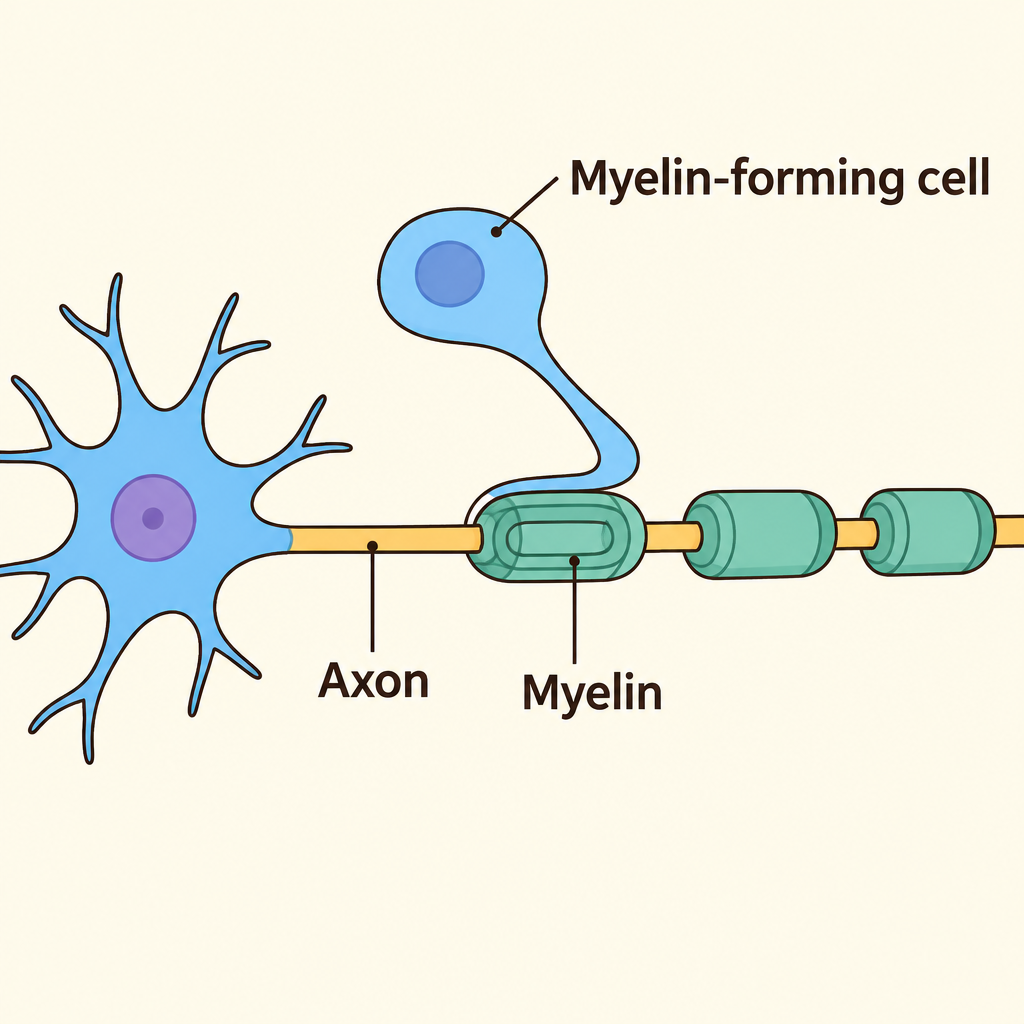
Notice how the myelin-forming cell wraps layers of insulation around the long axon, a physical change separate from the synapses at its tip.
In a 2014 study, mice were prevented from making new myelin-forming cells.[[6]](https://pubmed.ncbi.nlm.nih.gov/25324381/)
They failed to master a running wheel with irregularly spaced rungs.[[6]](https://pubmed.ncbi.nlm.nih.gov/25324381/)
So learning a skill can depend on adding insulation. That is a different level of change than spines or synapses.
Judging a Rewiring Claim
When you hear that something “rewires your brain,” ask what physically changed.
Is it a lasting trace or passing activity? Which level: synapse, spine, myelin, or map? Was it actually measured?
- Find the change: Ask what physically changed in the brain.
- Check it lasts: Separate a lasting trace from passing activity.
- Name the level: Decide if it is synapse, spine, myelin, or map.
- Look for measurement: Check whether the change was actually measured.
Watch for three myths: plasticity means new neurons, plasticity is always good, and plasticity belongs only to children.
- James on habit and the young
Check yourself
A study finds that adding insulation around axons helped mice learn a wheel with irregular rungs. The measured change is _____.
- myelin plasticity
- dendritic-spine plasticity
Answer: myelin plasticity
The insulation around axons is myelin, so this finding concerns myelin-level plasticity, not dendritic spines.
Match each finding to the physical level it measures: a connection gets stronger or weaker at a _____; a small bump appears or disappears as a _____; insulation is added around an axon as _____; and a body or sound layout shifts as a cortical _____.
Answer: Match each finding to the physical level it measures: a connection gets stronger or weaker at a synapse; a small bump appears or disappears as a dendritic spine; insulation is added around an axon as myelin; and a body or sound layout shifts as a cortical map.
Synapses change strength, spines appear or disappear, myelin adds insulation around axons, and cortical maps change their layout. A change at one level does not prove changes at the others.
Which example best shows neuroplasticity rather than passing brain activity?
- A new memory that remains later
- A brief mood lift from caffeine
- Brain firing while reading one sentence
- A momentary feeling of surprise
Answer: A new memory that remains later
A new memory is a lasting physical change in the nervous system. A passing mood or firing pattern counts only as activity unless it leaves a lasting trace.
Keep going
This is lesson 1 of 16 in Neuroplasticity: How the Brain Changes. Next up:
- How Synapses Learn
- What the Fixed-Brain Dogma Claimed
- Kittens and Critical Periods
- Maps That Move
- The New-Neuron Debate
Wondering turns any topic into short lessons you can read, watch, or listen to, with practice questions and an AI tutor.