Free sample lesson · Neurology as a Medical Career
Nervous System
How does a thought turn into a movement in a split second?
Lesson 1 of the Wondering course Neurology as a Medical Career
A Thought Becomes a Movement
How does a thought turn into a movement in a split second? The answer is your nervous system, the body's communication network.
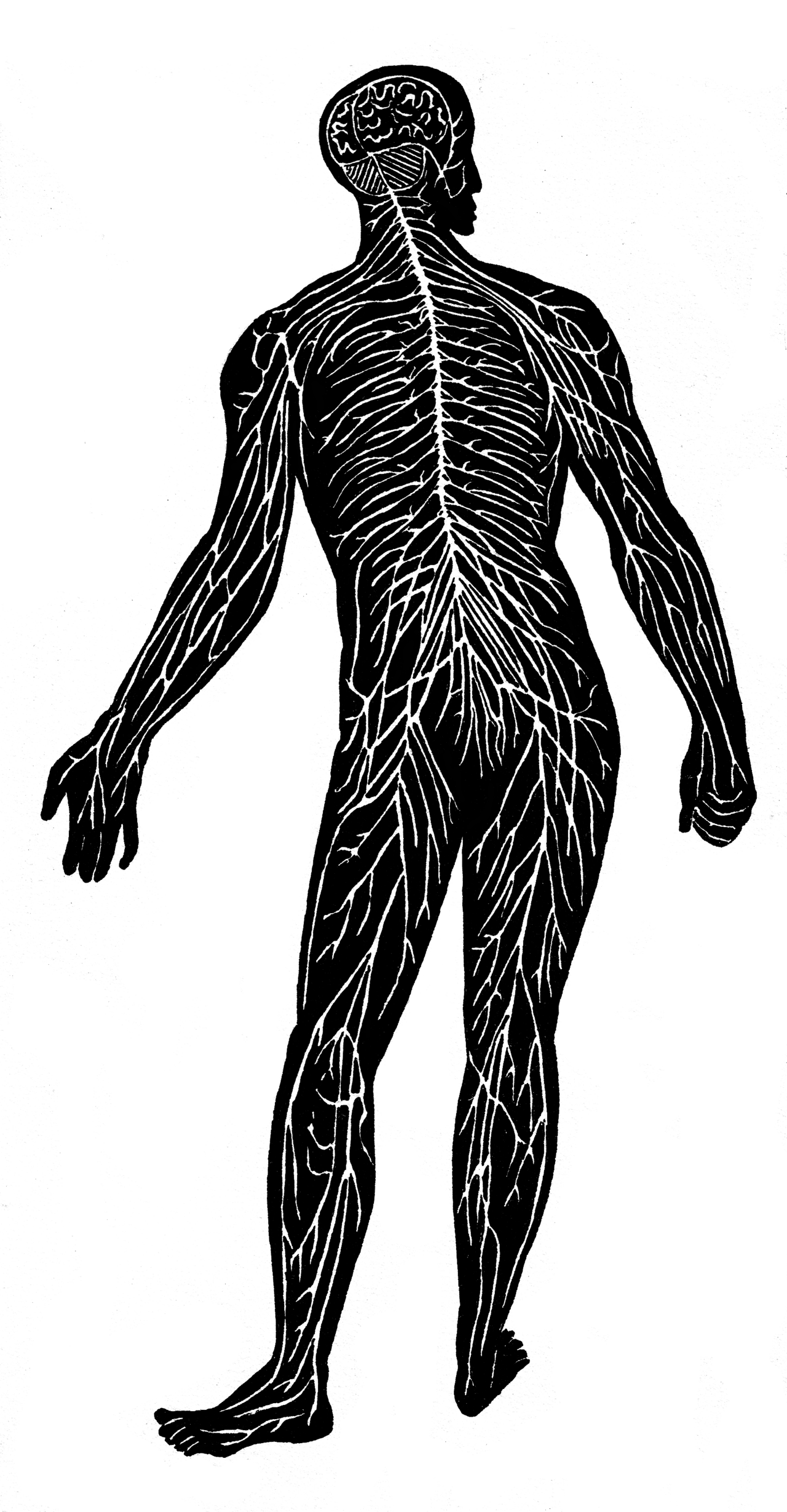
Nervous System (PSF).png) · Pearson Scott Foresman · Public Domain Mark 1.0 · Wikimedia Commons
It links your brain to your muscles, skin, and organs. Messages travel back and forth along this network constantly.
Understanding this network is the starting point for all of neurology, the medical field focused on the brain and nerves.
If you are curious about becoming a neurologist, this is where every case begins.
Two Main Parts
The nervous system has two main parts.
The central nervous system is the brain and the spinal cord. The brain plans, decides, and interprets information.
The spinal cord is the main highway. It carries messages between the brain and the rest of the body.
The peripheral nervous system is all the nerves that branch out from the brain and spinal cord to the muscles, skin, and organs.
- Nervous system: The body's communication network.
- Central nervous system
- Brain: Plans, decides, and interprets information.
- Spinal cord: Main highway for messages.
- Peripheral nervous system
- Nerves: Branch out to muscles, skin, and organs.
Signals Travel Both Ways
Information flows in two directions, like traffic on a two-way road.
Sensory signals travel from the body toward the brain. They report touch, temperature, pain, and the position of your limbs.
Motor signals travel from the brain down the spinal cord and out through nerves to the muscles, telling them when to contract.
- Sensory signals
- Motor signals
A common mix-up: nerves do more than give orders. They also carry reports back to the brain.
Neurons: The Messengers
The messages are carried by nerve cells called neurons.
Inside a neuron, a message moves as an electrical impulse. Neurons do not touch directly, though. Small gaps sit between them.
To cross a gap, a neuron releases chemical messengers that signal the next cell.
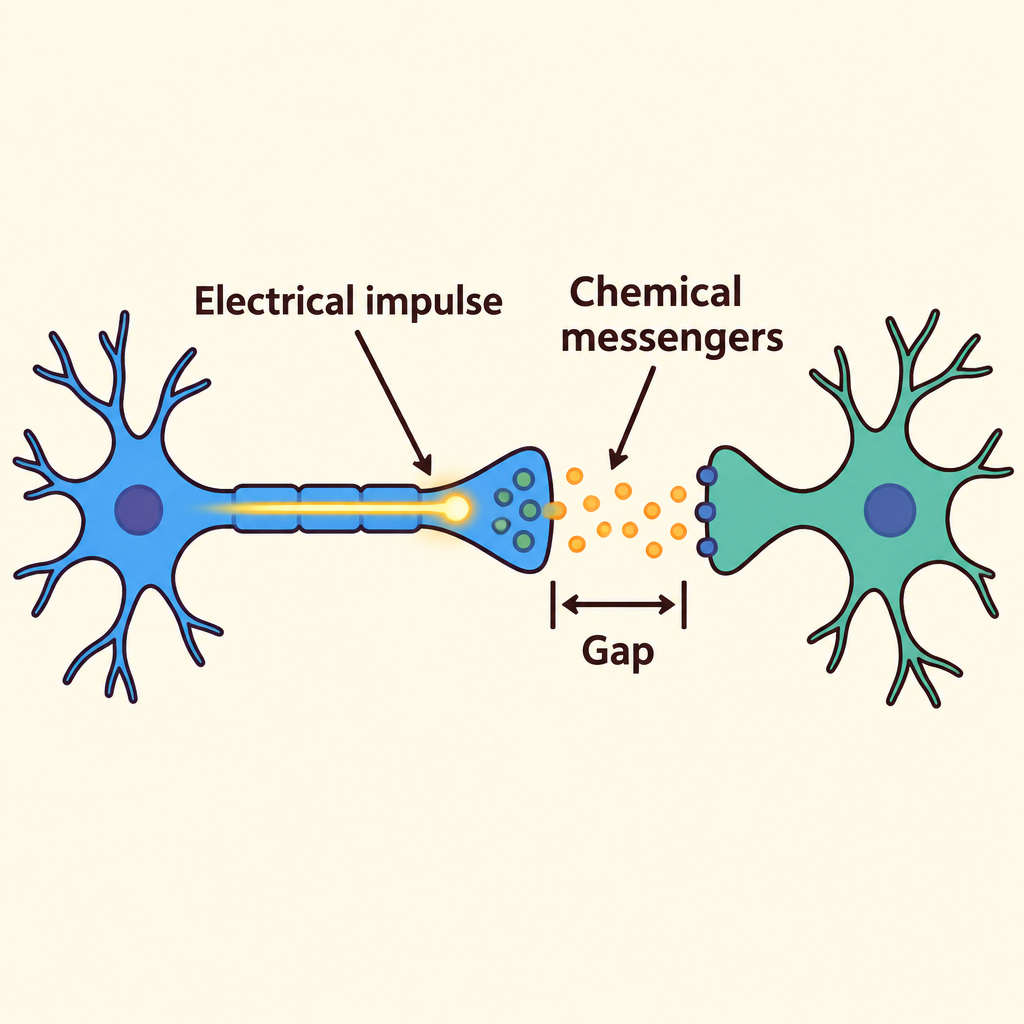
Notice the message travels as electricity along the first neuron, then crosses the small gap as chemical messengers to reach the next cell.
Electrical impulses plus chemical signals are why a thought can become a movement in a split second.
Imagine a Volleyball Block
Imagine a high school volleyball player who sees the ball coming. She decides to raise her right arm to block it.
She has a fraction of a second. If any part of the pathway from her brain to her arm muscles fails, she misses the block.
Each side of the brain mainly controls the opposite side of the body. So the motor cortex on her left side plans the right-arm move.
Follow the steps to see the whole trip.
- Eyes report: Her eyes send the ball's position to the brain.
- Brain plans: The motor cortex on the left side plans a right-arm movement.
- Spinal cord: The signal travels down the spinal cord to the neck level.
- Nerves to muscles: Peripheral nerves carry it to her shoulder and arm muscles, which contract.
- Feedback: Sensory nerves report the arm's position back so she can adjust.
How Neurologists Find the Problem
This pathway is the core idea of neurology as a career.
A neurologist examines four things: strength, sensation, reflexes, and coordination.
The results help answer one big question: does the problem lie in the brain, the spinal cord, or the peripheral nerves?
- What they check
- Strength
- Sensation
- Reflexes
- Coordination
- Where it could be
- Brain
- Spinal cord
- Peripheral nerves
The location then guides diagnosis and treatment.
Once they know the location, they use it to guide diagnosis and treatment. Finding where comes first.
Putting It All Together
The brain plans. The spinal cord carries. The peripheral nerves deliver.
Motor signals go out to the muscles. Sensory signals come back so the body can adjust.
Each side of the brain mainly controls the opposite side of the body.
Think back to the volleyball player. Every link in her chain is a place a neurologist might look, by testing strength, sensation, reflexes, and coordination.
Check yourself
A nerve that runs from the spinal cord down to the muscles of your forearm is part of the _____
- peripheral nervous system
- central nervous system
Answer: peripheral nervous system
The peripheral nervous system includes all the nerves that branch out from the brain and spinal cord to the muscles, skin, and organs. The central nervous system is only the brain and the spinal cord.
Fill in the missing divisions of the nervous system.
Answer: Central nervous system, Peripheral nervous system
The nervous system divides into the central nervous system (brain and spinal cord) and the peripheral nervous system (nerves).
Tap the structure along a neuron that conducts electrical impulses away from the cell body toward target muscles.
Answer: Axon
The axon is the long fiber of a neuron that transmits electrical impulses away from the cell body toward other cells or muscle fibers.
Keep going
This is lesson 1 of 12 in Neurology as a Medical Career. Next up:
- Common Disorders
- What Neurologists
- Daily Work
- Diagnostic Tools
- Subspecialties
Wondering turns any topic into short lessons you can read, watch, or listen to, with practice questions and an AI tutor.