Free sample lesson · Navier–Stokes: The Millennium Problem Explained
A fluid as a moving field
Lesson 1 of the Wondering course Navier–Stokes: The Millennium Problem Explained
Stir the water, watch the dye
Drop a bead of dye into a glass of water. Give it one slow stir.
The dye stretches into ribbons. It folds, thins, and curls.
You are not watching the dye. You are watching the water, made visible.
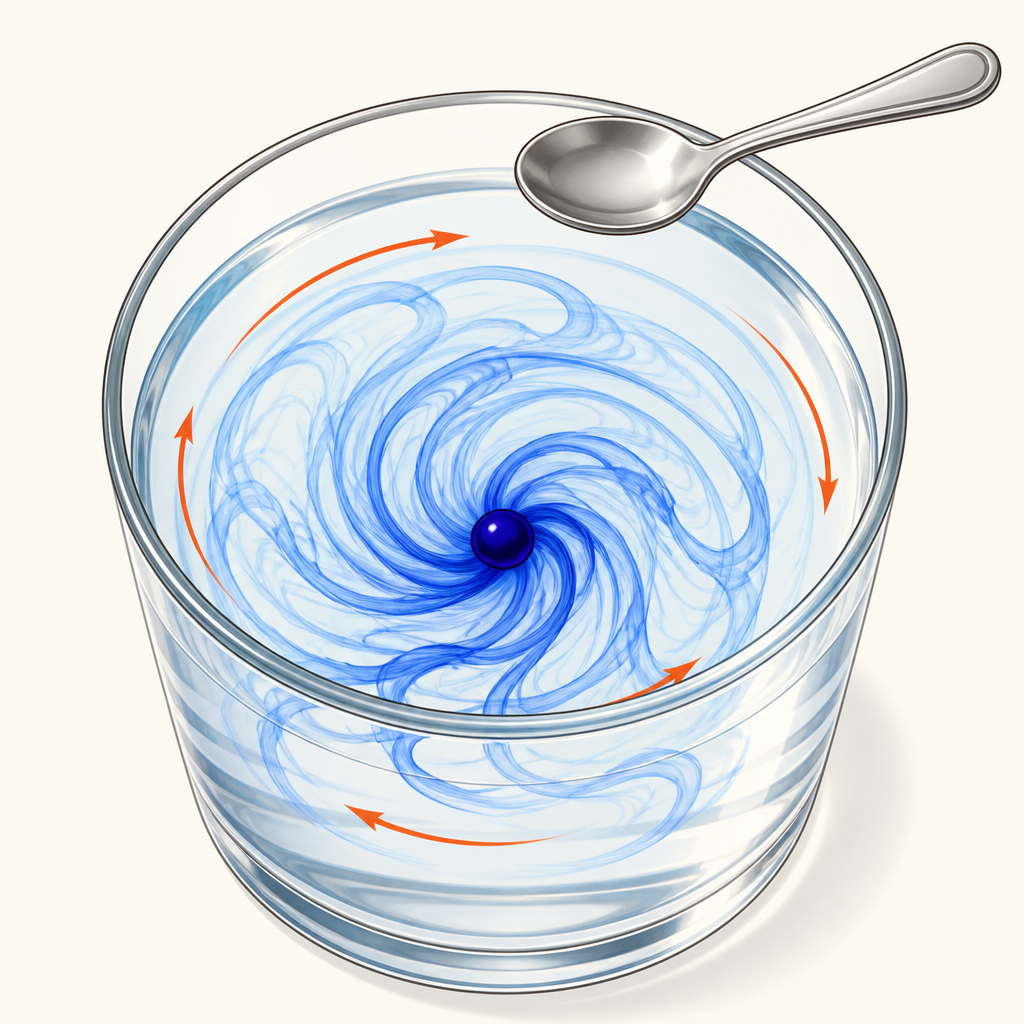
The dye never moves on its own; each ribbon traces the path the surrounding water took.
That hidden motion is what fluid mechanics tries to describe.
Treating a fluid as continuous
Water is really countless separate molecules. Tracking each one would be hopeless.
So we make a simplification called the continuum approximation.
We pretend the fluid fills space smoothly, with no gaps. Every point in the glass has a well-defined state.
- Molecules
- Continuum
This lets us describe the fluid with smooth quantities instead of molecular bookkeeping.
Velocity and pressure as fields
Pick any position x at any time t. Ask two questions.
How fast is the fluid moving there, and in what direction? That is the velocity $$u(x,t)$$, an arrow.
How hard is the fluid pushing there? That is the pressure $$p(x,t)$$, a single number.
- Velocity u
- Pressure p
Both change from place to place and moment to moment. That is what makes them fields.
Following versus watching
There are two honest ways to describe the same flow.
You can follow one small parcel of fluid and record where it travels, like tracking a single dye ribbon.
Or you can stand at a fixed location and record what passes by, moment after moment.
- Follow a parcel
- Watch a point
Field language does the second. It reports conditions at points in space, not the life story of any one parcel.
Reading a grid of arrows
Imagine a grid of dots across the glass, each carrying an arrow.
Long arrows mean fast fluid. Short arrows mean sluggish fluid. The direction shows where it heads next.
Where arrows curve around a common center, the fluid is swirling. Where neighbouring arrows point apart, the flow is spreading.
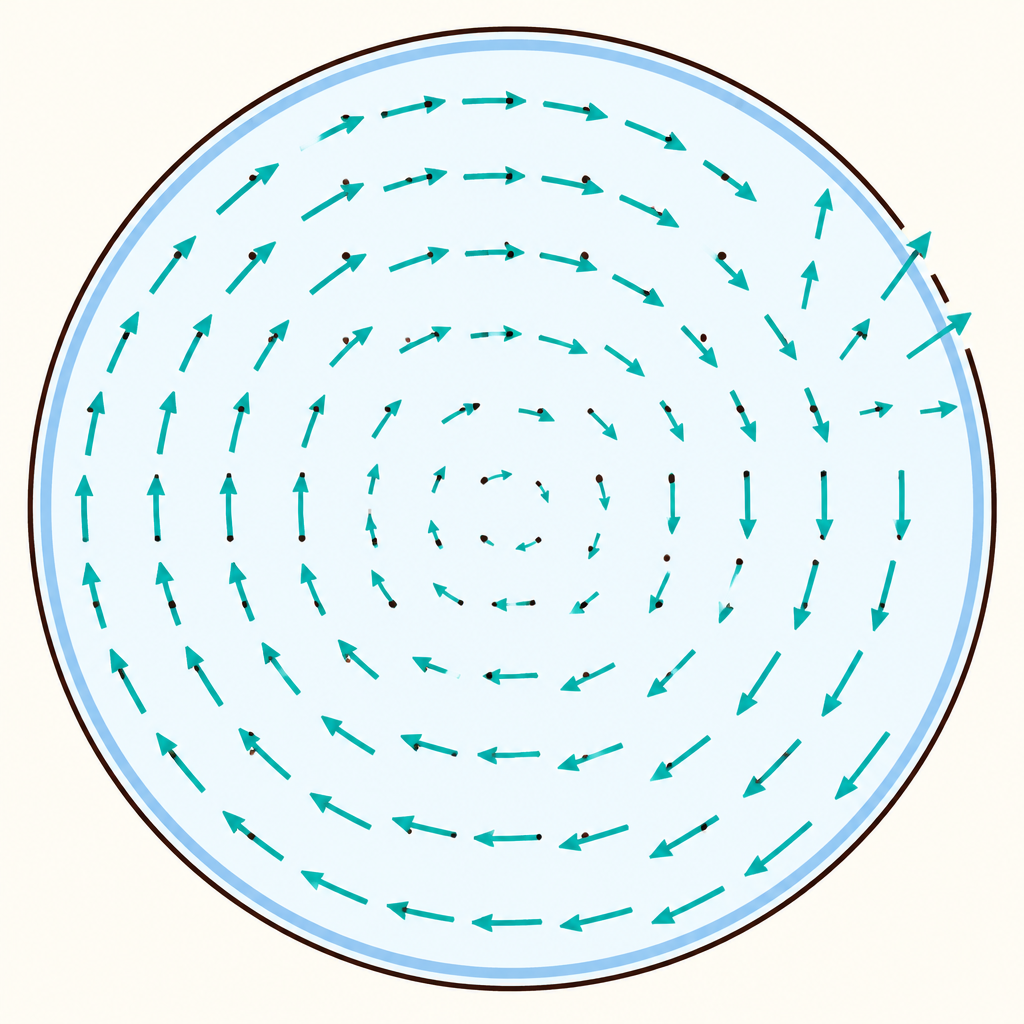
Compare arrow lengths and how neighbouring arrows turn: long arrows mark fast fluid, curving arrows mark a swirl.
One grid is one snapshot. A moment later, every arrow may have changed.
What an initial condition supplies
A snapshot alone does not tell you the future. You also need a starting point.
An initial condition supplies the whole velocity field at one chosen time, every arrow everywhere.
From that state, the rules of fluid motion carry the field forward to the next moment, and the next.
- Choose a time: Pick one chosen time to begin the description.
- Set every arrow: Supply the whole velocity field at that time, every arrow everywhere.
- Step forward: The rules of fluid motion carry the field to the next moment.
- Repeat: Continue moment after moment to follow how the flow develops.
Change the starting arrows and you get a different flow, even in the same glass.
Putting the picture together
A fluid becomes a moving field once you accept the continuum approximation.
At each position and time, the flow carries a velocity arrow and a pressure value.
Watching fixed points, rather than chasing parcels, gives you a full grid you can read at a glance.
- Continuum approximation: The fluid is treated as filling space smoothly.
- Velocity u(x,t): An arrow at each position and time.
- Pressure p(x,t): A single value at each position and time.
- Fixed points: Watching locations instead of chasing parcels.
- Initial condition: The whole velocity field at one chosen time.
Add an initial condition, and that grid becomes a story that runs forward in time.
Check yourself
The continuum approximation treats a fluid as filling space smoothly, without tracking each molecule.
- True
- False
Answer: True
This is correct. The continuum approximation replaces molecular bookkeeping with smooth quantities defined at every point.
In a fluid description, the _____ is an arrow showing speed and direction, the _____ is a single value, and an _____ gives the whole velocity field at one starting time.
Answer: In a fluid description, the velocity is an arrow showing speed and direction, the pressure is a single value, and an initial condition gives the whole velocity field at one starting time.
Velocity describes motion with an arrow, pressure is a scalar value, and an initial condition provides the starting velocity field.
On a grid of velocity arrows, what does a longer arrow indicate?
- Faster fluid motion
- Higher pressure
- A later measurement time
- A larger fluid molecule
Answer: Faster fluid motion
A longer arrow indicates faster fluid motion. Arrow direction shows where the fluid is moving.
Keep going
This is lesson 1 of 15 in Navier–Stokes: The Millennium Problem Explained. Next up:
- Reading Navier–Stokes one term at a time
- Incompressibility, pressure, and viscosity
- Existence, smoothness, and finite-time breakdown
- The exact challenge: all flows or one counterexample
- Why a weak solution is only part of the answer
Wondering turns any topic into short lessons you can read, watch, or listen to, with practice questions and an AI tutor.