Free sample lesson · National Quantum Strategy and Security
Core Principles
How can subatomic physics calculate complex problems in seconds?
Lesson 1 of the Wondering course National Quantum Strategy and Security
A Different Kind of Logic
Quantum computing runs on a different logic from the classical machines your agencies rely on today.
Classical computers hold one definite state at a time. Quantum computers use two principles: superposition, which lets quantum bits, or qubits, hold multiple states at once, and entanglement, which links particles across distance.
- Classical logic
- Quantum logic
For national strategy, these principles are the foundation of a new geopolitical era, and they set the urgency of R&D allocation.
Superposition And RSA Risk
Superposition allows a qubit to exist in multiple states simultaneously.
That property enables a form of parallel processing power, and it is why current RSA encryption standards are exposed.
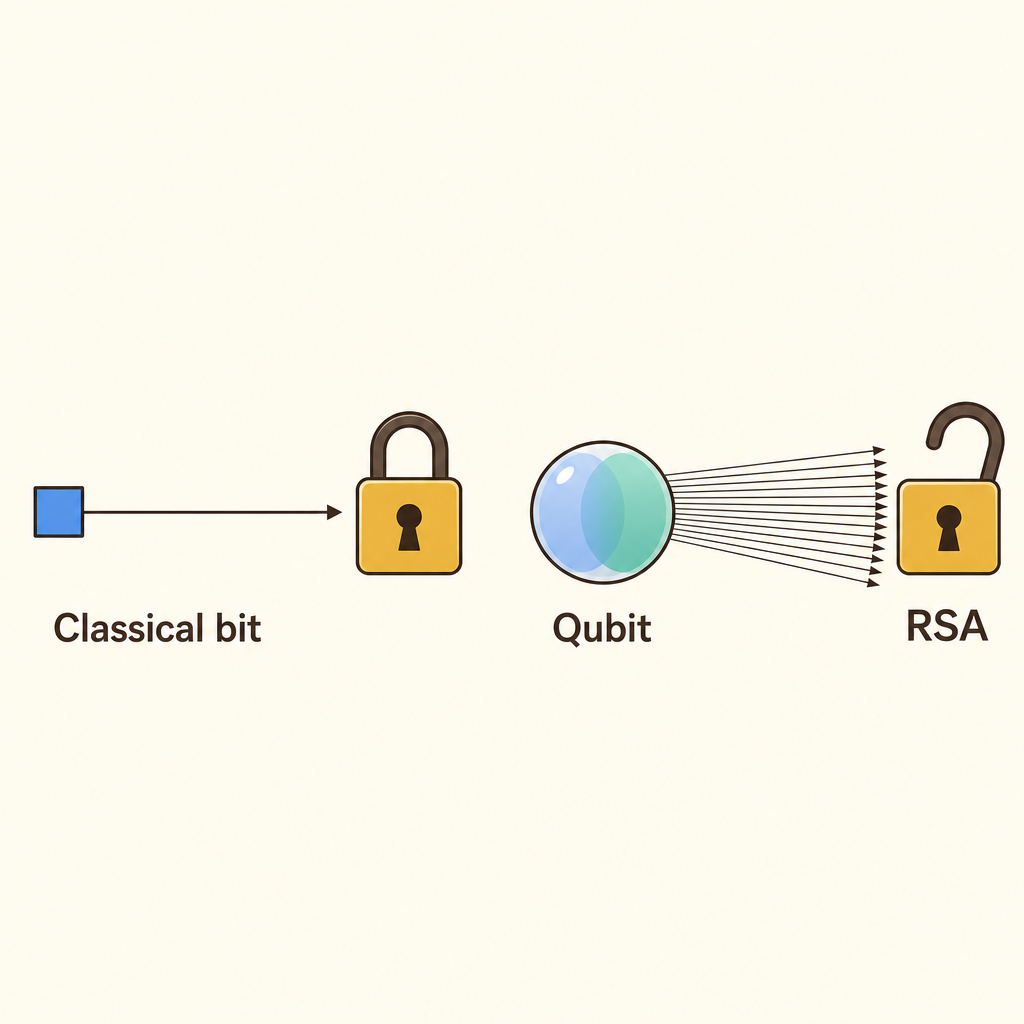
Notice how the qubit fans into many simultaneous paths while the classical bit follows a single route, which is the source of the pressure on RSA standards.
A strategic adversary who reaches a stable machine first could decrypt legacy government data that was archived years ago.
Entanglement And Secure Links
Entanglement creates a unique correlation between particles regardless of the distance separating them.
That correlation is the basis for quantum key distribution, or QKD, networks described as unhackable.
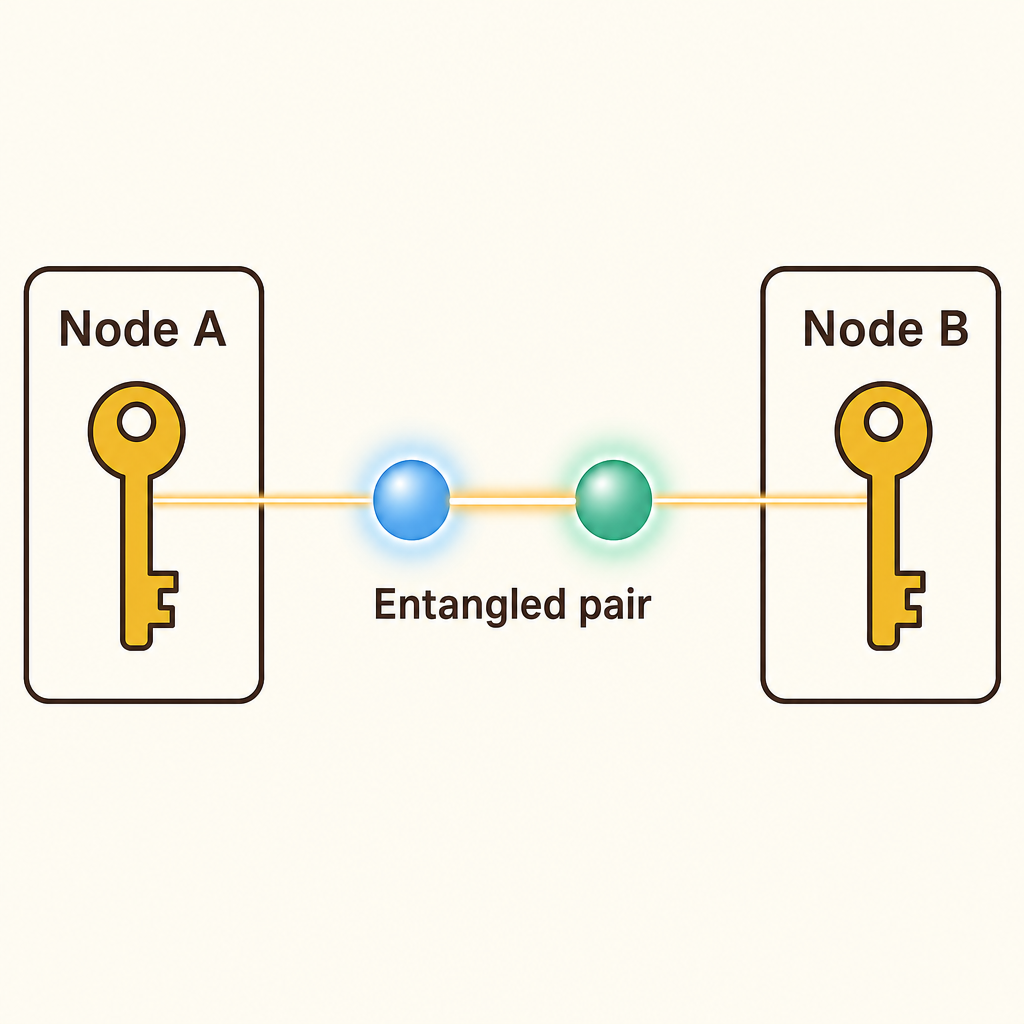
Notice that the two particles stay correlated across the whole distance, which is what lets both distant nodes hold the same key.
So the same physics that pressures old encryption also offers a way to protect future national communications.
The Quantum Advantage Threshold
Quantum advantage is the threshold where a quantum system outperforms classical supercomputers on a specific task.
The threshold arrives task by task, appearing first in narrow strategic areas such as cryptography and material simulation.
Assessing risk therefore means asking which task has crossed the line, rather than whether a machine is generally faster.
Milestones Worth Watching
Leadership attention belongs on scaling milestones, not on the low-level technical programming of these machines.
The decisive signal is a stable, error-corrected quantum computer, because that marks the transition from experimental physics to a deployable national security asset.
- Experimental physics: Early systems demonstrate the principles under tightly controlled conditions.
- Scaling milestones: Growth in qubit systems becomes the metric leadership tracks.
- Error correction: Stability turns fragile demonstrations into reliable computation.
- Deployable asset: The machine becomes a usable national security capability.
Before error correction, results remain fragile and largely demonstrative.
The Dual-Track Response
The policy answer runs on two tracks at the same time.
First, invest in domestic industry development so that supply chain sovereignty is preserved.
Second, prepare for the Q-Day transition to post-quantum cryptography, the point at which current encryption stops protecting national data.
- Dual-track approach: Both tracks run in parallel, not in sequence.
- Domestic industry: Investment preserves supply chain sovereignty.
- Post-quantum cryptography: Migration prepares systems for the Q-Day transition.
What To Carry Forward
Quantum systems reshape strategy because their logic differs, and that logic decides where the risk lands.
Track the scaling milestones, fund the domestic base, and begin the cryptographic migration before the threshold is crossed.
That discipline is how technological reality stays separate from strategic hype.
Check yourself
Does quantum advantage mean that a quantum system is generally faster than every classical computer?
- Yes
- No
Answer: No
No. Quantum advantage is task-specific: it occurs when a quantum system outperforms classical supercomputers on a particular task, such as cryptography or material simulation.
In quantum computing, _____ lets a qubit hold multiple states at once, while _____ creates correlations between particles across distance.
Answer: In quantum computing, superposition lets a qubit hold multiple states at once, while entanglement creates correlations between particles across distance.
Superposition concerns multiple possible states held by one qubit. Entanglement concerns correlations between particles, even when separated by distance.
Why does superposition create a strategic risk for legacy RSA encryption?
- It enables quantum systems to process multiple states in parallel
- It guarantees that every encrypted message becomes public immediately
- It prevents quantum systems from handling archived government data
- It makes classical computers hold multiple states simultaneously
Answer: It enables quantum systems to process multiple states in parallel
Superposition enables a form of parallel processing power, which is why current RSA encryption standards are exposed to sufficiently capable quantum systems.
Keep going
This is lesson 1 of 8 in National Quantum Strategy and Security. Next up:
- Hardware Modalities
- Critical Components
- Security Risks
- Policy Design
- Industry Engagement
Wondering turns any topic into short lessons you can read, watch, or listen to, with practice questions and an AI tutor.