Free sample lesson · mRNA Cancer Vaccines for Dogs
Cells & DNA
How does every cell in your dog's body know what to do?
Lesson 1 of the Wondering course mRNA Cancer Vaccines for Dogs
Why do Biscuit's cells act so differently?
Imagine a Labrador named Biscuit, nose to the ground, then sprinting across the yard.
A skin cell on her nose builds a tough protective coat. A muscle cell in her leg contracts so she can run.
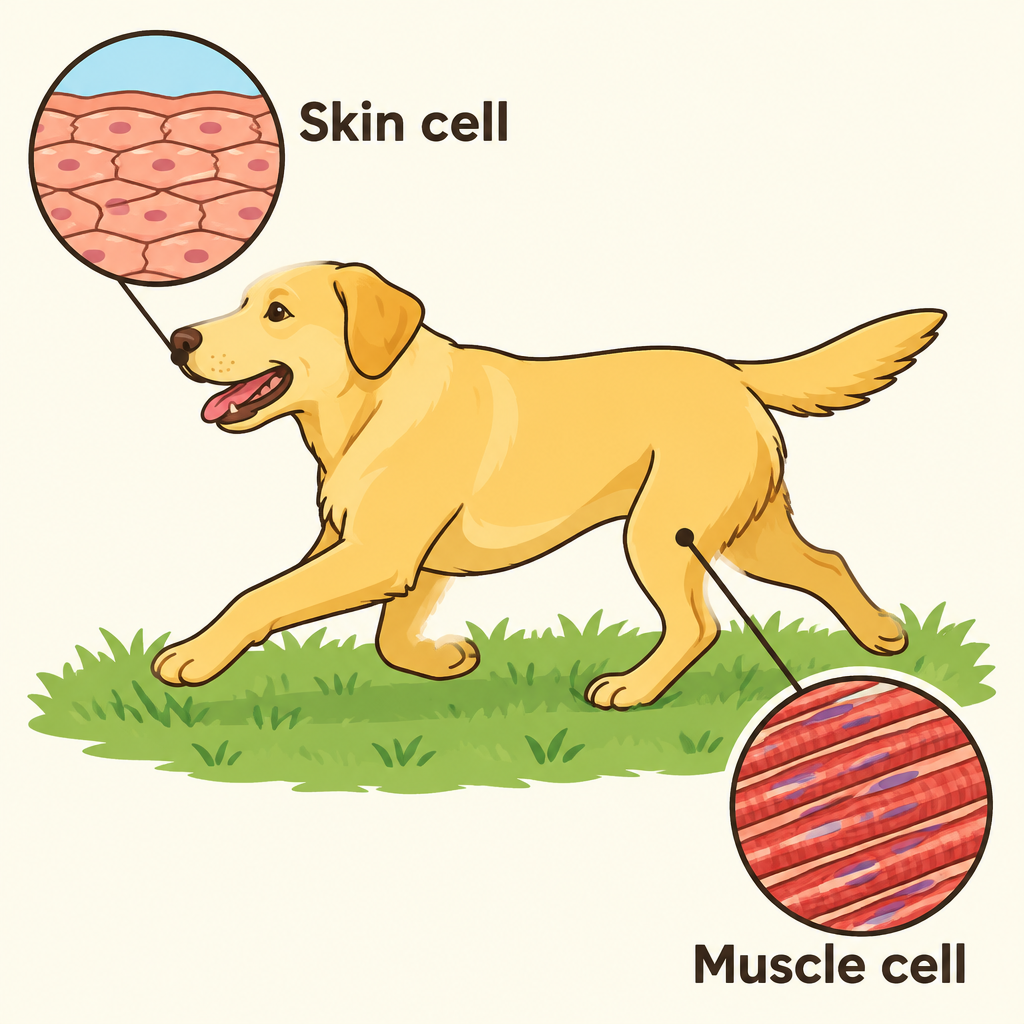
Notice how differently the two cells are built, even though both came from the same single egg.
Yet both cells started from the same single fertilized egg.
So how does a skin cell know not to act like a muscle cell? To answer that, we first need to look inside a cell.
Every cell carries an instruction book
Biscuit is made of trillions of cells, the smallest living units of life.
Inside nearly every cell, in a compartment called the nucleus, sits DNA: a long, coiled molecule written in a four-letter code (A, T, C, G).
Stretches of that code are called genes. Each gene holds the recipe for one specific protein.
- Biscuit's body: Made of trillions of cells.
- Cell: The smallest living unit of life.
- Nucleus: The compartment that holds the DNA.
- DNA: A long, coiled molecule written in A, T, C, G.
- Gene: A stretch of code with the recipe for one protein.
Each layer sits inside the one before it.
Proteins do most of the body's work, from building hair and muscle fibers to sending signals between cells.
So which recipes does each cell get?
Does each cell carry only its own manual?
Many people guess that a skin cell holds a skin manual and a muscle cell holds a muscle manual.
It seems logical. The cells look and act so differently that different instructions feel like the only explanation.
But Biscuit's cells all came from one egg, and DNA is copied each time a cell divides. Almost every cell carries the same complete DNA, roughly 20,000 genes.
- Common belief
- What really happens
So if the book is the same, what makes the cells differ?
Cells copy only the recipes they need
Each cell type switches on only the genes it needs.
To use a gene, the cell copies its DNA into a short, temporary note called messenger RNA (mRNA).
The mRNA leaves the nucleus for ribosomes, the cell's protein builders, which link amino acids in the order the note spells out.
- Switch on: The cell switches on a gene it needs.
- Copy to mRNA: The gene's DNA is copied into a temporary mRNA note.
- Leave nucleus: The mRNA travels out of the nucleus to ribosomes.
- Build protein: Ribosomes link amino acids in the order the note spells out.
- Break down: The mRNA is broken down, keeping protein amounts under control.
Soon the mRNA is broken down, so the cell stays in control of how much protein it makes.
So what does this look like in Biscuit's nose and leg?
Same DNA, different genes switched on
Suppose we follow two of Biscuit's cells. Both hold the same full set of roughly 20,000 genes.
The nose skin cell switches on keratin genes, for a tough protein found in skin, hair, and nails.
The leg muscle cell switches on genes for actin and myosin, the proteins that let muscle contract.
- Nose skin cell
- Leg muscle cell
Ribosomes build those proteins from the mRNA. Same DNA with different genes switched on gives two very different cells.
So what does that mean for the original question?
Which genes a cell reads decides its job
Back to Biscuit. Her nose cell never switches on muscle genes. It copies keratin genes into mRNA instead.
Every cell carries the whole instruction book; which genes it copies into mRNA and turns into proteins decides its job.
This flow, from DNA to mRNA to protein, runs every cell. It explains how DNA mistakes can lead to disease.
It even lets scientists deliver mRNA on purpose, teaching cells to make useful proteins.
Check yourself
A cell in a dog's ear and a cell in its stomach look and act very differently. These two cells _____.
- carry the same complete set of DNA
- each carry only the DNA instructions for their own job
Answer: carry the same complete set of DNA
Almost every cell in a dog carries the same complete DNA instruction book. The cells differ because each one switches on different genes, not because each holds only its own 'manual'.
Tap the compartment where the cell stores its DNA instruction book.
Answer: nucleus
The nucleus houses the cell's complete set of DNA, where active genes are transcribed into messenger RNA.
A cell copies a gene into a temporary _____ message. Because this message is soon _____, the cell keeps control over how much _____ it makes.
Answer: A cell copies a gene into a temporary mRNA message. Because this message is soon broken down, the cell keeps control over how much protein it makes.
mRNA is a short-lived copy of a gene. Since it is broken down quickly, the cell can control how much of each protein gets built.
Keep going
This is lesson 1 of 13 in mRNA Cancer Vaccines for Dogs. Next up:
- DNA to Protein
- Body Defenders
- Self vs. Foreign
- Immune Memory
- Classic Vaccines
Wondering turns any topic into short lessons you can read, watch, or listen to, with practice questions and an AI tutor.