Free sample lesson · Montessori Principles for Modern Educators
Prepared Space
Can a room really act as a child's second teacher?
Lesson 1 of the Wondering course Montessori Principles for Modern Educators
The Room as a Teacher
A Montessori classroom is more than just a physical space. It is a Prepared Environment designed to act as a second teacher for the child.
- Physical Space
- Prepared Environment
Every element in the room has a specific purpose. The goal is to remove obstacles that block natural development.
By organizing the space with intention, you allow children to follow their interests. This reduces the need for constant adult intervention.
Design for Independence
Physical accessibility is the foundation of independence. Materials are placed on low, open shelves where children can reach them easily.
- Accessibility: Materials are placed on low, open shelves for easy access.
- Furniture: Scaled to the child's physical dimensions.
- Curriculum Areas: Divided into distinct areas to help navigation.
Furniture is scaled to the physical dimensions of the child. This allows them to move and work comfortably without asking for help.
The room is divided into distinct curriculum areas. This structure helps children navigate the space and choose their own work with confidence.
Order and Mental Clarity
External order leads to internal mental order. A predictable and structured space helps a child develop focus and concentration.
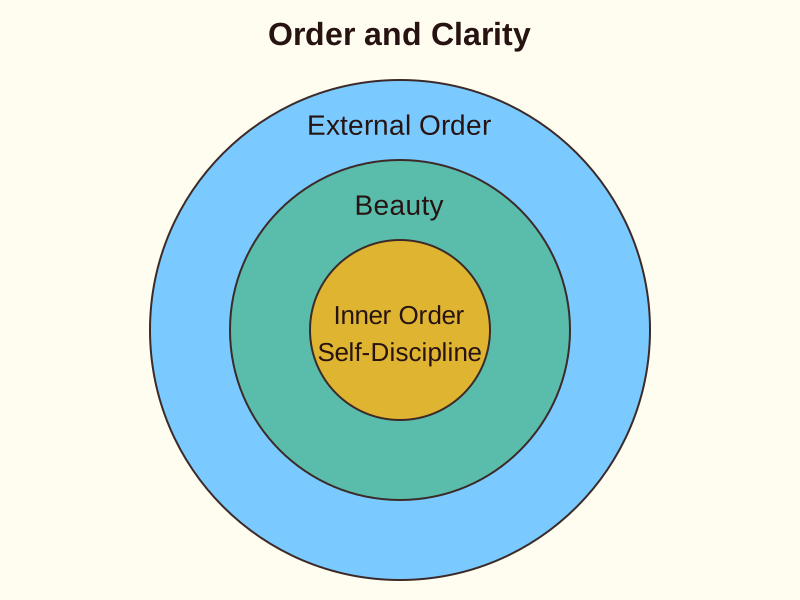
Beauty and aesthetics are also essential. A clean, pleasing environment invites the child to engage deeply with their chosen tasks.
When the environment is organized, children develop self-discipline. They learn to master their surroundings through purposeful activity.
The Role of the Educator
In a prepared space, the teacher is not a lecturer. Your role shifts to that of a designer and an observer.
- Observer: Observe how children interact with the space.
- Adjuster: Adjust materials to keep the environment challenging.
- Supporter: Ensure the environment remains responsive to evolving needs.
You must ensure the environment remains responsive to the evolving needs of your learners.
By observing how children interact with the space, you can adjust the materials. This keeps the environment challenging and supportive of their growth.
Check yourself
In a prepared space, the teacher acts primarily as _____.
- a designer and observer
- a direct lecturer
Answer: a designer and observer
In a Montessori environment, the teacher shifts from a traditional lecturer to a designer and observer who adapts the space to children's needs.
A structured and predictable space fosters _____, which directly supports the child's _____.
Answer: A structured and predictable space fosters external order, which directly supports the child's internal mental order.
Montessori observed that an organized external environment helps children develop focus, concentration, and self-discipline.
Why are materials placed on low, open shelves and furniture scaled to the child's body dimensions?
- To eliminate the need for adults to ask for assistance during lessons.
- To allow children to move and select work independently without seeking help.
- To ensure the educator can present direct lectures with minimal movement.
- To prevent children from choosing tasks outside their developmental stage.
Answer: To allow children to move and select work independently without seeking help.
Physical accessibility removes physical obstacles, enabling children to choose, reach, and complete work without needing constant adult assistance.
Keep going
This is lesson 1 of 7 in Montessori Principles for Modern Educators. Next up:
- Physical Layout
- The Absorbent Mind
- Sensitive Periods
- Observation Skills
- Work Cycles
Wondering turns any topic into short lessons you can read, watch, or listen to, with practice questions and an AI tutor.