Free sample lesson · Miraxis Physical AI Data Onboarding
Physical AI
What happens when an AI's 'hallucination' results in a physical collision instead of just a wrong word?
Lesson 1 of the Wondering course Miraxis Physical AI Data Onboarding
What You Will Learn
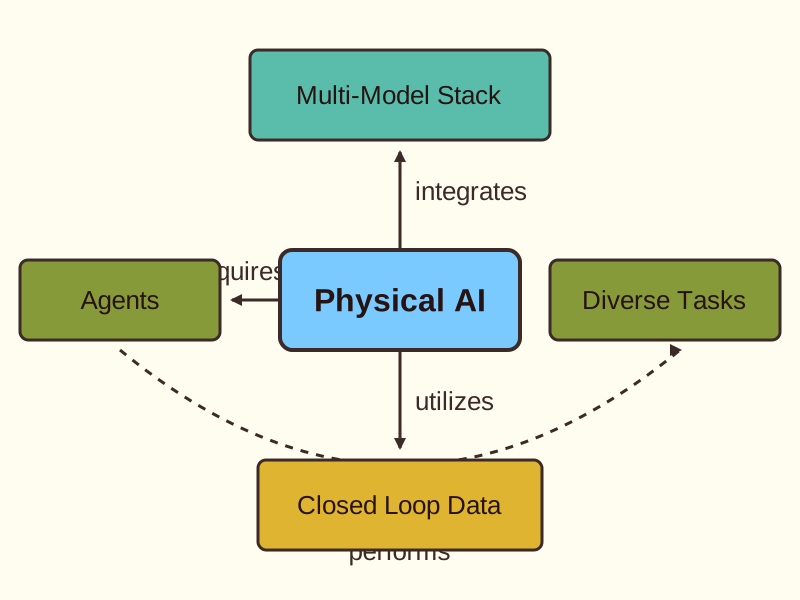
Understanding the shift from digital reasoning to physical action is the baseline for all robotics data work.
The Rise of Generalist Agents
The robotics industry is moving away from narrow, scripted machines. We are now building Generalist Physical Agents.
These systems do more than follow fixed paths. They perceive their surroundings and reason about their tasks.
They can recover from errors and improve over time. This shift allows one robot to handle many different tasks and body types.
- Narrow Machines
- Generalist Agents
From Labels to Closed Loops
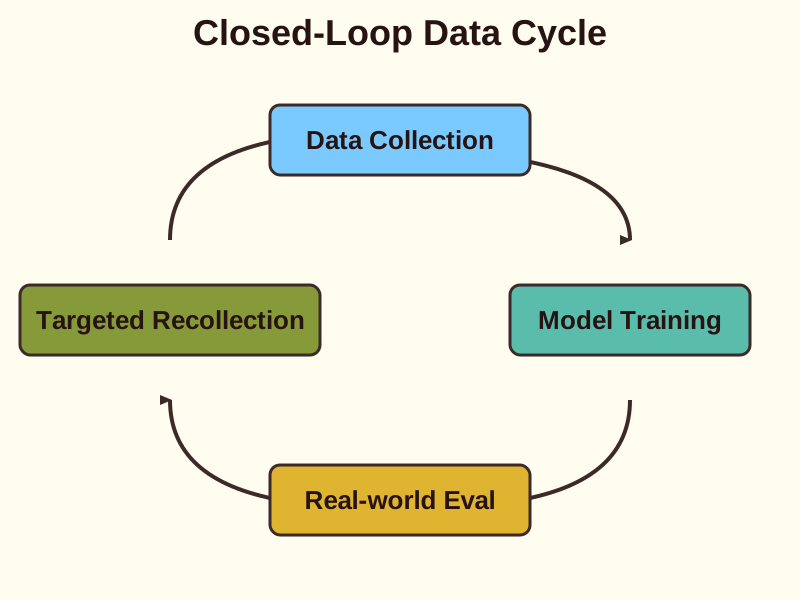
Data work is changing. In the past, we focused on isolated labels for static images.
Now, value lies in the closed loop. This means we collect data, train models, and evaluate them in the real world.
We then use those results to recollect better data. This cycle hardens the system for a safe public release.
The Multi-Model Stack
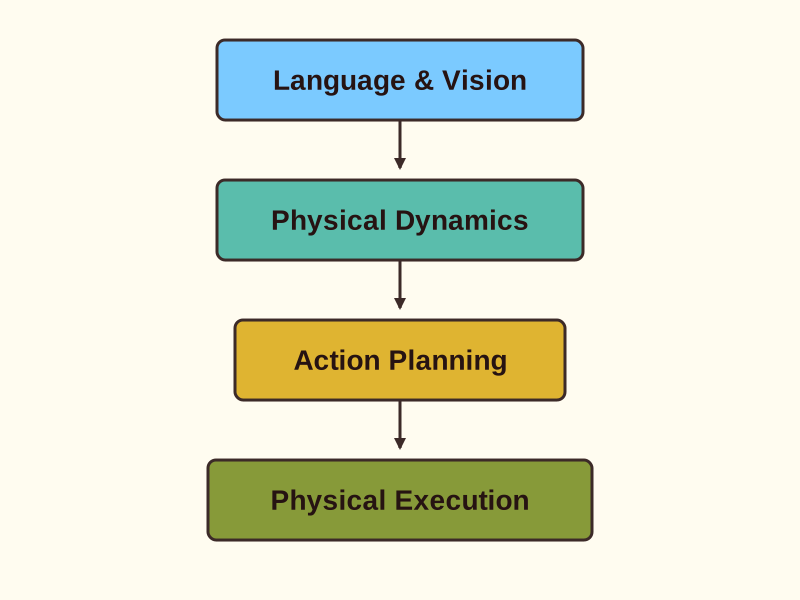
Physical AI is not just a single model. It is a complex stack of different technologies working together.
We map language and vision directly to physical actions. This requires models that understand physical dynamics.
By learning how objects move and react, the AI can plan its next steps. It uses these representations to predict the future of a physical scene.
Mapping Perception to Action
The goal is to bridge the gap between digital reasoning and physical movement.
AI practitioners must now handle multimodal data. This includes sensors, trajectories, and environmental feedback.
Success depends on how well the model translates a text command into a safe, precise physical motion. This is the foundation of modern robotics data work.
Putting It All Together
- Perceive: Process multimodal sensor data to understand the environment.
- Reason: Use world models to predict physical dynamics and plan actions.
- Act: Translate digital reasoning into safe, precise physical movement.
- Refine: Evaluate in a closed loop to improve the agent's generalist capabilities.
Check yourself
Generalist physical agents rely on _____ to complete tasks across different embodiments.
- reasoning and perception
- narrow scripts
Answer: reasoning and perception
Unlike narrow robots that use fixed scripts, generalist agents use reasoning and perception to adapt to various tasks and bodies.
Physical AI maps _____ and perception to _____ while learning physical dynamics.
Answer: Physical AI maps language and perception to actions while learning physical dynamics.
Physical AI isn't just about vision; it involves translating instructions (language) and sensory input (perception) into physical movement (actions).
Why are 'predictive representations of physical dynamics' necessary for Physical AI?
- To allow the agent to plan and evaluate actions
- To replace the need for multi-model stacks
- To eliminate the need for data collection
Answer: To allow the agent to plan and evaluate actions
To plan and evaluate movements, an agent must be able to predict how the physical world will react to its actions.
Keep going
This is lesson 1 of 51 in Miraxis Physical AI Data Onboarding. Next up:
- LLM Differences
- Agentic Comparison
- Embodied Reasoning
- Foundations
- Episode Anatomy
Wondering turns any topic into short lessons you can read, watch, or listen to, with practice questions and an AI tutor.