Free sample lesson · Mastering Local AI and Customization
Open Weights
Why are top teams moving critical AI workloads away from proprietary APIs?
Lesson 1 of the Wondering course Mastering Local AI and Customization
From Service to Infrastructure
Top teams are moving critical workloads off proprietary APIs. The reason is control.
Open weights turn your intelligence layer into something you own and run, the same way you own your database.
This is the shift from AI as a Service to AI as Infrastructure.
Models like Llama, Mistral, or Phi make that shift practical today.
- AI as a Service
- AI as Infrastructure
What Model Sovereignty Means
Model sovereignty is the ability to run intelligence on your own terms.
Local weights let you bypass API rate limits, keep user data private, and hold a version steady until you choose to change it.
Each of these is a product risk you no longer outsource.
- Rate limits: Local weights let you bypass API rate limits.
- Data privacy: User data stays inside your own environment.
- Version consistency: A version holds steady until you choose to change it.
- Local weights: Weights you run yourself rather than call remotely.
Containing the Intelligence Layer
You already containerize services. The intelligence layer is no different.
With Docker, teams package the model and its runtime together, so sensitive user data never leaves the local environment.
The boundary is now something you can point to on a diagram.
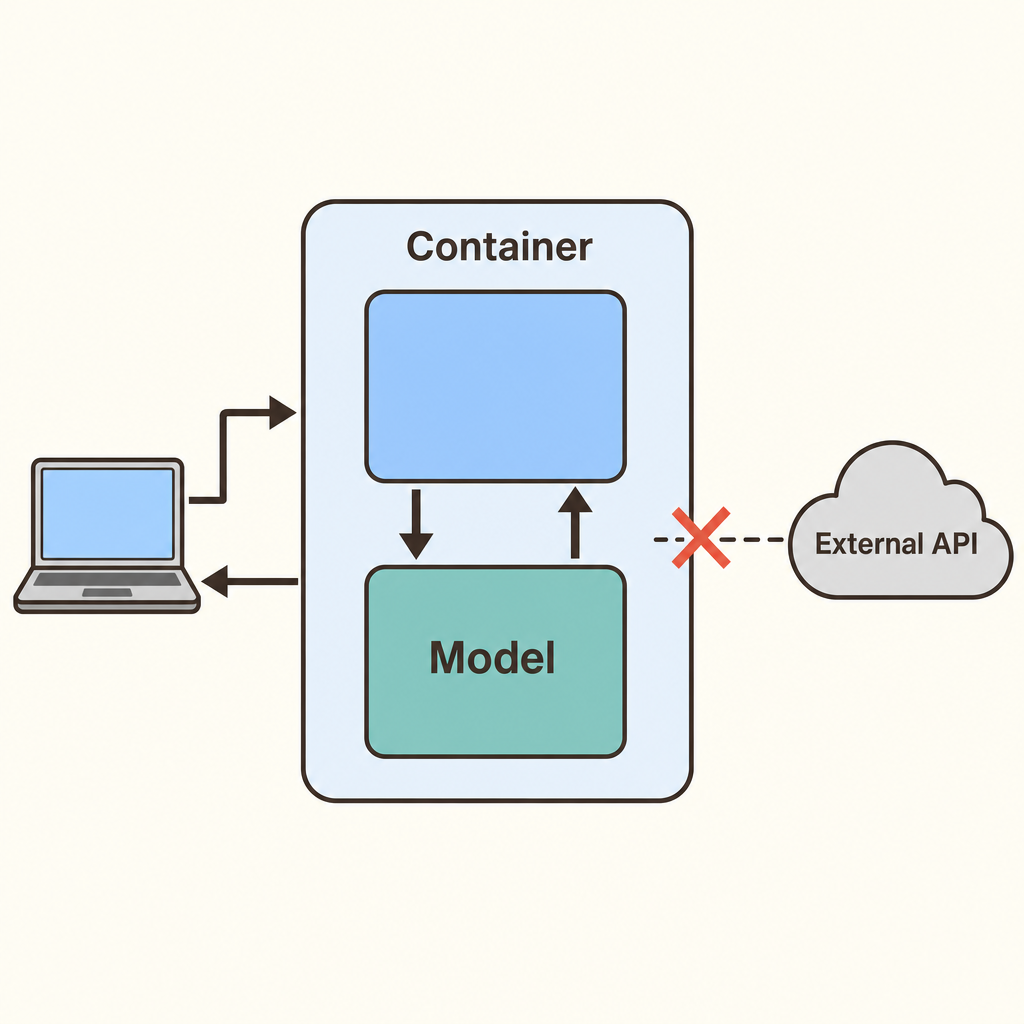
Notice that the request loop closes inside the container boundary, so no user data crosses to an outside API.
Why Data Leakage Is a Non-Starter
Some workloads simply cannot tolerate data leaving the building.
Personal AI research and proprietary application development are the clearest cases. In both, leaked data destroys the value of the work itself.
Open weights remove the question entirely.
No outbound call means no leakage path.
Transparency You Can Audit
Closed APIs give you outputs. Open weights give you the model.
That transparency is what makes it possible to audit model behavior rather than infer it from responses.
It also gives you deployment flexibility: on-premises or in a private cloud, on your schedule.
- Closed APIs
- Open weights
Customization Sits On Top
Ownership is the foundation. Customization is what it unlocks.
Once weights are local, fine-tuning and quantization become available to you. Together they support high-performance apps that stay cost-effective at scale.
None of this is reachable through a closed API.
- Cost-effective scale: High-performance LLM-powered apps that stay affordable as usage grows.
- Fine-tuning and quantization: Deeper customization of behavior and performance.
- Local open weights: The foundation that makes the layers above reachable.
Each level rests on the one below
The Command Line Is the Control Panel
Managing local models is a command line discipline.
As you master those tools, you gain the ability to swap, upgrade, and optimize your AI stack.
The workflow is not one-and-done. You evaluate, then move again.
- Swap: Move to a different open-weights model when it fits better.
- Upgrade: Move to a newer version on your own schedule.
- Optimize: Apply quantization and tuning for performance and cost.
- Evaluate: Check behavior directly, then decide the next move.
Escaping Provider Lock-In
Lock-in is rarely a single decision. It accumulates.
A closed provider controls the roadmap and the pricing structure, and your product inherits both.
Open weights break that dependency. You choose when a model changes, and what it costs to run.
Putting It Into Practice
Start where the risk is highest: a workload where data leakage is a non-starter.
Containerize the model with Docker, verify behavior through direct auditing, then tune for cost.
What you gain is ownership over privacy, cost, and reliability.
- Pick workload: Choose a case where data leakage is a non-starter.
- Containerize: Package the model with Docker so data stays local.
- Audit behavior: Use the transparency of open weights to check the model directly.
- Tune for cost: Apply fine-tuning and quantization to stay cost-effective at scale.
Open weights are the foundation everything else in local AI is built on.
Check yourself
Model sovereignty means a product team can run its intelligence layer on infrastructure it controls.
- True
- False
Answer: True
This is correct. Model sovereignty means running intelligence on your own terms, including control over privacy, model versions, and operating conditions. It does not merely mean choosing a different hosted API.
Local weights enable _____ for task-specific behavior, while _____ reduces model resource requirements for cost-effective deployment.
Answer: Local weights enable fine-tuning for task-specific behavior, while quantization reduces model resource requirements for cost-effective deployment.
Fine-tuning adapts a local model to a particular task or application. Quantization reduces the numerical precision used by model weights, which can lower memory and serving costs. Both require access to the model weights rather than only a closed API.
A product leader is deploying a personal AI research application whose data cannot leave the organization. Which choice best applies model sovereignty?
- Run open weights in a controlled local or private-cloud environment
- Use a hosted API with a longer data-retention agreement
- Use a hosted API and rotate prompts more frequently
- Keep the provider's default model version and add more application logging
Answer: Run open weights in a controlled local or private-cloud environment
Running open weights locally or in a private cloud removes the outbound API call that could expose sensitive data. It also gives the team control over the deployed model version. A hosted closed API would preserve an external data-transfer path.
Keep going
This is lesson 1 of 12 in Mastering Local AI and Customization. Next up:
- Local Setup
- Cost Modeling
- Context Efficiency
- App Architecture
- Tool Integration
Wondering turns any topic into short lessons you can read, watch, or listen to, with practice questions and an AI tutor.