Free sample lesson · Mastering Biological Classification Fundamentals
Taxonomic Hierarchy
How can 1.8 million known species fit into just seven ranks?
Lesson 1 of the Wondering course Mastering Biological Classification Fundamentals
Can seven ranks hold 1.8 million species?
Biologists have named about 1.8 million species. Yet every one of them is classified using just seven ranks.
Imagine a student placing a human beside a lion. One walks upright on two legs. The other is a big cat that hunts on four.
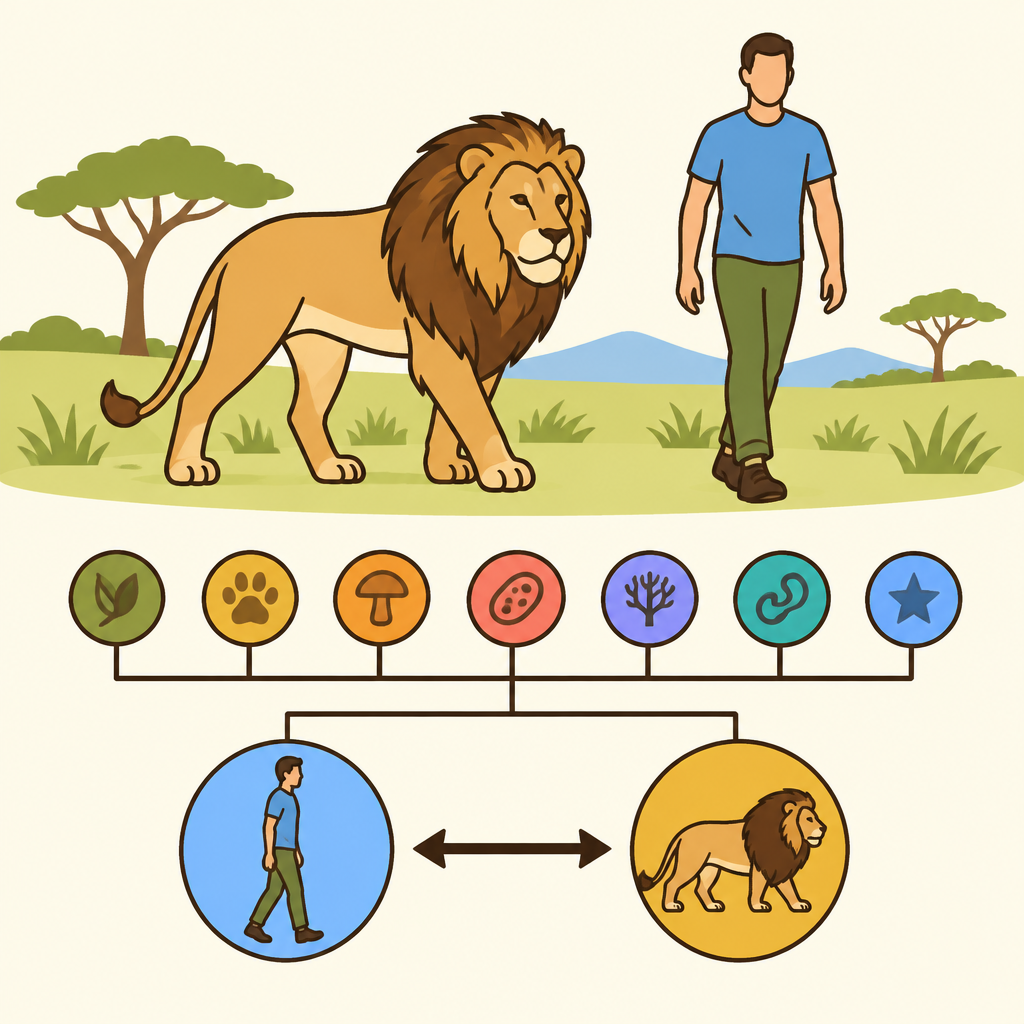
The lion, Panthera leo: one of the two organisms we will compare
They look very different. Yet their classification can tell you exactly how closely related they are.
To see how, start with the question biologists ask first: which features count when grouping organisms?
Important shared features build the big groups
Biologists look for important features shared by a large variety of organisms.
A feature counts only if it has a similar origin, structure and position across those organisms. Organisms sharing such features go into one group.
Divisions within that group then rest on progressively less important features.
So sorting runs from broad to fine. What levels does this broad-to-fine sorting produce?
Seven ranks run from kingdom to species
The largest group is the kingdom. Each kingdom splits into smaller groups, which split again, and so on.
From highest to lowest: kingdom, phylum (called division in plants), class, order, family, genus, species.
- Main ranks: Listed from kingdom (highest) to species (lowest).
- Broad ranks
- Kingdom: The largest group.
- Phylum or division: Division is used in plants.
- Class
- Fine ranks
- Order
- Family
- Genus
- Species: The lowest rank.
- Extra levels
- Subphylum: Marked by the prefix sub-.
- Superclass: Marked by the prefix super-.
Each rank sits inside the one above it.
Each rank sits inside the one above it.
Biologists sometimes add intermediate levels marked by sub- or super-, such as subphylum and superclass.
But if every split narrows the group, what changes as you move down?
Variety shrinks at every step down
The kingdom holds the greatest variety. Its members share certain important features but show many differences.
Organisms in a genus, by contrast, are very similar.
The species is the smallest unit. Its members are identical in general appearance and can mate to produce fertile offspring.
- Kingdom: Greatest variety: important features shared, many differences.
- Genus: Organisms are very similar.
- Species: Identical in general appearance; can produce fertile offspring.
Phylum, class, order and family sit between these layers.
So the lower the shared rank, the more alike and closely related the organisms are.
Yet many learners still picture the ranks in a very different way.
Ranks are not separate filing labels
Many newcomers treat the seven ranks like filing categories, each an unrelated label.
It seems reasonable. Names like Chordata or Felidae sound arbitrary, so it feels as if a species could slot into any order or family.
But the ranks are nested. A genus belongs to one family, that family to one order, and so on upward.
- Filing labels
- Nested ranks
Each group contains only smaller groups, so a species has exactly one place at every rank.
How does that play out with the human and the lion?
Human and lion split at order
Suppose the student lines up both classifications. Human: Animalia, Chordata, Mammalia, Primates, Hominidae, Homo, sapiens.
Lion: Animalia, Chordata, Mammalia, Carnivora, Felidae, Panthera, leo.
Kingdom, phylum and class match. At order they split: Primates versus Carnivora. Every rank below differs too.
- Animalia: Kingdom: shared
- Chordata: Phylum: shared
- Mammalia: Class: lowest shared rank
The lowest rank they share is class Mammalia.
So what does that shared rank actually tell us?
The last shared rank measures kinship
Back to the opening question. Seven ranks can hold 1.8 million species because each rank nests inside the one above, splitting groups ever finer.
Organisms within a group share a common ancestral history. So the lower the last rank two organisms share, the more ancestry they share.
Human and lion meet only at class Mammalia: related as mammals, but not closely, so they cannot interbreed.
- List both: Write out each organism's seven ranks.
- Start at kingdom: Compare the names rank by rank from the top down.
- Find the split: Note the first rank where the names differ.
- Read the rank above: The last shared rank shows how closely related they are.
Check yourself
Compared with the organisms in one order, the organisms in one genus are _____
- more similar to one another
- more varied and less alike
Answer: more similar to one another
The variety of organisms shrinks as you move down the ranks. Genus is below order, so the organisms in a genus are more alike. An order contains several families and genera, so it holds more variety.
In plants, the rank just below kingdom is called a _____ instead of a phylum. The smallest unit of classification is the _____, whose members can mate and produce _____ offspring.
Answer: In plants, the rank just below kingdom is called a division instead of a phylum. The smallest unit of classification is the species, whose members can mate and produce fertile offspring.
Plants use 'division' where animals use 'phylum'. Members of a species can interbreed, and their offspring are fertile. That means the offspring can reproduce too.
A biologist finds that two beetles belong to the same genus. Which statement must also be true about them?
- They are also in the same family and the same order
- They are in the same family but could be in different orders
- They could be in different families, since each rank is a separate label
- They must be the same species and can interbreed
Answer: They are also in the same family and the same order
The ranks are nested, so every genus sits inside one family, that family inside one order, and so on. Two organisms in the same genus must therefore share every rank above it. Ranks are not separate labels that can be mixed and matched.
Keep going
This is lesson 1 of 14 in Mastering Biological Classification Fundamentals. Next up:
- Binomial Nomenclature
- Five Kingdoms
- Viruses
- Monera
- Protista
Wondering turns any topic into short lessons you can read, watch, or listen to, with practice questions and an AI tutor.