Free sample lesson · Mark Zuckerberg: Lessons from Building Meta
Why Control Lets Him Ignore Critics
Meta's apps reached 3.60 billion people a day in June 2026, yet when investors demanded cuts to his Reality Labs spending, Zuckerberg simply said no, and they could not make him. Why can one man shrug off the people who own most of his company's shares?
Lesson 1 of the Wondering course Mark Zuckerberg: Lessons from Building Meta
The Freedom to Say No
Meta’s apps reached 3.60 billion people daily in June 2026.[[3]](https://pulse2.com/meta-reports-second-quarter-2026-revenue-of-60-8-billion-up-28-percent-year-over-year/)
Yet Zuckerberg rejected investor demands to cut Reality Labs spending. Meta later reached a record valuation.[[1]](https://colossus.com/article/mark-zuckerberg-profile/)
That standoff reveals structural independence: continuing without winning outside approval.
Profits reduced his need for funding. Control weakened shareholder and board pressure, keeping an unpopular bet alive.
- Structural independence: Continuing without winning outside approval.
- Early profits: Reduced his need for funding.
- Voting control: Weakened shareholder and board pressure.
Ten Votes Beat One
Why can investors complain but not replace him?
Facebook issued Class A shares with one vote and Class B shares with ten votes.[[2]](https://www.sec.gov/Archives/edgar/data/1326801/000119312512034517/d287954ds1.htm)
The 2012 filing warned that Zuckerberg could control director elections. Jeremy Stern, author of the Colossus profile of Zuckerberg, says removing him is effectively impossible.[[2]](https://www.sec.gov/Archives/edgar/data/1326801/000119312512034517/d287954ds1.htm)[[1]](https://colossus.com/article/mark-zuckerberg-profile/)
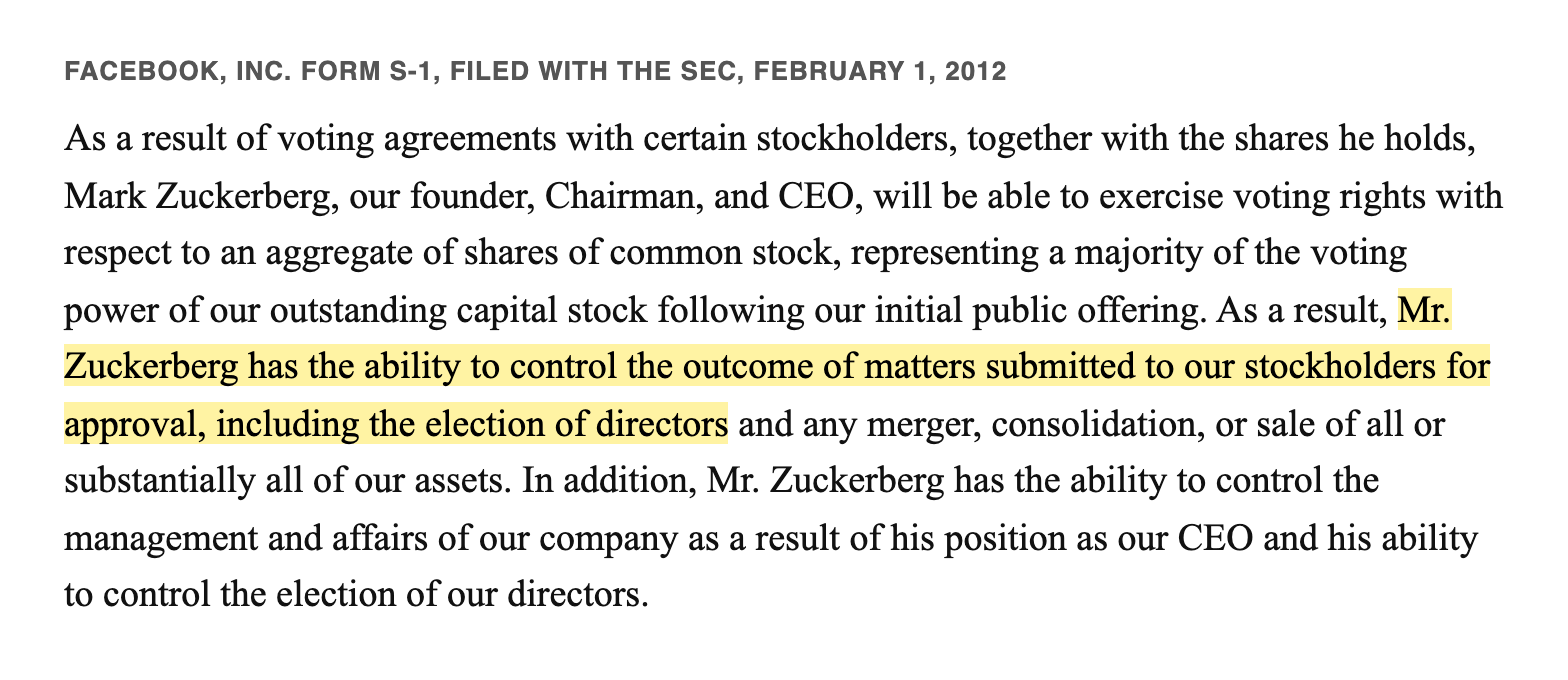
Facebook's own IPO filing told investors in 2012 that Zuckerberg could control the election of its directors. · Facebook, Inc., Form S-1 Registration Statement (SEC EDGAR, February 1, 2012)
- What majority voting control actually covers
Facebook also elected the controlled company exemption. Because he controls a majority of the votes, the company was not required to have a majority of independent directors, a compensation committee, or an independent nominating function. Instead, the full board, whose members he can elect, nominates new directors. Shareholders can criticize him, but they cannot turn disagreement into his removal.[[2]](https://www.sec.gov/Archives/edgar/data/1326801/000119312512034517/d287954ds1.htm)
Profit Removes Another Dependency
What if a founder controls votes but constantly needs fresh cash? Approval still matters because that founder must persuade new funders.
Zuckerberg says he does not need to raise money or convince many other people along the way.[[1]](https://colossus.com/article/mark-zuckerberg-profile/)
He contrasts himself with Sam Altman and Elon Musk, whose capital-hungry companies needed public selling.[[1]](https://colossus.com/article/mark-zuckerberg-profile/)
- Zuckerberg
- Altman and Musk
A Builder Before Facebook
In 1996, Zuckerberg’s father planned colored office lights. Zuckerberg instead built ZuckNet in Atari BASIC, linking the dental office’s computers within two days.[[1]](https://colossus.com/article/mark-zuckerberg-profile/)
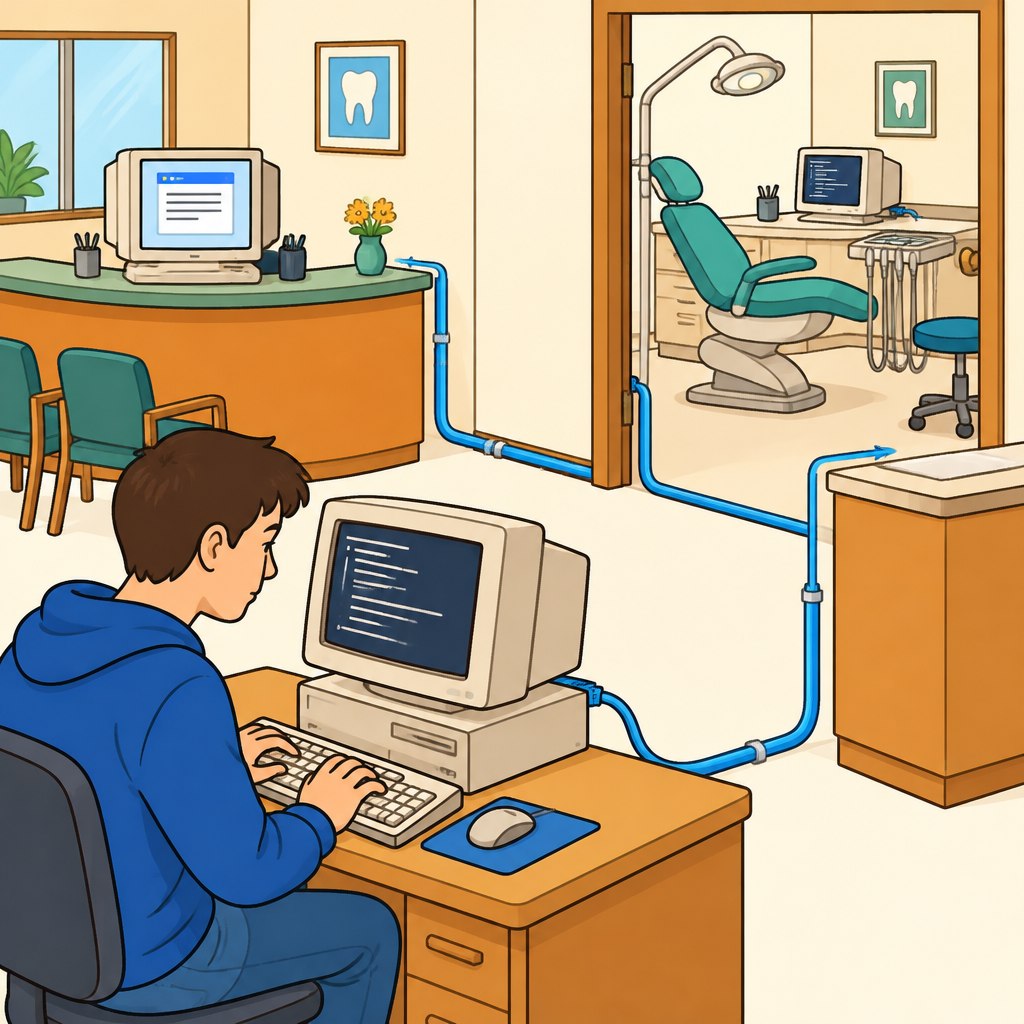
Notice that the project was a working link between real office computers, not decoration, which is the kind of repeated building that signals builder identity.
The family used it one year before AOL Instant Messenger.[[1]](https://colossus.com/article/mark-zuckerberg-profile/)
Decades later, he told Priscilla Chan, “I did not set out to build a company. I just love building things.”[[1]](https://colossus.com/article/mark-zuckerberg-profile/)
A working tool and repeated building reveal builder identity, rather than money or status motives.
What Freedom Gets Used For
Why does Facebook make money? Its 2012 IPO letter reverses the usual answer: it aims to “make money to build better services.”[[2]](https://www.sec.gov/Archives/edgar/data/1326801/000119312512034517/d287954ds1.htm)
Builder identity directs his freedom toward long, methodical improvement.[[1]](https://colossus.com/article/mark-zuckerberg-profile/)
The rejection-and-revenge plot in The Social Network suggests another motive. Stern instead traces Facebook to serial website building.[[1]](https://colossus.com/article/mark-zuckerberg-profile/)
- The Social Network
- Stern's account
When assessing founders, favor repeated actions over a dramatic origin story.
Diagnose Power Before Personality
Could a founder shrug off critics? First inspect funding: early profits create independence, while repeated fundraising creates dependence.
Then inspect votes. A founder with voting control can resist shareholder pressure; one without it has stronger reasons to maintain support.
Finally inspect motive. Repeated creation signals a builder; revenge, money, or status require different evidence.
- Assess a founder
- Early profits?: Early profits create independence; repeated fundraising creates dependence.
- Voting control?
- Can resist pressure: Can shrug off shareholder pressure.
- Must maintain support: Has stronger reasons to keep backers onside.
- Repeated creation?
- Builder signal
- Seek other evidence: Revenge, money, or status require different evidence.
- then
- then
Early “robotic” criticism still made Zuckerberg insecure.[[1]](https://colossus.com/article/mark-zuckerberg-profile/) Structure explains why he can ignore critics. Builder identity explains what he chooses to do instead.
Check yourself
Does voting control help a founder resist shareholder pressure?
- Yes
- No
Answer: Yes
Yes. When a founder holds enough voting power, shareholders may criticize decisions but cannot easily replace the founder or directors.
Early profits reduce dependence on _____, while voting control weakens shareholder and board _____.
Answer: Early profits reduce dependence on funding, while voting control weakens shareholder and board pressure.
Both supports contribute to structural independence. Profits reduce the need to raise money, while voting control makes it harder for critics to turn disagreement into removal.
A founder’s company earns early profits, and the founder holds enough votes to control director elections. What is the best prediction?
- The founder can resist pressure more easily.
- The founder must accept every investor demand.
- The founder’s public image becomes automatically positive.
- The company can no longer make unpopular decisions.
Answer: The founder can resist pressure more easily.
This founder is more able to ignore public or investor criticism. Profits reduce dependence on new funders, and voting control limits shareholder and board pressure. Either support alone may be incomplete, but together they create structural independence.
Keep going
This is lesson 1 of 6 in Mark Zuckerberg: Lessons from Building Meta. Next up:
- The Dictator's Dilemma
- The Apple Problem
- Pronounced Dead Four Times
- Why Glasses Instead of Phones
- The AI Wager
Wondering turns any topic into short lessons you can read, watch, or listen to, with practice questions and an AI tutor.