Free sample lesson · Lean Analytics: Use Data to Build a Better Startup Faster
One Metric
What if focusing on just ONE number could transform your startup's success?
Lesson 1 of the Wondering course Lean Analytics: Use Data to Build a Better Startup Faster
Lesson Overview: The One Metric That Matters
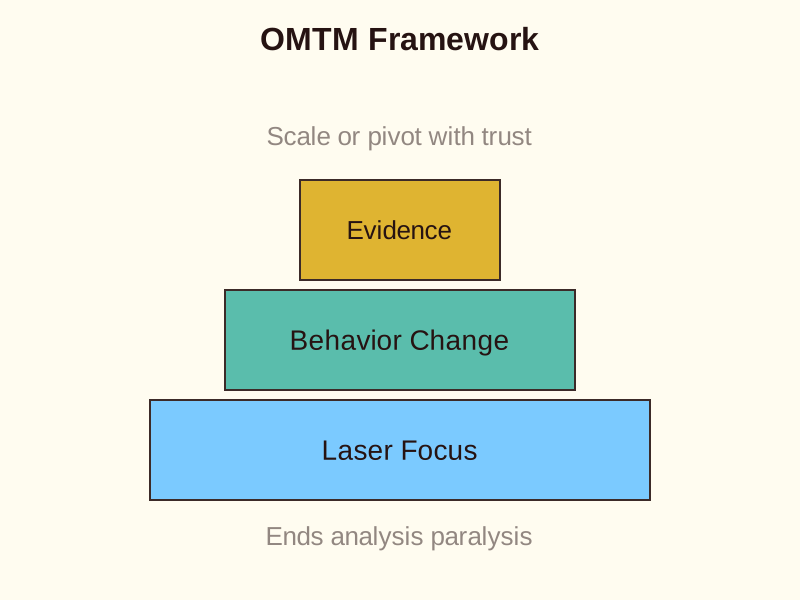
Discover how the One Metric That Matters (OMTM) eliminates analysis paralysis, guides real behavior change, and protects startups from false progress.
The Power of One Number
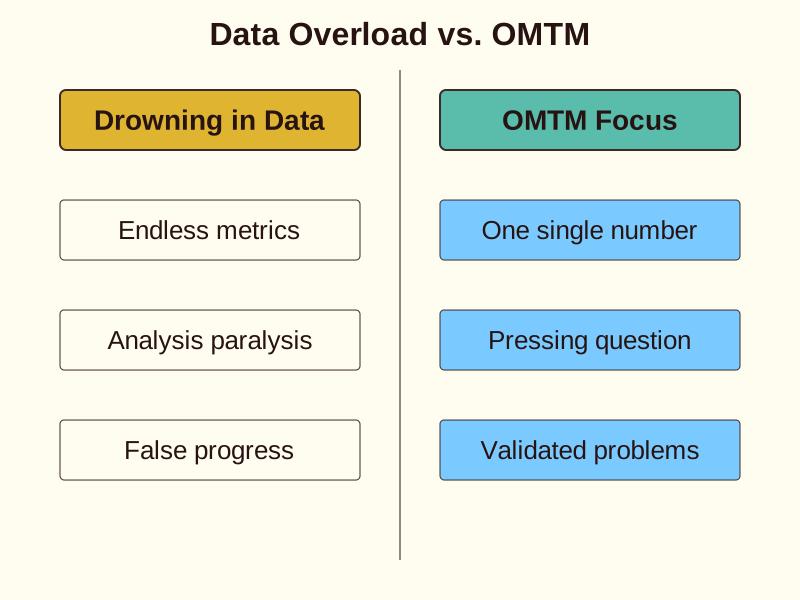
Startups often drown in data. The One Metric That Matters (OMTM) is the single number you focus on above everything else right now.
It answers your most pressing business question. By zeroing in on one goal, you gain clarity to validate problems and identify the right customers.
Focusing on one metric prevents analysis paralysis. It protects you from the danger of lying to yourself about progress.
Driving Real Behavior Change
A true OMTM must drive behavior change. If measuring the number does not change how you act, it is the wrong metric.
- The framework has a 2024 edition
Your OMTM will evolve as your business grows. You should choose it based on your business model, growth stage, and target audience.
- Assess Stage: Determine your startup's current growth stage and pressing business question.
- Match Model: Select a metric that fits your specific business model and target audience.
- Drive Action: Ensure measuring the metric directly alters team behavior and daily decisions.
Avoiding the Vanity Trap
A common misconception is that an OMTM is just a high-level number that does not impact team focus.
Imagine a team tracking "Total Registered Users." This answers a business question and provides a measurable goal.
However, if the team continues the same marketing plan regardless of whether this number goes up or down, it fails as an OMTM. It must force a decision to iterate or scale.
- Vanity Metric
- True OMTM
Using Evidence to Lead
The OMTM provides the trustworthy evidence needed to navigate product development and monetization.
It aligns the entire team toward one measurable outcome. This focus ensures every resource helps solve the current most critical risk.
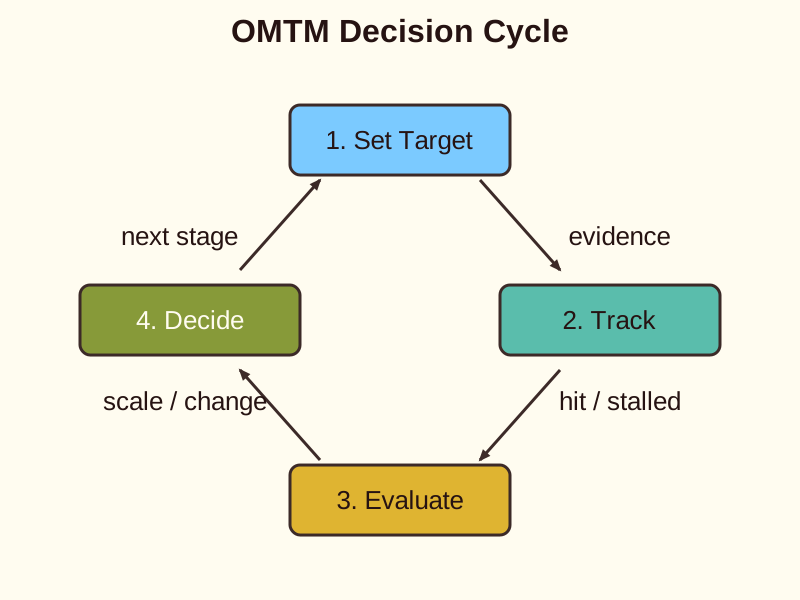
When the metric hits its target, you move to the next stage. If it stalls, you know exactly where to change direction.
Putting It All Together
- Identify Risk: Pinpoint the most critical current business risk.
- Select OMTM: Choose a single metric that directly measures that risk and drives behavior.
- Act on Evidence: Use metric thresholds to decide whether to scale or pivot.
Check yourself
A true One Metric That Matters (OMTM) must _____ to be considered effective.
- directly drive behavior change in the team
- remain unchanged across all growth stages
Answer: directly drive behavior change in the team
If measuring a metric does not alter how your team acts or makes daily decisions, it fails as an OMTM.
To use an OMTM effectively, first _____ to identify the core risk, then _____ to select an actionable metric, and finally _____ to alter team decisions.
Answer: To use an OMTM effectively, first Assess Stage to identify the core risk, then Match Model to select an actionable metric, and finally Drive Action to alter team decisions.
The OMTM framework follows a sequence: evaluating the startup stage, selecting a metric fitting the business model, and ensuring that metric changes day-to-day decisions.
A team tracks 'Total Registered Users.' The metric increases steadily every week, but the marketing team follows the exact same campaign strategy regardless of the number. Why does this metric fail as an OMTM?
- It does not force a change in team behavior or decisions.
- It cannot be measured with precise numerical data.
- It focuses on user growth rather than financial revenue.
- It changes over time instead of remaining permanently fixed.
Answer: It does not force a change in team behavior or decisions.
Even if a metric answers a high-level question, it fails as an OMTM if it does not force decisions to iterate, scale, or change behavior.
Keep going
This is lesson 1 of 51 in Lean Analytics: Use Data to Build a Better Startup Faster. Next up:
- Evolving OMTM
- Vanity Metrics
- Actionable Metrics
- Qualitative & Quantitative
- Systematize Qualitative
Wondering turns any topic into short lessons you can read, watch, or listen to, with practice questions and an AI tutor.