Free sample lesson · Kimi K3: Open Frontier Intelligence
Two Scaling Axes
Why does K3 scale parameters and thinking together?
Lesson 1 of the Wondering course Kimi K3: Open Frontier Intelligence
Overview: Two Scaling Axes in Kimi K3
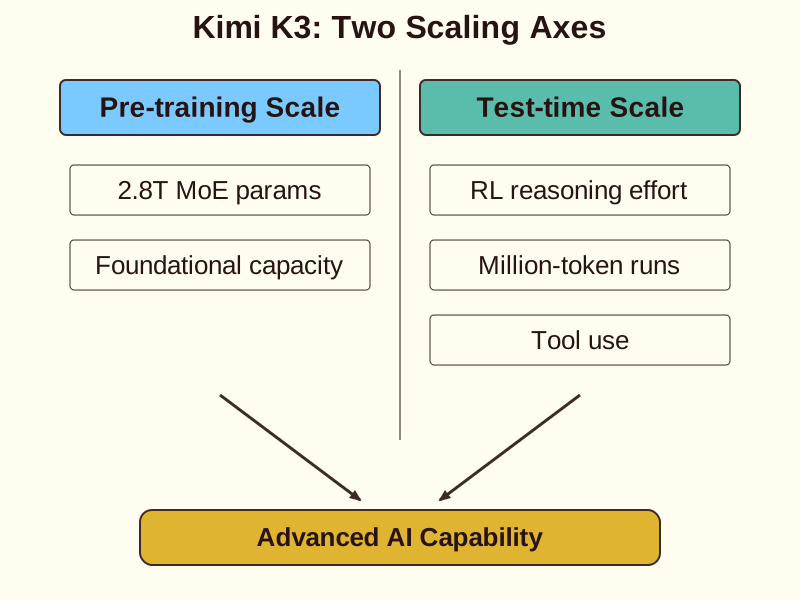
Discover how Moonshot AI combines pre-training scale and test-time agentic reasoning to push foundation model capabilities.
The Two Axes of K3
Moonshot AI positions Kimi K3 as a dual-scaling model. It does not only rely on a larger checkpoint.
K3 combines pre-training scale with test-time scale. This approach addresses foundation capabilities and agentic reasoning simultaneously.
- Pre-training Scale
- Test-time Scale
- Two knobs, not one
Axis One: Pre-training Scale
Pre-training scale involves model capacity, data quality, and training compute. These choices happen before the model is deployed.
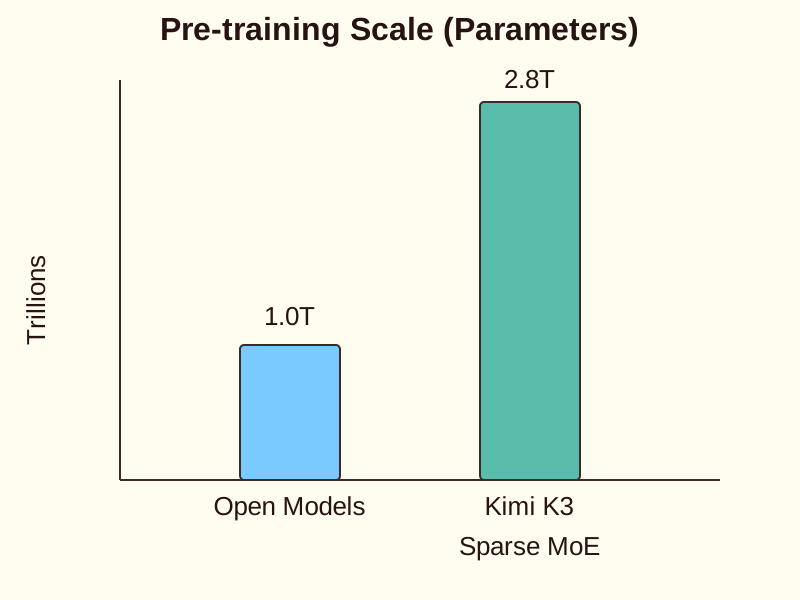
K3 moves into the 3T-class regime. It uses a 2.8T-parameter sparse Mixture-of-Experts (MoE) architecture.
Many open models remain near the 1T-class regime. The report treats this larger sparse capacity as evidence for the pre-training axis; the number alone does not prove task quality.
Axis Two: Test-time Scale
Test-time scale focuses on reasoning effort during deployment. This includes Reinforcement Learning (RL) and long-horizon interaction.
K3 trains across multiple reasoning-effort levels. It uses agentic trajectories that can reach one million tokens.
This axis includes tool use and verification attempts. It is not just about writing longer chains of thought.
- Reasoning Effort: Trains across multiple levels of reasoning to handle complex problems.
- Long-horizon: Executes agentic trajectories reaching up to one million tokens.
- Tools & Verification: Integrates external tool use and verification attempts beyond mere thought chains.
How the Axes Reinforce Each Other
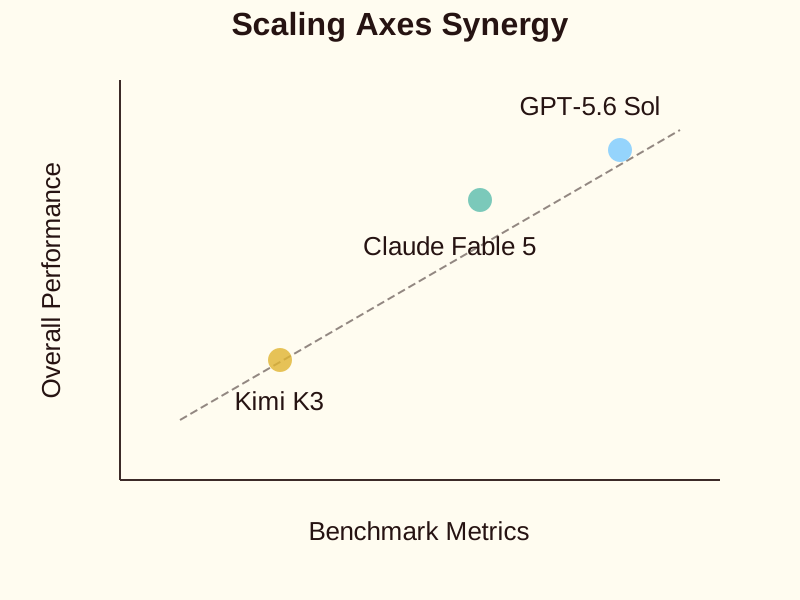
The report argues these axes work together. The report argues that foundation capacity and long-horizon planning can reinforce each other.
However, more compute does not guarantee success. K3 still trails models like Claude Fable 5 and GPT-5.6 Sol in overall benchmarks.
Infrastructure like kernels and sandboxes support both axes. The goal is a model that plans, calls tools, and checks its own work.
Putting It All Together
- Foundation Base: Use the 2.8T parameter MoE foundation as the pre-trained starting point.
- Test-Time Planning: Use a policy trained with RL and allocate extended reasoning effort during inference.
- Verification: Use tool calls and self-checks to test intermediate results.
Check yourself
In the Kimi K3 architecture, test-time scale primarily focuses on reasoning effort and interaction that occurs _____.
- during deployment
- before deployment
Answer: during deployment
Test-time scaling takes place during deployment when processing queries, using reinforcement learning, tools, and extended reasoning effort. Compute choices like increasing parameter size or dataset volume happen before deployment during pre-training.
In Kimi K3's dual-scaling framework, _____ describes foundation capacity through a 2.8T-parameter sparse MoE architecture, whereas _____ describes deployed reasoning effort through agentic trajectories reaching up to one million tokens.
Answer: In Kimi K3's dual-scaling framework, pre-training scale describes foundation capacity through a 2.8T-parameter sparse MoE architecture, whereas test-time scale describes deployed reasoning effort through agentic trajectories reaching up to one million tokens.
Pre-training scale covers model capacity, data, architecture, and optimization before deployment. Test-time scale covers reasoning effort, long-horizon interaction, tools, and verification attempts during deployment.
Which statement best reflects the report's claim about how the two scaling axes interact?
- Foundation capacity and test-time reasoning are designed to reinforce each other, without guaranteeing success on every task.
- A higher parameter count eliminates the need to run external code verification sandboxes.
- Test-time scaling directly increases the permanent parameter count of the pre-trained checkpoint.
- Pre-training scale completely replaces the need for test-time reinforcement learning and tool calls.
Answer: Foundation capacity and test-time reasoning are designed to reinforce each other, without guaranteeing success on every task.
The report presents foundation-model scale and test-time reasoning as complementary axes. It does not isolate a causal requirement or claim that either axis guarantees success.
Keep going
This is lesson 1 of 16 in Kimi K3: Open Frontier Intelligence. Next up:
- Reading K3 Numbers
- Hybrid KDA and MLA
- Bounded Delta Attention
- Attention Residuals
- Stable LatentMoE
Wondering turns any topic into short lessons you can read, watch, or listen to, with practice questions and an AI tutor.