Free sample lesson · Jev System One Essentials
Meet Jev
What if an AI model refused to write a single word and only gave back decisions?
Lesson 1 of the Wondering course Jev System One Essentials
A Model That Gives Decisions
Most AI models you have used answer in words. Ask a question, get paragraphs back.
Jev works differently. It does not write a single word of prose.
Instead, Jev gives back decisions. You hand it a situation, and it returns a choice.
For an engineer, that changes what your integration code should expect to receive.
Decisions Versus Words
A text-generating model produces language: sentences, summaries, drafts.
Jev produces decisions. Its output is the choice itself, with no written explanation wrapped around it.
- Text model
- Jev
When you call Jev, plan to handle a decision. There are no paragraphs to parse.
Mixing up these two kinds of model leads straight to picking the wrong tool.
One Model, One Job
Jev is built on a one-model architecture. A single model handles the work.
You send your request to one place, and one kind of answer comes back.
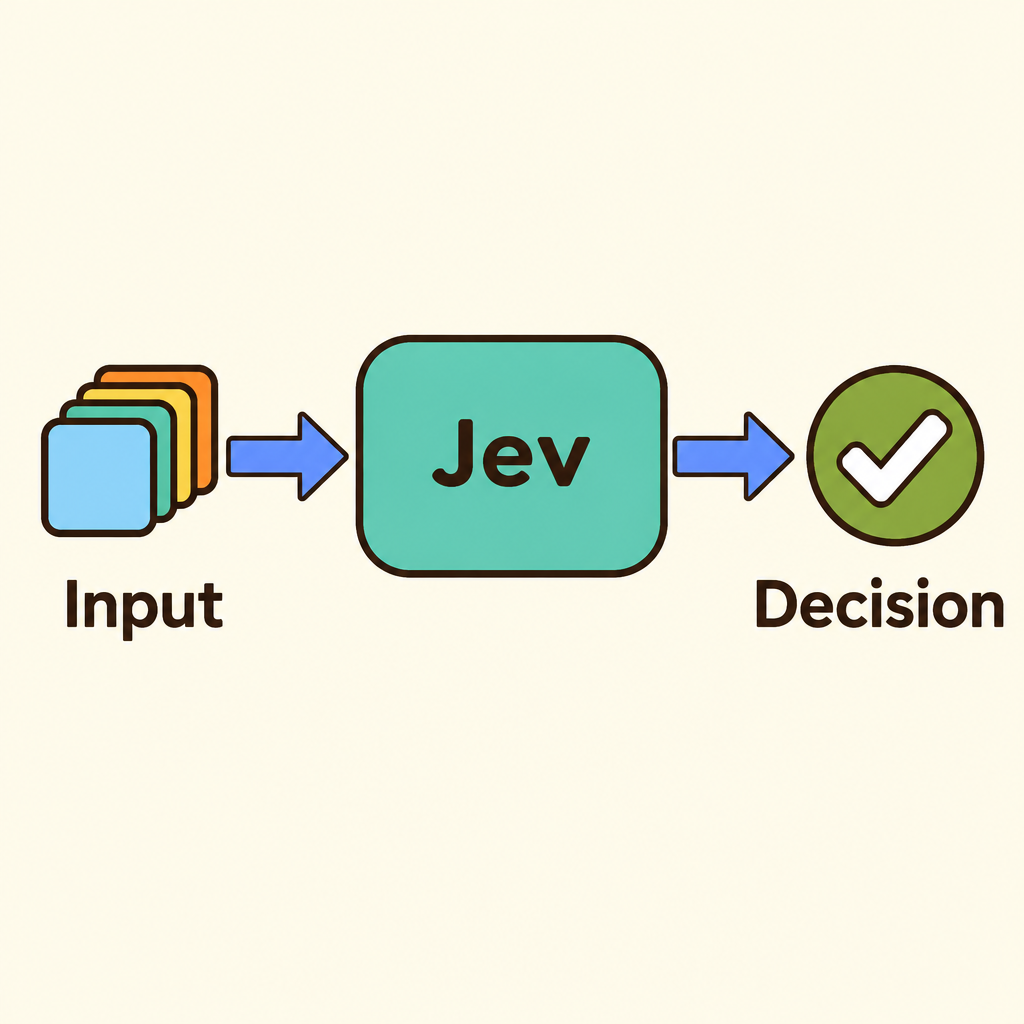
Notice there is only one model in the path, and what leaves it is a single decision rather than a block of text.
That single model has a focused job: turn the input it receives into a decision.
For integration, this keeps your mental model simple. Input goes in, a decision comes out.
What Jev Is Not
Knowing the limits matters as much as knowing the strengths.
Jev is not a writer. Requests for an email draft, a summary, or a chat reply do not fit.
Jev is not a multi-model pipeline either. It is one model returning decisions.
If your feature needs a choice made, Jev is a candidate. If it needs prose, look at a different tool.
Choose Before You Code
The cheapest time to pick a tool is before you write integration code.
Start by asking what your feature must produce. Is it written language, or a decision?
If it is written language, Jev is the wrong fit. If it is a decision, Jev may be the right one.
- Define feature output: Ask what your feature must produce.
- Text or decision?
- Use another tool: Jev does not write language.
- Consider Jev: Jev returns decisions.
Settling this early saves you from building around an output you cannot use.
Key Takeaways
Recognize it: Jev returns decisions, never written words.
Explain it: Tell a colleague, "Jev is one model. You give it a situation, and it gives back a choice."
Use it: Before writing code, check whether your feature needs a decision or prose.
Get that question right, and you will reach for Jev only when it fits.
- Jev is
- One model: A single model handles the work.
- A decision maker: It returns a choice for each situation.
- Jev is not
- A writer: No drafts, summaries, or chat replies.
- A multi-model pipeline: There is no chain of separate models.
Check yourself
You call Jev and get a response back. Your code should expect to receive _____
- a decision, with no prose around it.
- a paragraph that explains a decision.
Answer: a decision, with no prose around it.
Jev returns a decision, the choice itself, with no written explanation around it. There are no paragraphs to parse, unlike a text-generating model.
Jev uses a _____ architecture: you send a situation as input, and it returns a _____. If a feature needs _____, look at a different tool.
Answer: Jev uses a one-model architecture: you send a situation as input, and it returns a decision. If a feature needs prose, look at a different tool.
A single model handles the work and turns input into a decision. Jev is not a writer, so prose needs another tool.
Your team is building four features. Which one is the best fit for Jev?
- Look at an expense report and return approve or flag
- Draft a polite reply to a customer's email
- Summarize last week's bug reports for a manager
- Chat with users in a help widget
Answer: Look at an expense report and return approve or flag
Jev turns a situation into a choice, so approve-or-flag fits. Drafting replies, summarizing, and chatting all need written language, which Jev does not produce.
Keep going
This is lesson 1 of 13 in Jev System One Essentials. Next up:
- System One
- Versus LLMs
- State Input
- Typed Questions
- Output Primitives
Wondering turns any topic into short lessons you can read, watch, or listen to, with practice questions and an AI tutor.