Free sample lesson · Java for Backend and Automation
JVM Architecture
How does Java run on any operating system without changes?
Lesson 1 of the Wondering course Java for Backend and Automation
The Magic of Portability
In JavaScript, your code often runs directly in a browser or Node.js environment. Java works differently to achieve its famous Write Once, Run Anywhere promise.
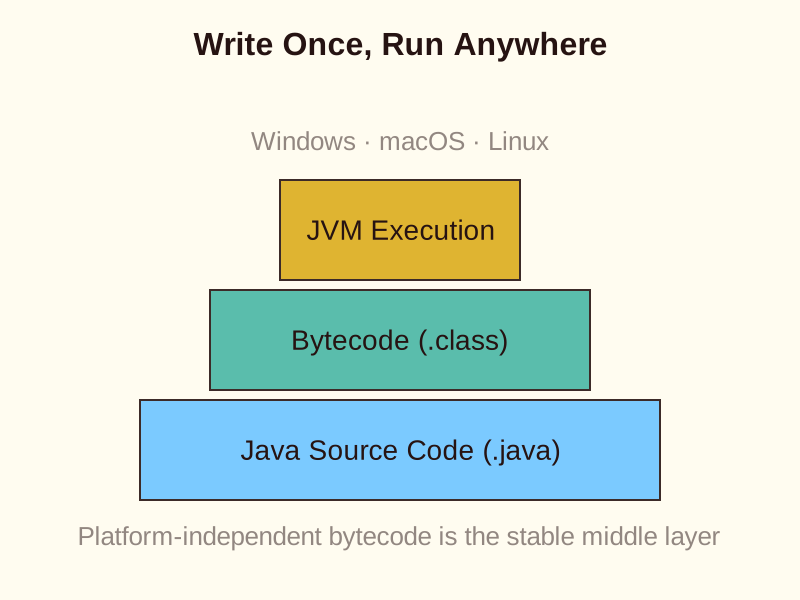
Java does not compile code directly into machine language for your CPU. Instead, it creates an intermediate form called bytecode.
This bytecode is platform-independent. It does not care if you are using Windows, macOS, or a Linux server.
The JVM as a Translator
The Java Virtual Machine (JVM) is the engine that makes Java work. It sits between your compiled bytecode and the physical hardware.
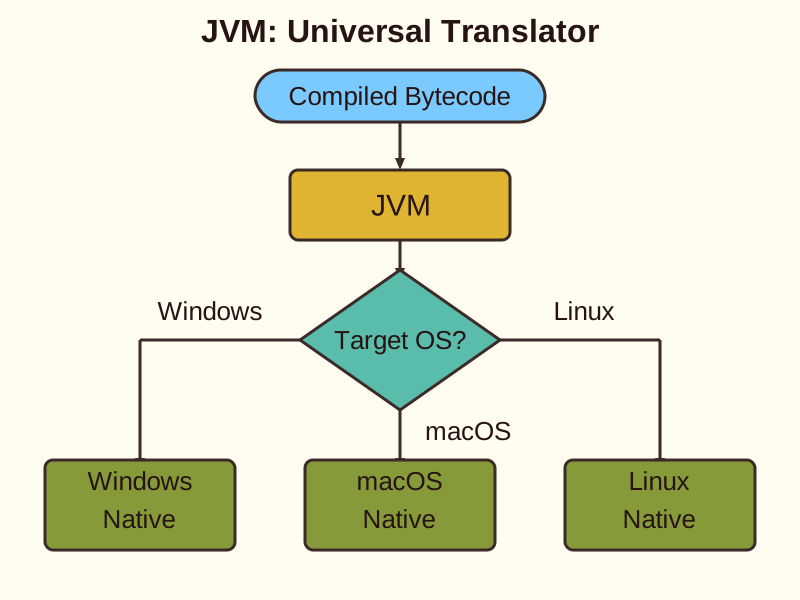
Think of the JVM as a universal translator. It takes the generic bytecode and converts it into native instructions that a specific operating system understands.
This abstraction layer is why you can run the same file on any device without changing a single line of code.
Three Core JVM Components
The JVM architecture relies on three main parts to manage your application.
- Class Loader: Brings your .class files into memory.
- Runtime Data Areas: Organizes that memory into specific sections like stacks and heaps.
- Execution Engine: Carries out instructions by interpreting or compiling bytecode into native code.
First, the Class Loader brings your .class files into memory. Second, the Runtime Data Areas organize that memory into specific sections like stacks and heaps.
Finally, the Execution Engine carries out the instructions. It interprets the bytecode or compiles it into native code for high performance.
Why Backend Developers Care
Understanding the JVM is vital for building robust backend web services. It helps you optimize performance and manage memory effectively.
For automation engineers, this architecture ensures scripts run reliably across diverse environments. Whether you are solving Leetcode problems or scaling a server, the JVM is your foundation.
Mastering this flow allows you to write code that is both portable and highly efficient.
Putting It All Together: Tracing Java Execution
- Write & Compile: Translate human-readable source code into platform-independent bytecode.
- Load into JVM: The Class Loader brings the compiled file into memory for the virtual machine.
- Execute & Translate: The Execution Engine and Runtime Data Areas process instructions into native machine code.
Check yourself
In Java, _____ translates platform-independent bytecode into native machine instructions for the host operating system.
- the JVM
- the CPU
Answer: the JVM
The Java Virtual Machine (JVM) acts as an abstraction layer between generic bytecode and physical hardware, converting bytecode into native instructions for the host OS.
Within the JVM architecture, the _____ brings compiled files into memory, while _____ organize that memory into specific sections like stacks and heaps.
Answer: Within the JVM architecture, the Class Loader brings compiled files into memory, while Runtime Data Areas organize that memory into specific sections like stacks and heaps.
The Class Loader handles loading .class files into memory, whereas the Runtime Data Areas structure and manage memory allocation.
Which JVM component is responsible for carrying out bytecode instructions by interpreting them or compiling them to native code?
- Class Loader
- Runtime Data Areas
- Execution Engine
- Operating System Kernel
Answer: Execution Engine
The Execution Engine executes bytecode instructions, using an interpreter or compiler to generate native code for high performance.
Keep going
This is lesson 1 of 12 in Java for Backend and Automation. Next up:
- Strong Typing
- Memory Management
- Class Structures
- Interface Design
- Inheritance Patterns
Wondering turns any topic into short lessons you can read, watch, or listen to, with practice questions and an AI tutor.