Free sample lesson · Isamu Noguchi: Form and Space
Dual Heritage
How did straddling East and West forge a revolutionary artistic vision?
Lesson 1 of the Wondering course Isamu Noguchi: Form and Space
Born Between Two Worlds
Isamu Noguchi was born in Los Angeles in a family split across an ocean.
His father, Yone Noguchi, was a Japanese poet. His mother, Leonie Gilmour, was an American writer.
- Father
- Mother
That double origin became the defining tension of his life and work.
For a designer, this is the starting point: identity as raw material, not background biography.
A Childhood That Moved
Noguchi spent his childhood in Japan and his adolescence in the United States.
Neither place fully claimed him. He never felt entirely at home in either culture.
- Born in Los Angeles: Born to a Japanese father and an American mother.
- Years in Japan: Early exposure to Japanese carpentry and gardens.
- Years in the United States: He never felt entirely at home in either culture.
That displacement could have stayed a wound.
Instead he turned it into a working method, treating the gap between cultures as space he was free to design in.
Refusing a Single Identity
Noguchi refused to be confined by one national identity.
That refusal was productive. It let him build an aesthetic that bridged Eastern spiritualism and Western industrialism.
Notice the pairing: spirit and machine, held together rather than ranked.
A single passport aesthetic would have forced him to choose. He declined the choice.
Two Workshops, One Language
His materials training came from Japanese carpentry and gardens.
His formal training came later, inside the New York and Paris avant-garde scenes.
Carpentry taught joinery, grain, and restraint. The avant-garde taught abstraction and pure form.
- Japanese roots
- Western avant-garde
Combined, they let him see space and material through a global lens.
Seeing the Work Itself
The synthesis is visible in the objects.
Noguchi gardens and sculptural spaces read as abstract modernist form and as traditional Japanese landscape at the same time.
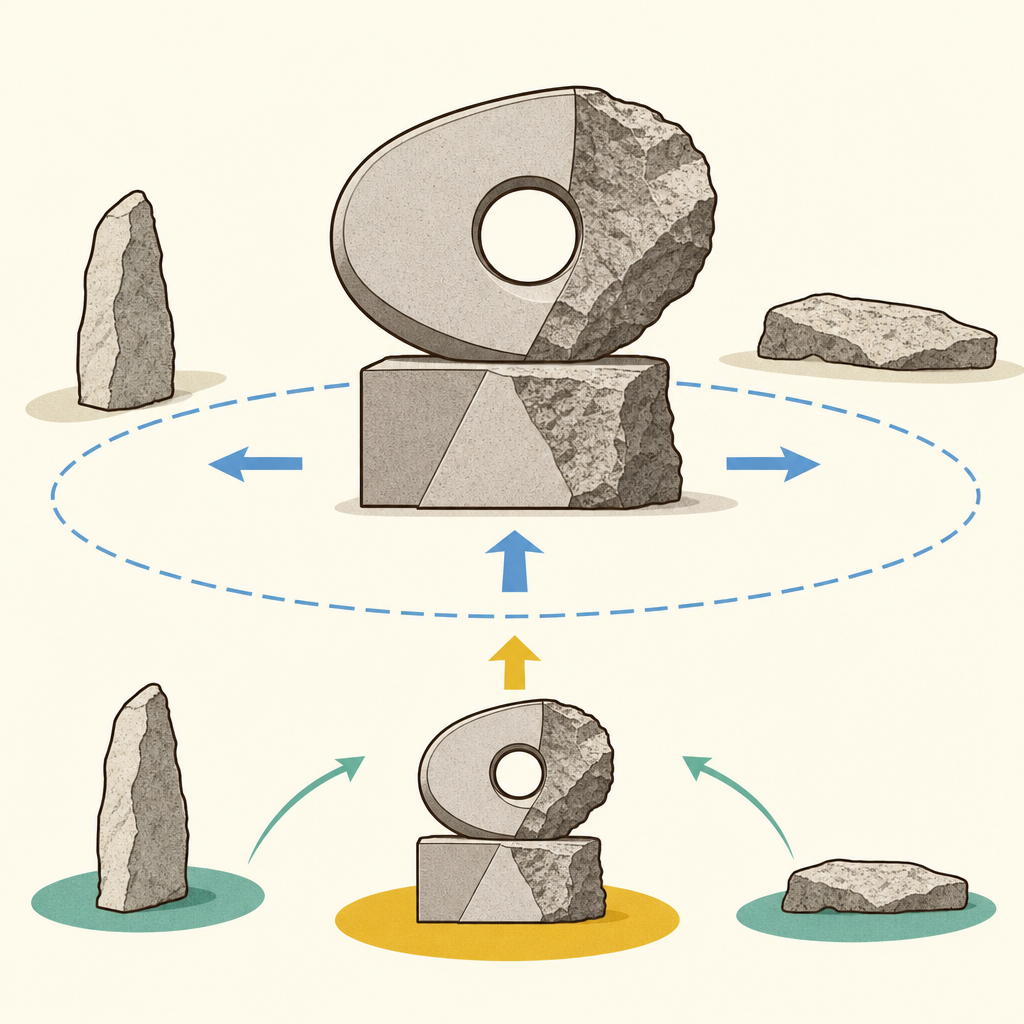
Where East and West meet in one space
Look for the evidence: raw stone left partly rough, precise placement, and generous empty space between elements.
Neither reading cancels the other. That simultaneity is the point.
Building a Universal Language
Cultural synthesis is the working concept here.
Japanese traditional craftsmanship supplies material intelligence. Western modernist abstraction supplies simplified, universal form.
- Japanese craftsmanship: Carpentry and gardens supply material intelligence.
- Modernist abstraction: Western avant-garde supplies simplified form.
- Universal visual language: Legible beyond any single culture.
- Geographical boundaries: The finished language transcends them.
Fused, they produce a visual language that transcends geographical boundaries.
The result reads as neither Japanese nor Western, and as legible to both.
Applying It To Your Work
Noguchi is a working model for designers today.
Treat your own cross-cultural experiences as design inputs rather than personal footnotes.
- Name sources: Identify the distinct cultural and craft traditions you actually carry.
- Extract principles: Pull out material and spatial principles rather than surface motifs.
- Fuse: Combine them into one coherent approach to space and material.
- Test reach: Check that the result reads clearly beyond its geographical origin.
Then test whether the result still speaks past its origin.
A cohesive philosophy is the goal, not a collage of borrowed motifs.
Check yourself
Isamu Noguchi had a Japanese poet for a father and an American writer for a mother.
- True
- False
Answer: True
This statement is correct. Yone Noguchi was a Japanese poet, and Leonie Gilmour was an American writer.
Japanese carpentry supplied _____, while Western modernist abstraction supplied _____.
Answer: Japanese carpentry supplied material intelligence, while Western modernist abstraction supplied simplified universal form.
Japanese carpentry contributed knowledge of materials, joinery, grain, and restraint. Western modernist abstraction contributed simplified forms that could communicate across geographic boundaries.
A designer combines carefully chosen raw stone, precise placement, and generous empty space. Which interpretation best reflects cultural synthesis in Noguchi’s work?
- It copies Japanese motifs without changing them.
- It combines traditional material understanding with simplified modernist form.
- It rejects traditional craftsmanship in favor of industrial production.
- It chooses a single national identity for the work.
Answer: It combines traditional material understanding with simplified modernist form.
Cultural synthesis allows a work to read simultaneously as traditional Japanese landscape and abstract modernist form. Rough stone, precise placement, and empty space support both readings.
Keep going
This is lesson 1 of 8 in Isamu Noguchi: Form and Space. Next up:
- Apprenticeship
- Raw Stone
- Interlocking Forms
- Akari Lanterns
- Iconic Furniture
Wondering turns any topic into short lessons you can read, watch, or listen to, with practice questions and an AI tutor.