Free sample lesson · Introductory Statistics 2e II — Sampling Distributions and Estimation
Density Turns Width into Probability
A sensor reads exactly 15.000 volts; why can that event have probability zero?
Lesson 1 of the Wondering course Introductory Statistics 2e II — Sampling Distributions and Estimation
When Exact Readings Get Zero
A sensor reads exactly 15.000 volts. In a continuous model, that exact event can have probability zero.
Why? For a continuous measurement, probability is the area under a curve called a density.
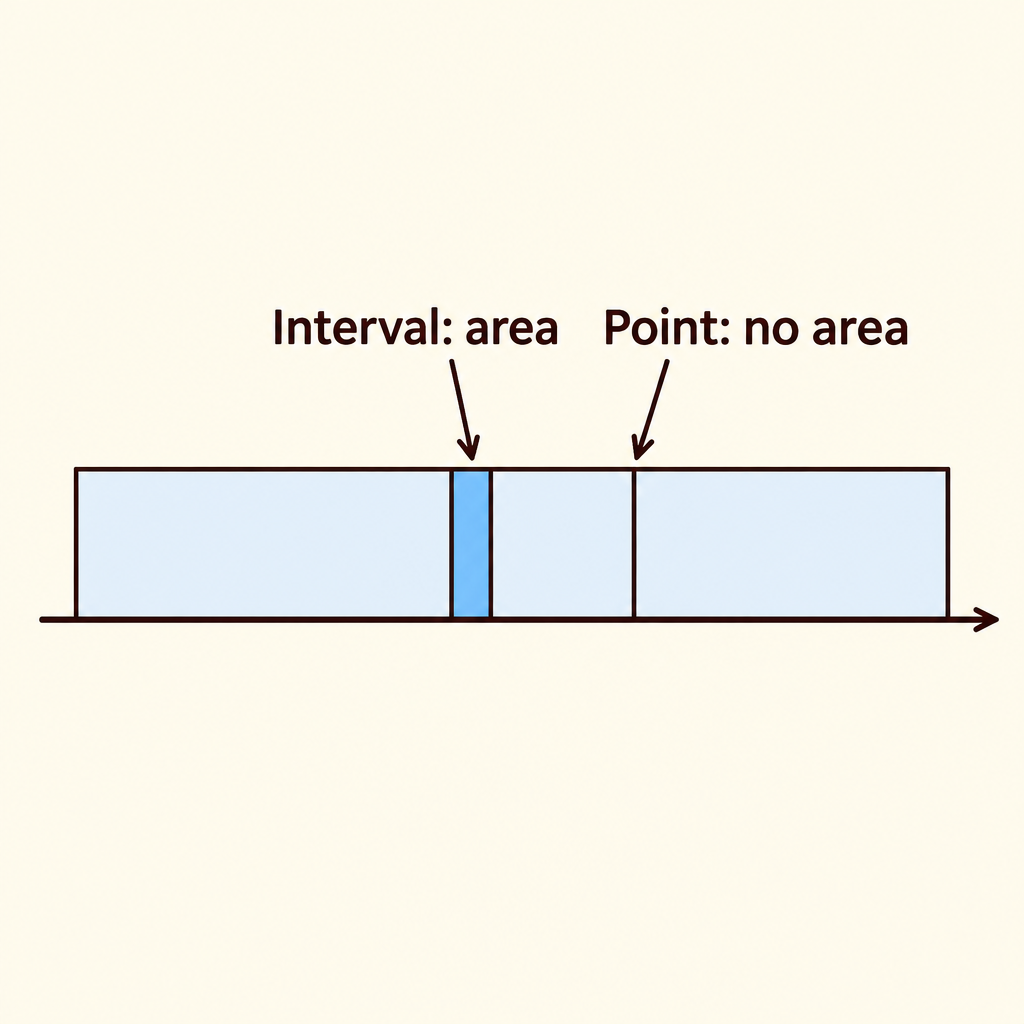
The strip has width and therefore area, but the single vertical line at one exact value covers no area at all.
An exact point has no width. No width means no area, so it has no probability.
A small interval around 15 does have width. That interval gets a positive chance.
What Makes a Valid Density
A continuous density follows two rules. It is never negative, and the total area under it equals one.
Here is an illustrative model: $$X \sim \text{Uniform}(10, 20)$$, where X is a sensor voltage in volts.
A uniform density on $$[a, b]$$ is flat at height $$1/(b-a)$$. Here that is $$1/10$$.
- Find width: The model runs from 10 to 20 volts, a width of 10.
- Set height: Uniform height is 1/(b-a), which here is 1/10.
- Check sign: The height 1/10 is never negative.
- Check area: Width 10 times height 1/10 gives total area 1.
Passing these rules does not make a curve a good model for your process. It only makes it a valid density.
Interval Probability Is Area
To find a probability, shade the area over your interval.
For $$P(12 < X < 15)$$, the rectangle has width $$15 - 12 = 3$$ and height $$1/10$$.
Area is $$3 \times 1/10 = 0.30$$. So there is a 0.30 chance the voltage lands between 12 and 15.
The height 1/10 alone is not a probability. Adding heights means nothing; only areas count, and areas always stay between 0 and 1.
- Density height
- Interval area
A Point Versus a Narrow Interval
Zoom in on the exact value 15. A single point has width zero, so $$P(X = 15) = 0$$.
Widen it slightly. The interval from 14.9 to 15.1 has width 0.2, so its probability is $$0.2/10 = 0.02$$.
As percentages, the chances are 30% for 12 to 15, 2% for 14.9 to 15.1, and 0% for exactly 15.
- 12 to 15: Width 3 out of a total width of 10.
- 14.9 to 15.1: Width 0.2 still gives a positive area.
- Exactly 15: A point has zero width, so zero area.
Probability shrinks with width. It hits zero only when the width is zero.
Zero Does Not Mean Impossible
Probability zero in a continuum does not mean a value is impossible. The voltage must land somewhere, yet every exact spot has zero area.
A recorded 15.000 usually stands for a rounded interval of real readings. That interval has positive probability.
Since points add no area, endpoints do not matter: $$P(12 < X < 15) = P(12 \le X \le 15) = 0.30$$.
- Strict endpoints, 12 < X < 15: Area of width 3 times height 1/10.
- Inclusive endpoints, 12 ≤ X ≤ 15: Including the points adds zero area.
- Exact point, X = 15: Zero probability, yet still possible.
For discrete variables, single values can carry positive probability.
Discrete variables differ. Their probability masses give single values positive probability.
Density Has Units
Density is probability per unit of X. If X is voltage, the density 1/10 means 0.1 probability per volt.
So a density height can exceed one when the supported interval is narrow. Only areas, such as 0.30, must stay between 0 and 1.
- Density has units
Always describe X in words with units, such as sensor voltage in volts. Then the area has a clear meaning.
Putting It to Work
Ask first: is X continuous or discrete? Continuous measurements use areas. Discrete counts use point masses.
For a uniform interval, multiply width by density height. Endpoints do not change the answer.
- Question about X
- Continuous or discrete?
- Find interval width: Endpoints do not change it.
- Multiply by height: Uniform case: width times density height.
- Probability as area
- Use point masses: Single values can have positive probability.
- Continuous
- Discrete
The cumulative distribution $$F(x) = P(X \le x)$$ adds up area from the left through x.
And when a value has probability zero, remember it can still be observed.
Check yourself
A task's finishing time is uniform from 0 to 0.5 hours, so its density height is 2 per hour. A height of 2 means _____
- the model is fine, because only areas under the curve must stay between 0 and 1
- the model is broken, because the chance of any single time cannot be bigger than 1
Answer: the model is fine, because only areas under the curve must stay between 0 and 1
Density is probability per hour, not probability. The total area is 2 × 0.5 = 1, so the model is valid. Only areas must be between 0 and 1, not heights.
For a continuous variable, the chance of landing in an interval equals the _____ under the density curve over that interval. The whole curve must enclose a total of exactly _____. The curve's _____ is not a probability, so it may be larger than 1 when the range of values is narrow.
Answer: For a continuous variable, the chance of landing in an interval equals the area under the density curve over that interval. The whole curve must enclose a total of exactly one. The curve's height is not a probability, so it may be larger than 1 when the range of values is narrow.
Probability is area over an interval, and the total area is always 1. Height is density, meaning probability per unit, so it can go above 1 as long as the areas stay between 0 and 1.
A bus arrives at a random time, so your wait is uniform from 0 to 20 minutes. What is the probability that you wait between 5 and 9 minutes?
- 0.20
- 0.05
- 0.45
- 0.25
Answer: 0.20
The interval is 9 − 5 = 4 minutes wide, out of 20 minutes total, so the area is 4 ÷ 20 = 0.20. The value 0.05 is only the density height, 1/20, not an area.
Keep going
This is lesson 1 of 8 in Introductory Statistics 2e II — Sampling Distributions and Estimation. Next up:
- Uniform and Exponential Waiting
- Standardize Before Comparing
- Statistics Have Distributions Too
- The Central Limit Bridge
- Confidence Describes a Procedure
Wondering turns any topic into short lessons you can read, watch, or listen to, with practice questions and an AI tutor.