Free sample lesson · Introduction to Sociology 3e I — Sociological Foundations
Sociological Imagination
Why do factory closures turn one lost job into a public issue?
Lesson 1 of the Wondering course Introduction to Sociology 3e I — Sociological Foundations
Biography Meets History
A factory closes. One worker loses a job, and it feels deeply personal: lost income, lost routine, worry about the future.
Now zoom out. Hundreds of workers lost jobs on the same day, in the same town, for the same reason.
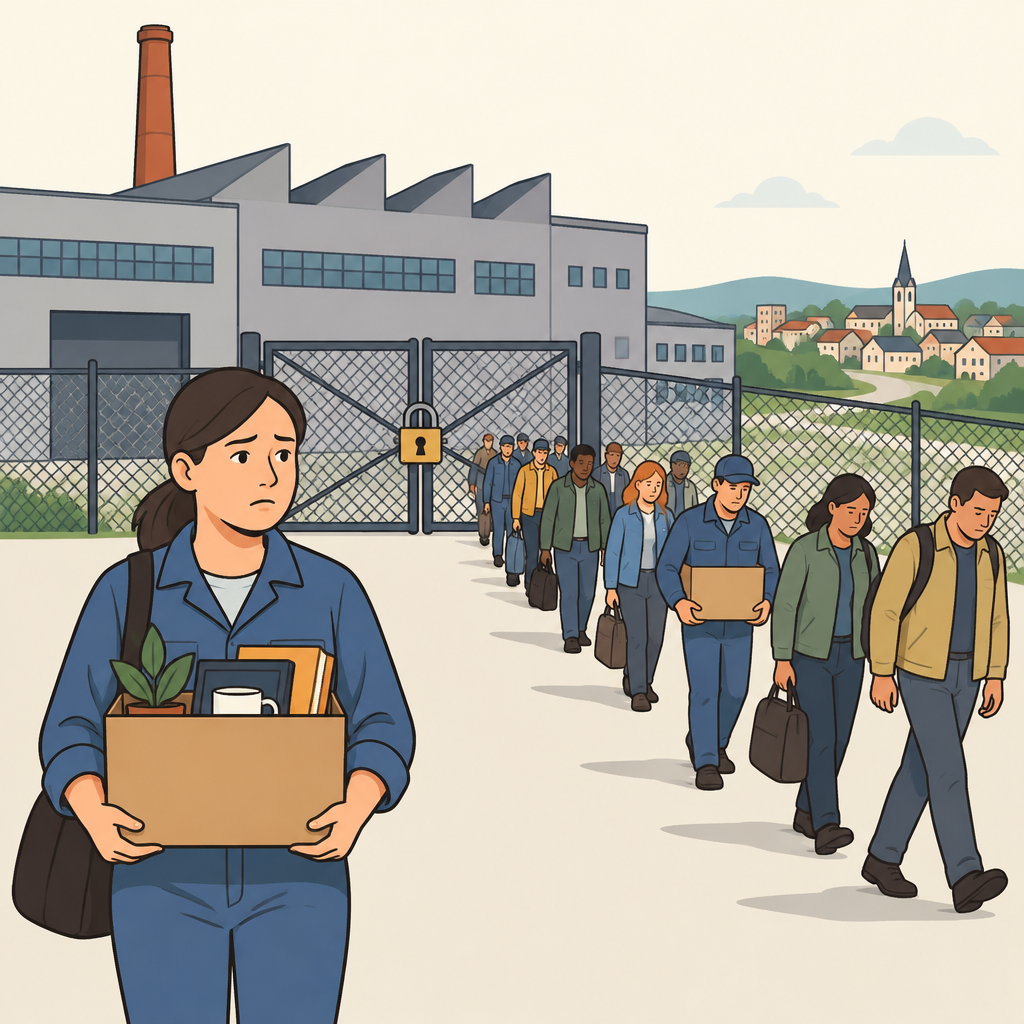
Notice how the single worker in front is part of a larger crowd leaving the same closed factory, which is what turns one loss into a pattern.
The sociological imagination, an idea from C. Wright Mills, links personal experience (biography) to historical conditions, institutions, and group patterns (history).
Sociology is the systematic study of society and social interaction. This lens is one of its starting tools.
Personal Troubles, Public Issues
Mills separated two kinds of problems.
A personal trouble is felt inside one life: the worker's stress, savings, and next steps.
A public issue is a pattern rooted in institutions and history, such as regional factory closures that leave many workers jobless at once.
- Personal trouble
- Public issue
Careful: a public issue does not mean any issue that gets publicity. A viral story about one person is still one story.
Three Ways to Explain a Layoff
The same layoff can be explained at different levels.
Individual: a psychological account looks at how the worker copes, feels, and decides.
Institutional: credential rules shape who qualifies for replacement work.
Historical: regional deindustrialization explains why the factory closed and why few similar jobs remain.
- Individual
- Institutional
- Historical
Both personal and social levels may matter. Good analysis keeps them apart before connecting them.
Structure Without Erasing Agency
A common mistake: thinking a social explanation excuses every choice or says people have no agency.
It does neither. Agency (a person's capacity to choose) and structure (patterned conditions around them) are complementary levels of analysis.
The laid-off worker still decides how to search, retrain, or move. Those choices happen inside options shaped by institutions and history.
- Historical conditions: Regional deindustrialization closes factories.
- Institutions: Credential rules shape who qualifies for new work.
- Individual agency: The worker decides how to search, retrain, or move.
Each layer shapes the options inside it; the core still chooses.
- Map, not verdict
Social Facts and Institutions
Social facts are patterned ways of acting and thinking that confront you as external expectations. You did not invent them, yet they shape you.
Institutions stabilize recurring roles and practices, like schools and workplaces with credential rules.
Graduation requirements are a clear case. They shape every student's options, though no single student created them.
Popularity alone is not enough. Many people liking a song is a shared preference, not an external constraint.
Ask: does it press on you as an expectation with consequences?
Testing the Connection
One vivid story cannot establish a population pattern. You need evidence.
Pick an observable indicator: for example, unemployment across a region after closures, or who gets hired into replacement jobs.
If the indicator shows a repeated pattern, the public issue gains support. If not, revise your claim.
- Personal trouble
- Propose public issue
- Choose observable indicator: For example, regional unemployment after closures.
- Repeated pattern?
- Issue gains support
- Revise
Limits still apply. A pattern does not mean every group member shares one experience, and it does not settle responsibility.
Calling a pattern unfair is a separate step that needs values and argument beyond description.
Using the Lens Yourself
When you meet a personal story, run three moves.
Separate the levels: individual, institutional, historical.
Connect the trouble to a plausible public issue, such as a layoff to regional deindustrialization.
Test it with one observable indicator before claiming a pattern.
- Separate: Sort explanations into individual, institutional, and historical levels.
- Connect: Link the trouble to a plausible public issue.
- Test: Name one observable indicator that could show the pattern.
Sociology is systematic study, not opinion about society. Stories and patterns both count, and each answers a different question.
Check yourself
Which of these is an institutional constraint that students face as an outside expectation?
- Sam's school requires four years of English to graduate
- Most students at Sam's school drink coffee in the morning
Answer: Sam's school requires four years of English to graduate
A graduation rule shapes every student's options even though no single student made it. Lots of students drinking coffee is common, but being common does not make it a social fact or institution.
Measuring that layoffs hit one region more than others is an _____ claim. Proposing that factory closures explain this is a _____ move. Deciding the pattern is unfair is a _____ judgment.
Answer: Measuring that layoffs hit one region more than others is an empirical claim. Proposing that factory closures explain this is a theoretical move. Deciding the pattern is unfair is a normative judgment.
Empirical claims describe what can be measured, theoretical moves offer an explanation, and normative judgments need values and argument. Describing a pattern alone does not decide whether it is fair.
Maria lost her job when the factory in her town closed. Which question looks at her situation with the sociological imagination?
- Have many factories in her region closed, and who can find new work?
- How is Maria coping emotionally with the stress of losing her job?
- Was Maria working hard enough to keep her job at the factory?
- What should Maria have done differently before the factory closed?
Answer: Have many factories in her region closed, and who can find new work?
The sociological imagination links a personal trouble to wider patterns, such as regional factory closures and access to new work. Asking about her coping or her effort looks only at Maria as an individual.
Keep going
This is lesson 1 of 11 in Introduction to Sociology 3e I — Sociological Foundations. Next up:
- Three Theoretical Lenses
- Questions Into Evidence
- Measuring Social Life
- Choosing a Research Method
- Culture's Building Blocks
Wondering turns any topic into short lessons you can read, watch, or listen to, with practice questions and an AI tutor.