Free sample lesson · How to Do Great Work
The Four Steps to the Frontier
At Bell Labs, Richard Hamming shared an office with Claude Shannon. At the same time, Shannon was inventing information theory and Hamming was inventing coding theory. Hamming called it 'suspicious' and said 'it was in the atmosphere.' Why did those two, out of everyone at Bell Labs, see it? This lesson's answer is that both had reached a frontier. From far away, the edge of knowledge looks smooth. Up close, it is full of gaps.
Lesson 1 of the Wondering course How to Do Great Work
Two Discoveries, One Office
At Bell Labs, Richard Hamming shared an office with Claude Shannon. At the same time, Shannon invented information theory and Hamming invented coding theory.
Hamming called it suspicious. His explanation: "it was in the atmosphere."
Out of everyone at Bell Labs, why did those two see it?
Both had reached a frontier. From far away, the edge of knowledge looks smooth. Up close, it is full of gaps.
Paul Graham's essay How to Do Great Work explains how people get close enough to see those gaps.[[1]](https://paulgraham.com/greatwork.html)
Four Steps, in Order
Graham asked what great-work techniques from many fields have in common. He found a definite shape, "not just a point labelled 'work hard.'"[[1]](https://paulgraham.com/greatwork.html)
The recipe: choose a field, learn enough to get to the frontier, notice gaps, and explore the promising ones.[[1]](https://paulgraham.com/greatwork.html)
- Choose a field: Pick the field you will work in.
- Reach the frontier: Learn enough to get to its edge, where new things become visible.
- Notice gaps: See what the field has not yet explained.
- Explore: Chase the promising gaps; this is where discovery happens.
He says practically everyone who has done great work, from painters to physicists, did it this way.[[1]](https://paulgraham.com/greatwork.html)
Steps one and two put you where new things become visible. Steps three and four are where discovery happens.
Skip the early steps and there is nothing yet to notice.
Step Two Takes Years
Graham sketches a path: teach yourself calculus at 14, and by 21 you are exploring unanswered questions in physics.[[1]](https://paulgraham.com/greatwork.html)
- Teach yourself calculus: Step one is underway: a field is chosen.
- Climb to the frontier: Step two: learning enough to reach the edge.
- Exploring unanswered physics: Now gaps are visible and can be explored.
The years in between are step two, the slow climb to the frontier.
Hamming felt this from the other side. Every seven years or so he moved fields: numerical analysis, hardware, software.
Each move meant he had to "start over as a baby." Step two restarted every time.
So learning a field's basics is not great work yet. It is the price of being able to see gaps at all.
The Edge Is Full of Gaps
Knowledge expands fractally, Graham writes. From a distance its edge looks smooth. Up close, it is full of gaps.[[1]](https://paulgraham.com/greatwork.html)
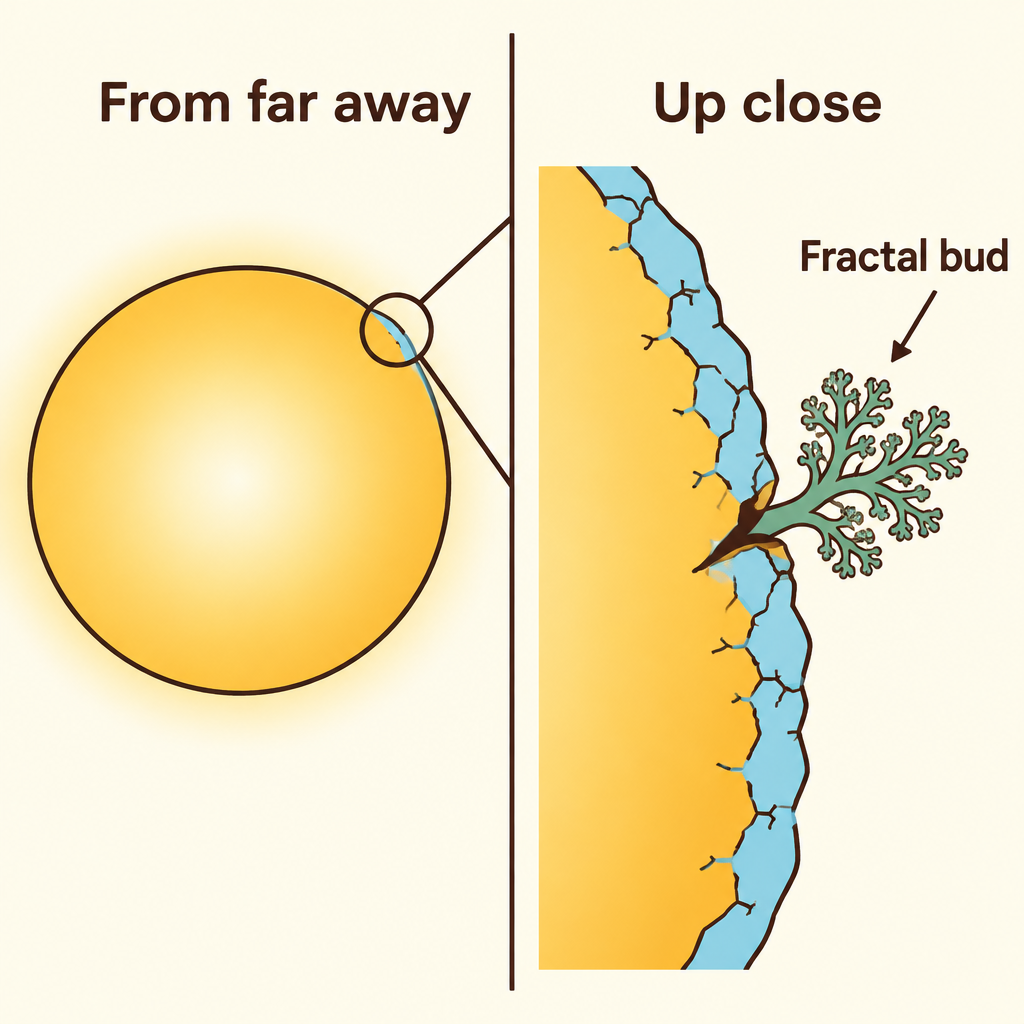
The same edge that looks smooth at a distance shows cracks when magnified, and one opened crack reveals a whole branching world inside.
Most people never see them. The brain prefers to ignore gaps to keep a simpler model.[[1]](https://paulgraham.com/greatwork.html)
So noticing gaps is a skill. You have to stop smoothing anomalies away.
"The big prize is to discover a new fractal bud."[[1]](https://paulgraham.com/greatwork.html) It is a crack in the surface that you pry open to find a whole world inside.
Think a real gap would already be filled? Shannon and Hamming each found one, side by side.
Factors That Multiply
Graham names four factors in great work: ability, interest, effort, and luck. They multiply "in the literal, mathematical sense."[[1]](https://paulgraham.com/greatwork.html)
So a near-zero in one sinks the result. Effort with zero interest is not a small version of great work; it tends toward nothing.
Nor do more hours fix it. Overwork brings diminishing returns: "fatigue will make you stupid."[[1]](https://paulgraham.com/greatwork.html)
Hamming on luck: "The particular thing you do is luck, but that you do something is not." Luck decides which thing a prepared mind finds, not whether it finds something.
Precise Gap or Crank?
Graham's test: chase an overlooked idea only if you know the field well enough to say precisely what everyone is overlooking.[[1]](https://paulgraham.com/greatwork.html)
Picture two founders. One has wired up a dozen billing systems and can name the exact step all of them make painful.
The other says "billing is broken" and incumbents "don't get it."
- Billing veteran
- Vague critic
Graham warns that "they don't get it" drifts toward cranks.[[1]](https://paulgraham.com/greatwork.html)
Outsiders sometimes discover things because they ignore a field's assumptions.[[1]](https://paulgraham.com/greatwork.html) They still have to name the gap.
Diagnose a Stalled Founder
A stuck founder has usually skipped a step. Ask where they are in the sequence.
- Stalled founder
- Chosen a field?
- Pick and test: Choose a field you are drawn to and test interest by working.
- At the frontier?
- Keep learning: Step two: expect years before gaps appear.
- Gap stated precisely?
- Look closer: Vague claims that others do not get it are not gaps.
- Explore it
- No
- Yes
- No
- Recheck
- Yes
- No
- Recheck
- Yes
Choosing? Pick a field you are drawn to and test your interest by working in it (see the next lesson).
Building expertise? Expect years of step two before gaps appear.
Full of ideas? Check that you can state the gap precisely, then explore the promising one.
- Not a path for everyone
Check yourself
If a startup founder works extremely hard but has almost no genuine interest in the problem, is great work still likely under Graham's model?
- Yes
- No
Answer: No
No. Ability, interest, effort, and luck multiply. A near-zero level of interest can pull the overall result toward zero, even when effort is high.
Graham's recipe for great work is to _____, then _____, next _____, and finally _____.
Answer: Graham's recipe for great work is to choose a field, then reach the frontier, next notice gaps, and finally explore promising ones.
The sequence matters. Choosing a field comes first, followed by enough learning to reach its frontier. Only then can someone notice and explore promising gaps.
A founder has chosen a field and spent two months reading basic material, but cannot identify any specific unanswered question. Which next step best follows Graham's advice?
- Continue learning until the field's gaps become visible
- Immediately explore a random idea to create momentum
- Skip learning and work longer hours on the same vague idea
- Assume experts have already solved every worthwhile problem
Answer: Continue learning until the field's gaps become visible
The founder is still working toward the frontier. They should continue learning the field rather than forcing a discovery before they know enough to see meaningful gaps.
Keep going
This is lesson 1 of 10 in How to Do Great Work. Next up:
- Find Your Work by Working
- Lies That Get You Started
- Work That Compounds
- Aim for Best, Stay Earnest
- Novel and Obvious: Fixing Broken Models
Wondering turns any topic into short lessons you can read, watch, or listen to, with practice questions and an AI tutor.