Free sample lesson · How startup fundraising works
Fundraising Is Conversations
Why did Freshpaint need 160 investor conversations for one seed round?
Lesson 1 of the Wondering course How startup fundraising works
What You Will Learn
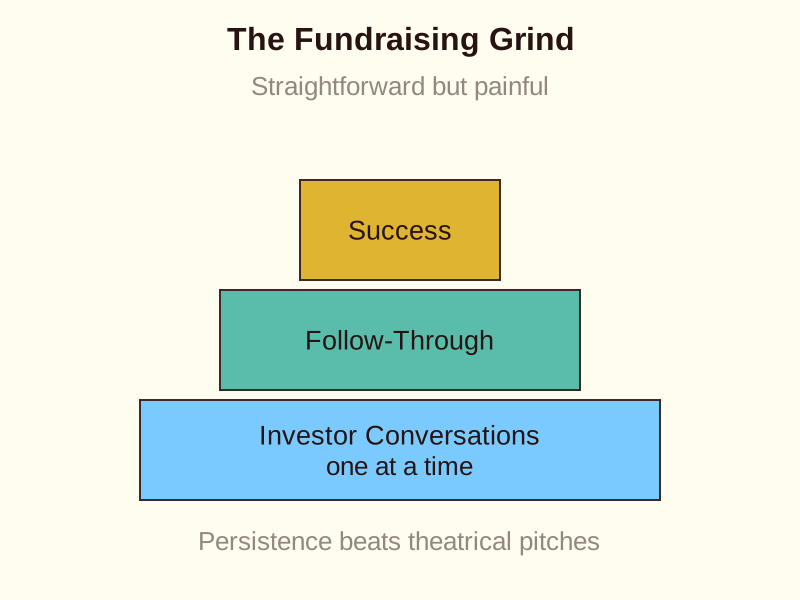
Seeing fundraising as repeated ordinary conversations prevents founders from optimizing for theatrical pitches instead of consistent follow-through.
The Myth of the Big Pitch
Many founders believe fundraising is a high-stakes performance. They imagine a single, dramatic presentation on a stage like Shark Tank that secures their future.
In reality, fundraising is not a theatrical event. It is a series of quiet, one-on-one conversations.
Brad Flora compares the process to people talking in a cafe. It is about building relationships through repeated private meetings and follow-up emails.
- The Myth
- The Reality
The Reality of the Grind
Fundraising is a numbers game that requires persistence. Success often comes from many small checks rather than one large lead investor.
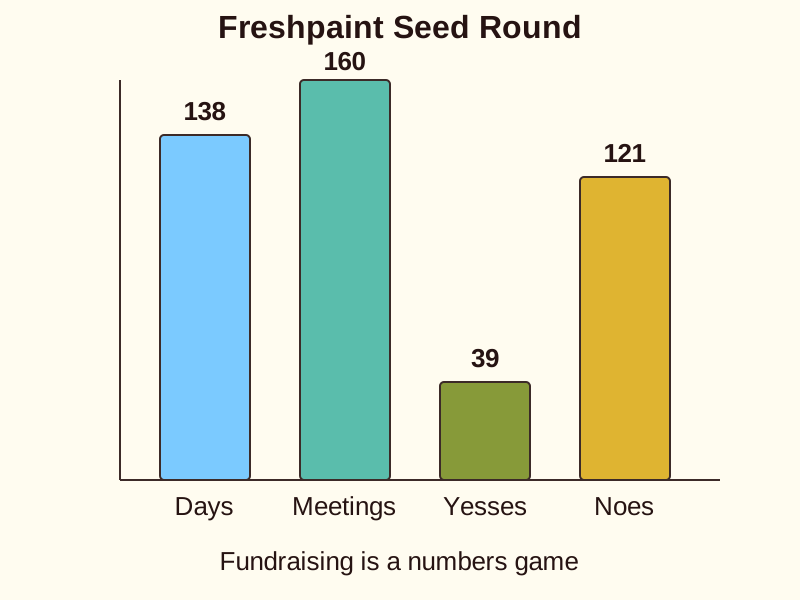
Consider the startup Freshpaint. They spent 4 months and 18 days raising their seed round.
They met with 160 different investors. Out of those, 39 people said yes. Their checks ranged from as small as $5,000 to as large as $200,000.
Simple but Painful
The process is operationally simple: keep talking until you have enough commitments. However, it is emotionally difficult because of the constant rejection.
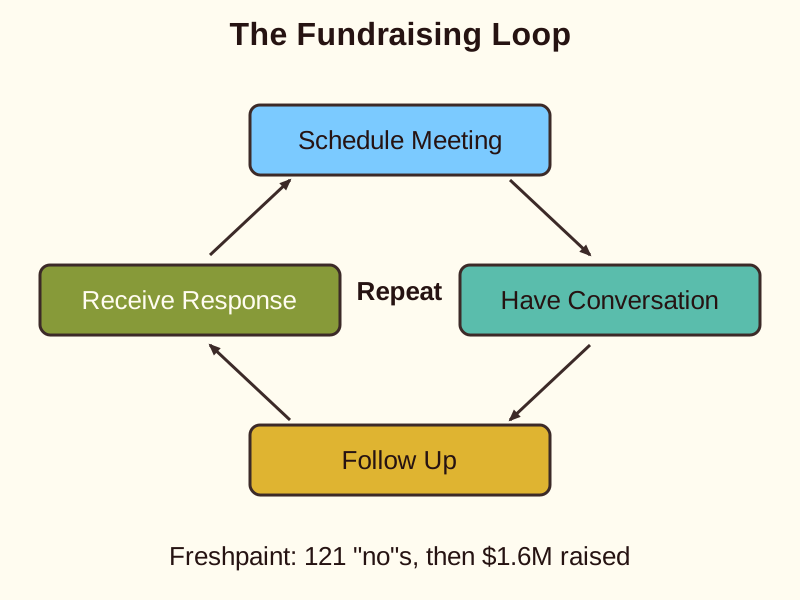
Freshpaint eventually raised $1.6M, but they had to hear "no" 121 times to get there.
If your process feels slow or repetitive, it does not mean it is broken. It means you are doing the work of a normal fundraising loop.
Focus on Conversations
Do not spend all your time polishing a single showpiece performance. Your goal is to explain your business clearly many times to different people.
Pitch competitions and demo events are marketing tools. They create attention but are not the substance of fundraising.
Real progress happens in the follow-up. Focus on the grind of individual meetings to turn interest into actual capital.
- Stop Polishing: Avoid spending all your time on a single showpiece performance.
- Explain Clearly: Focus on explaining your business clearly many times to different people.
- Pursue Follow-ups: Prioritize the grind of individual meetings to turn interest into actual capital.
How to Apply It in Real Life
- Ditch the Theatre: Stop waiting for a major demo day and start booking individual introductory coffee chats.
- Embrace the Numbers: Expect a high volume of meetings and rejections as a normal operational baseline.
- Focus on Follow-Through: Treat every conversation as a relationship-building step rather than a one-shot closing attempt.
Check yourself
Fundraising is best described as _____.
- a series of quiet conversations
- a single high-stakes performance
Answer: a series of quiet conversations
While many imagine a single theatrical performance, real fundraising happens through many private, one-on-one conversations.
A normal fundraising loop involves _____ from various investors rather than _____ investor deciding everything immediately.
Answer: A normal fundraising loop involves many small checks from various investors rather than one large lead investor deciding everything immediately.
Success often comes from the 'grind' of collecting multiple smaller commitments over several months.
If a founder faces 100+ rejections over four months, what does this typically indicate about their fundraising process?
- The process is broken and needs a secret new strategy.
- The founder is performing the work of a normal fundraising loop.
- The startup is fundamentally uninvestable.
Answer: The founder is performing the work of a normal fundraising loop.
High rejection is a normal part of the 'numbers game' in fundraising. It is an emotionally painful but operationally standard loop, not a sign of a broken strategy.
Keep going
This is lesson 1 of 8 in How startup fundraising works. Next up:
- Start Before Raising
- Convince Without Performing
- Rejection Needs Few Believers
- Seed Rounds Are Smaller
- SAFEs Preserve Early Control
Wondering turns any topic into short lessons you can read, watch, or listen to, with practice questions and an AI tutor.