Free sample lesson · How Not to Age
Aging: Modifiable
What if getting older doesn't have to mean getting sicker?
Lesson 1 of the Wondering course How Not to Age
Aging Happens Inside Your Cells
Aging is more than birthdays piling up. It is a biological process happening inside your cells.
Over time, cells collect damage. They start to work less well, and their repair systems slow down.
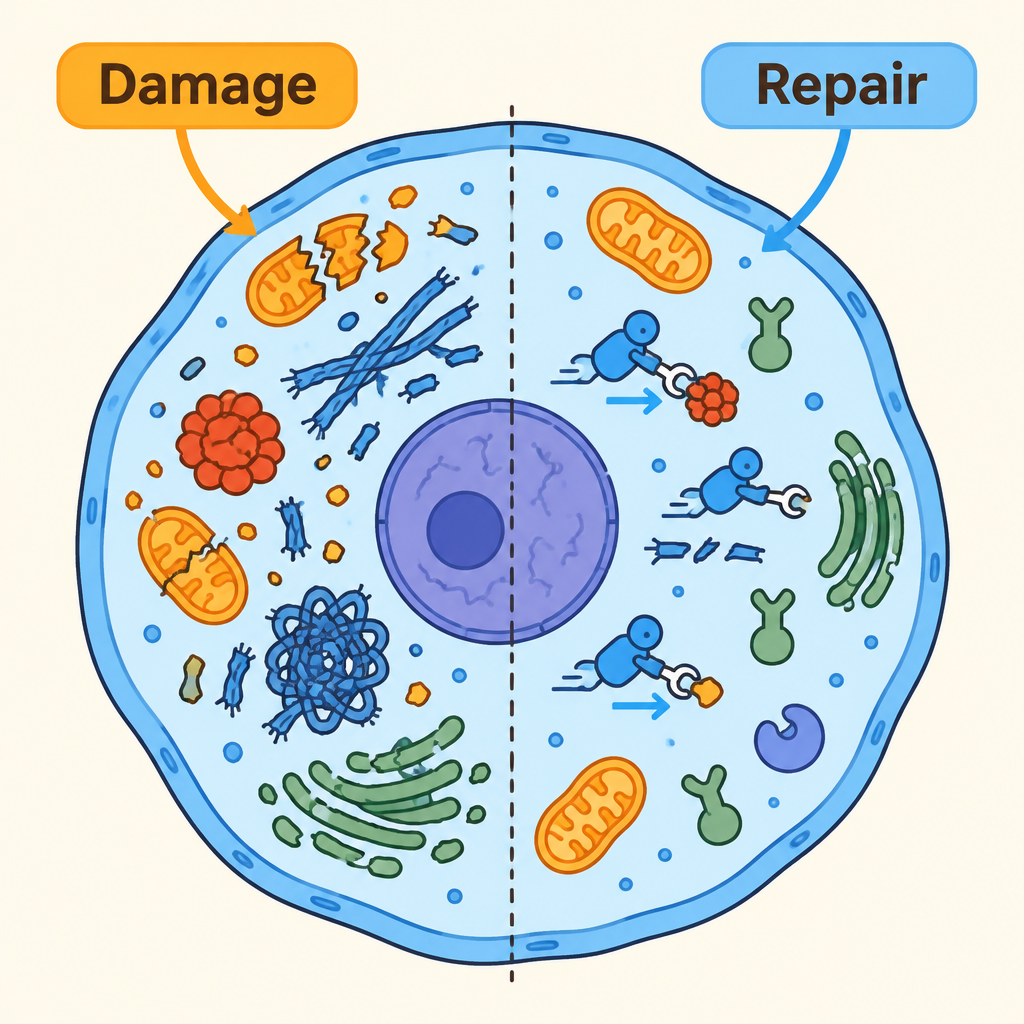
Notice that damage keeps piling up while repair falls behind; aging is that growing gap, and it is where intervention can help.
That steady decline is what changes how an older body works.
Here is the hopeful part: once we understand these mechanisms, we can intervene to slow, or even partially reverse, age-related decline.
Aging Drives Major Disease
Why care about how fast you age?
Because aging is the primary risk factor for the biggest diseases we face. These include heart disease, cancer, stroke, diabetes, and Alzheimer's disease.
- Aging: The primary risk factor
- Heart disease
- Cancer
- Stroke
- Diabetes and Alzheimer's
- Diabetes
- Alzheimer's disease
Slowing aging works on a shared root beneath all five.
That is a powerful reason to treat aging as something worth acting on.
Lifestyle Outweighs Your Genes
Many people assume long life simply runs in the family. The data tell a different story.
Genetics accounts for only 15-30% of longevity.
Lifestyle choices you can control influence the other 70-85%.
- Share of longevity from genetics: The part you inherit.
- Share of longevity from lifestyle: The part your choices control.
Most of aging is within your control.
So most of how you age is shaped by your daily habits. Your inherited DNA plays a much smaller part.
The Levers You Control
Which choices matter most? Four stand out: diet, exercise, sleep, and stress management.
These factors can significantly influence how quickly or slowly you age.
Researchers have identified eleven fundamental pathways through which aging happens at the cellular level.
By understanding these biological mechanisms, we can intervene to slow or even partially reverse age-related decline.
- Understand mechanisms: Aging runs through eleven fundamental cellular pathways.
- Pick a lever: Choose diet, exercise, sleep, or stress management.
- Intervene: Change the habit so it influences how fast you age.
- Slow decline: Age-related decline can slow or even partially reverse.
Lessons From Blue Zones
Blue zones are regions where people routinely live past 100.
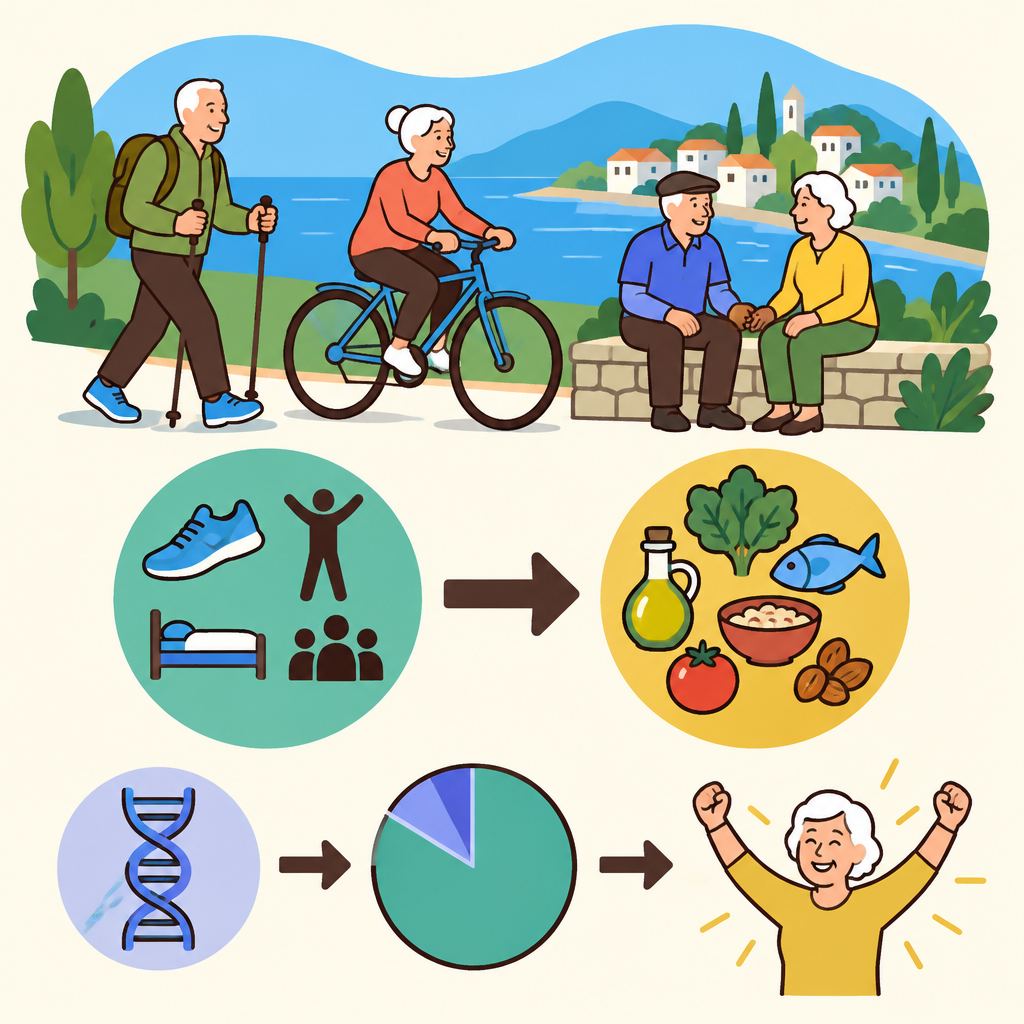
Long lives in a blue zone
What do these long-lived people share? Researchers point to their lifestyle and dietary patterns.
Blue zones show that these patterns are more important than genetics for longevity.
They are real-world proof of the 70-85% figure: everyday habits add up to long, healthy lives.
Healthspan vs Lifespan
Living longer is only part of the goal. Extra years spent sick or disabled are not much of a prize.
Lifespan is the total number of years you live.
Healthspan is the years you stay healthy, vital, and free of disease.
- Lifespan
- Healthspan
The aim of healthy aging is to stretch healthspan so it fills as much of your lifespan as possible.
Putting It Into Practice
Let us pull it together.
Aging is a biological process, and it is the main risk factor for major diseases.
Genes shape only 15-30% of longevity. Diet, exercise, sleep, and stress management influence the other 70-85%.
The target is healthspan: more good years, rather than simply more years.
Check yourself
When it comes to how long people live, _____ has the larger influence
- lifestyle
- genetics
Answer: lifestyle
Lifestyle factors (diet, exercise, sleep, stress management) account for about 70-85% of longevity, while genetics accounts for only about 15-30%.
In longevity research, _____ determines only about 15-30% of how long we live, while _____ accounts for about 70-85%.
Answer: In longevity research, genetics determines only about 15-30% of how long we live, while lifestyle accounts for about 70-85%.
Genetics plays a minor role (15-30%), and lifestyle choices such as diet, exercise, sleep, and stress management play the major role (70-85%).
Maria's parents both died in their 60s. She concludes that she will also die young no matter what she does. Which response best fits what research shows about aging?
- Her lifestyle choices influence most of her longevity, so she has real control
- Her genes decide most of her longevity, so her choices matter little
- Genes and lifestyle each decide exactly half, so her outcome is a coin flip
- Aging is just the passage of time, so nothing affects how fast she ages
Answer: Her lifestyle choices influence most of her longevity, so she has real control
Genetics explains only about 15-30% of longevity. The remaining 70-85% depends on lifestyle factors like diet, exercise, sleep, and stress management, so Maria's choices can strongly shape how she ages.
Keep going
This is lesson 1 of 30 in How Not to Age. Next up:
- Cellular Rust
- Cellular Recycling
- Telomeres
- Zombie Cells
- Inflammaging
Wondering turns any topic into short lessons you can read, watch, or listen to, with practice questions and an AI tutor.