Free sample lesson · How Music Is Built
Pitch Basics
Why does a plucked string sound higher when you shorten it?
Lesson 1 of the Wondering course How Music Is Built
Why does a shorter string sound higher?
Imagine a guitarist plucking an open string. It rings out with a low, steady note.
Then she presses the same string down halfway along the neck and plucks again. She hopes the note will sound noticeably higher, and it does.

A musician plays an acoustic guitar, focusing on the fingers pressing the strings · Shixart1985 · CC BY 2.0 · Wikimedia Commons

Nothing new was added. Same string, same guitar, same fingers.
So what changed when she pressed down? To answer that, we first need to know where any note comes from.
Every note starts as a vibration
Pluck a string and it shakes back and forth. A column of air in a flute or the skin of a drum does the same.
As the source vibrates, it pushes the air around it back and forth. That sends waves of pressure travelling to your ears.
- Source vibrates: A string, air column, or drumhead shakes back and forth.
- Air is pushed: The shaking pushes the air around it back and forth.
- Waves travel: Waves of pressure move through the air to your ears.
- You hear: Your brain turns those waves into a sound.
No vibration, no sound. Every note you have ever heard began this way.
But a vibration can be quick or slow. Which part of it decides whether a note is high or low?
Faster shaking sounds higher
Picture two strings. One swings back and forth slowly. The other shakes many more times in the same second.
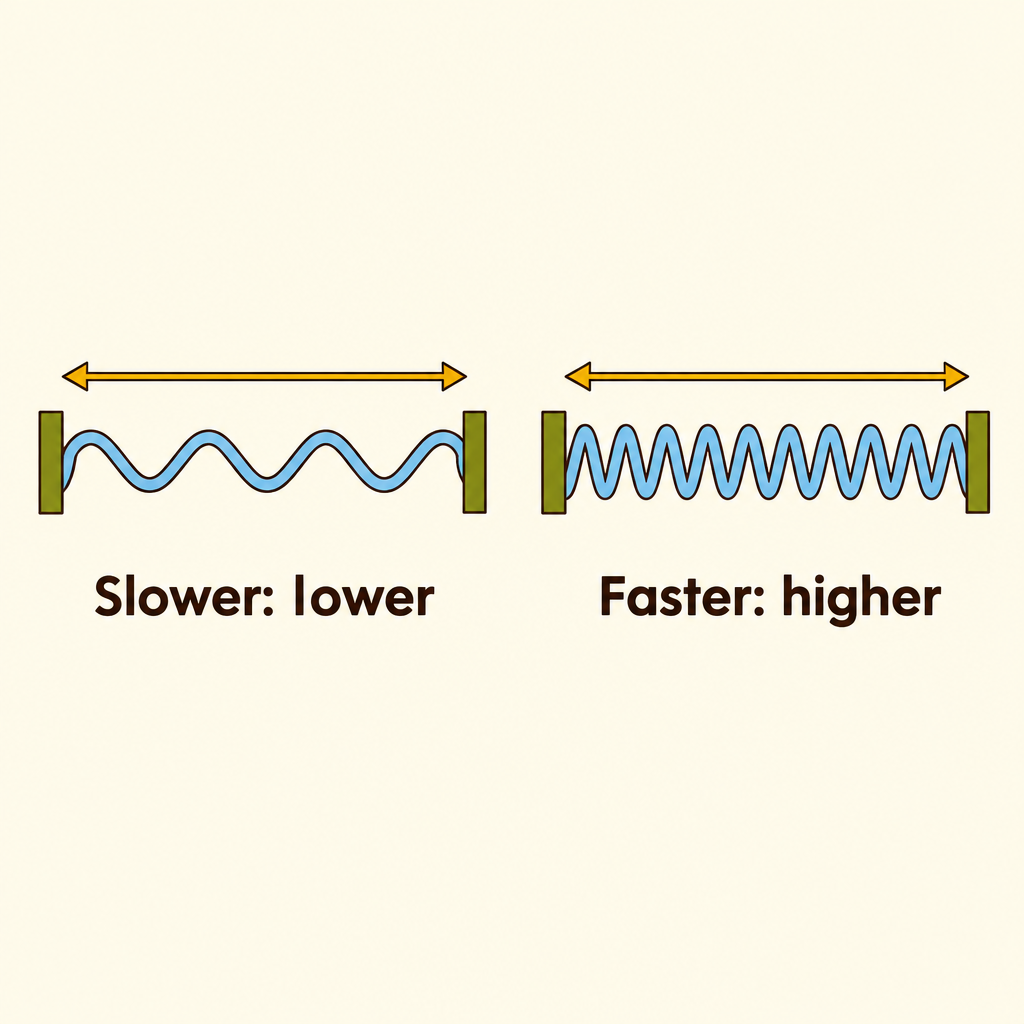
Notice how the right string makes many more back-and-forth swings in the same time, which your ear hears as a higher pitch.
Your brain hears the difference as pitch. Faster vibration sounds higher, slower vibration sounds lower.
The number of vibrations each second has a name: frequency. So pitch is simply how your brain hears frequency.
That seems tidy. But what about playing harder? Surely a strong pluck changes the note too?
Does plucking harder make a higher note?
Many newcomers think so. A higher note seems like a stronger sound, and pressing a string feels like it squeezes the sound upward.
But try it. Pluck harder and the string swings wider, so it sounds louder.
It still vibrates at the same rate, so the pitch stays the same.
- Common belief
- What happens
Loudness and pitch are separate: force changes how wide the string swings, not how fast.
So if force does not set the speed, what does?
Three things set a string's speed
On a string, three things decide how fast it vibrates: its length, its tension, and its thickness.
A shorter, tighter, or thinner string vibrates faster and sounds higher. Make it longer, looser, or thicker and it slows down.
That explains the guitar. Pressing a string against the neck shortens the part that is free to vibrate.
So how much higher does it get when you shorten it by half?
Half the string, twice the speed
Imagine the open string vibrates about 110 times per second.
Pressing at the halfway point leaves half as much string free to vibrate. A string half as long vibrates twice as fast.
Pressed halfway, it now goes about 220 times per second.
- Open string: The full length of the string is free to vibrate.
- Pressed halfway: Half the length vibrates twice as fast: one octave up.
Halving the length doubles the vibrations per second. The ear hears a higher version of the same note, a distance musicians call an octave.
Why does this one link matter so much beyond a single guitar?
Shorter string, faster shake, higher note
Back to the guitarist. When she pressed the string halfway, she did not squeeze the sound or play harder.
She left a shorter piece free to vibrate. That piece shook twice as fast, and her ear heard the faster vibration as a higher pitch.
Pitch depends only on how fast the source vibrates, never on how hard you play.
This simple link between vibration and pitch is the base on which scales, chords, and melodies are built.
- Scales, chords, melodies: Built by arranging pitches.
- Pitch: How the brain hears frequency.
- Vibration speed: How many times per second the source vibrates.
Each level rests on the one below.
Check yourself
Imagine you pluck a guitar string gently, then pluck the same string much harder. Compared with the gentle pluck, the hard pluck sounds _____
- louder, but at the same pitch
- louder and at a higher pitch
Answer: louder, but at the same pitch
Plucking harder makes the string swing wider, so it sounds louder. It still vibrates the same number of times per second, so the pitch does not change.
A shorter string vibrates _____, so our ears hear a _____ note. Plucking that string harder only makes it _____.
Answer: A shorter string vibrates faster, so our ears hear a higher note. Plucking that string harder only makes it louder.
Shortening a string speeds up its vibration, and faster vibration is heard as higher pitch. Plucking harder changes loudness, not pitch.
Two singers hold notes, and one note sounds clearly higher than the other. What is different about the source of the higher note?
- It vibrates more times per second
- It pushes air out with more force
- It makes a louder sound
- It vibrates fewer times per second
Answer: It vibrates more times per second
Pitch depends on how many times per second the source vibrates. Faster vibration sounds higher. How loud or forceful a sound is does not set its pitch.
Keep going
This is lesson 1 of 13 in How Music Is Built. Next up:
- Octave Mystery
- Musical Alphabet
- Piano Map
- Written Music
- Major Minor
Wondering turns any topic into short lessons you can read, watch, or listen to, with practice questions and an AI tutor.