Free sample lesson · How Large Language Models (LLMs) Work
Text to Numbers
How can a computer, which only knows numbers, understand the words you're reading right now?
Lesson 1 of the Wondering course How Large Language Models (LLMs) Work
Computers Only Know Numbers
Every word you read here is made of letters. A computer does not see them the way you do.
Computers cannot directly understand human language. They only process numbers.
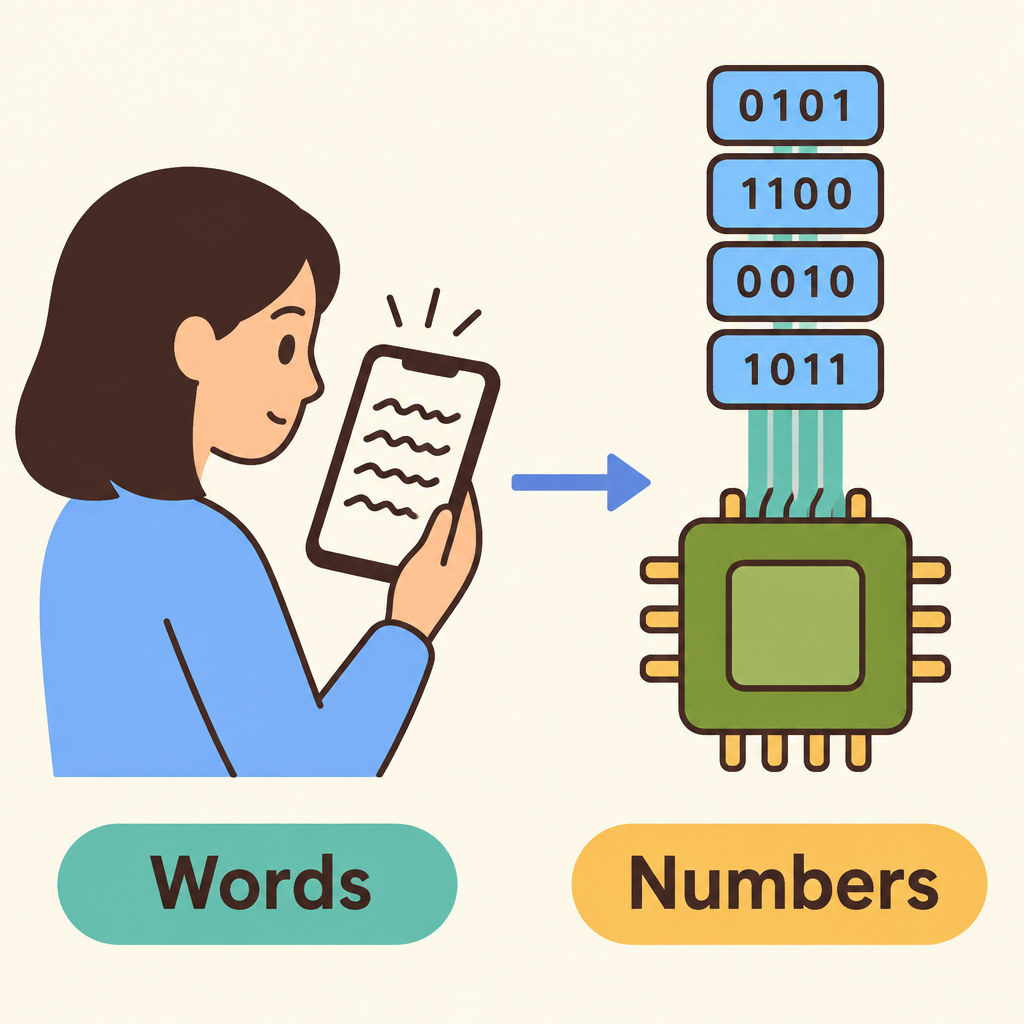
Notice that the same sentence exists as readable words on the person's side but must appear as numbers on the computer's side before it can be processed.
So before an AI system can work with a sentence, something has to change. The words must become numbers first.
This lesson shows how that translation works.
From Words to Vectors
AI systems solve the language problem with one move: they convert words and sentences into vectors.
A vector is an array of numbers. Think of it as a list the computer can actually handle.
- Human text: You start with words and sentences.
- Convert: The AI system turns the text into numbers.
- Vector: The result is an array of numbers.
- Process: A neural network works with those vectors.
Once text becomes vectors, a neural network can process it.
Text goes in as words. It travels through the model as numbers.
What a Vector Looks Like
A vector is a single-dimensional array of numbers. That means one row of values, in order.
Here is a made-up example for the word cat: $$[0.2, 0.7, 0.1]$$. The numbers are only for illustration.
The idea is always the same: text becomes one ordered list of numbers.
- Is a vector
- Not a vector
A word written as letters is not a vector. Neither is a grid with rows and columns.
Vectors Flow Through Every Layer
Vectors are more than an entry ticket. They are the fundamental data structure inside a large language model, or LLM.
An LLM is built from layers. The vectors flow through every layer of the model.
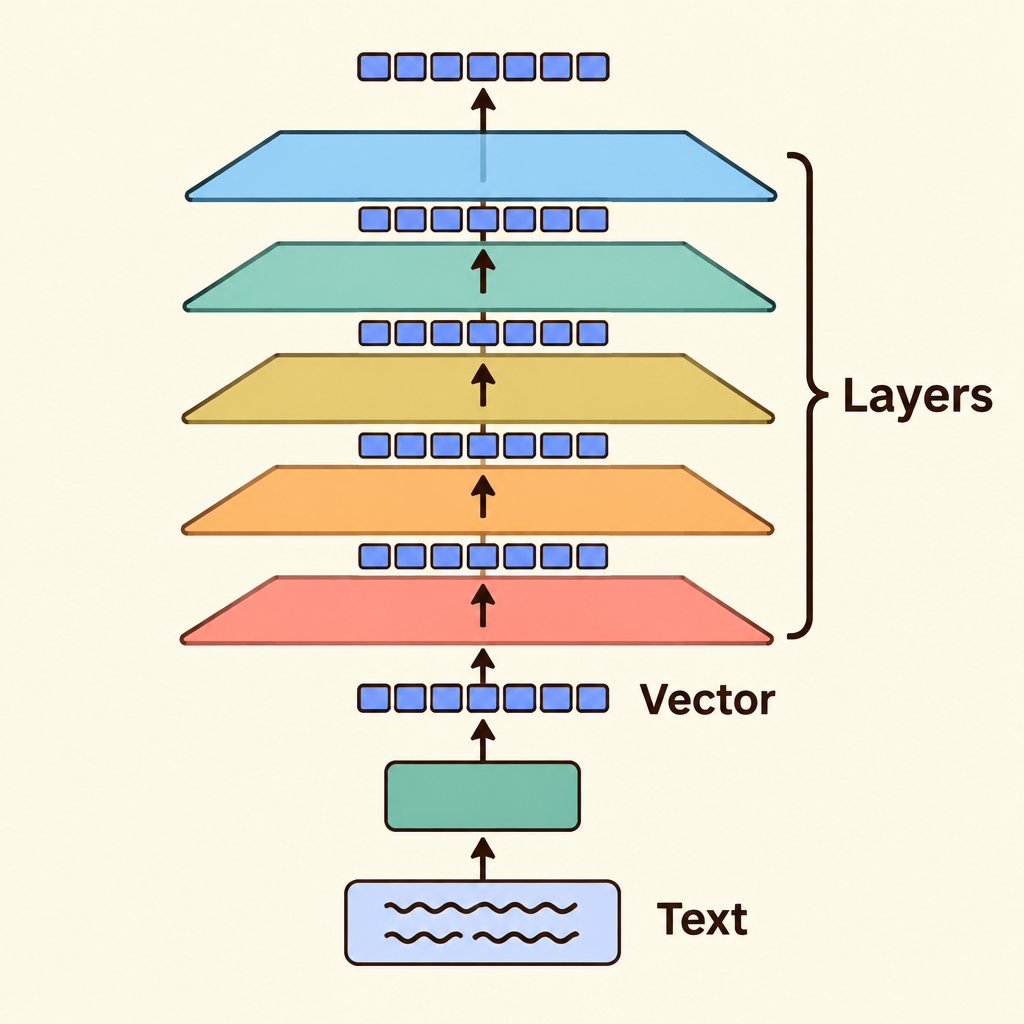
Follow the same row of numbers as it passes through each layer, showing that the model works with vectors at every stage rather than raw words.
At each stop, the model works with numbers, never raw words.
So when you picture an LLM at work, picture lists of numbers moving from layer to layer.
Why Numbers Make Understanding Possible
Why go to all this trouble? Because numbers allow mathematical operations.
Words cannot be added or multiplied. Vectors can.
Those operations, repeated through the layers of an LLM, are what ultimately produce intelligent language understanding.
The surprising part is where the understanding comes from: math done on lists of numbers.
Key Takeaways
You can now spot this idea anywhere AI handles text.
Explain it to a colleague like this: computers only process numbers, so AI turns text into vectors first.
Remember the chain: text becomes vectors, vectors flow through every layer, and math on them produces language understanding.
This translation is the first step to understanding how LLMs work.
Check yourself
Can a computer directly understand human language without converting it into numbers?
- Yes
- No
Answer: No
No. Computers only process numbers, so text must be converted into numbers (vectors) before an AI system can work with it.
Computers process only _____, so AI systems convert text into _____, which then flow through every _____ of an LLM.
Answer: Computers process only numbers, so AI systems convert text into vectors, which then flow through every layer of an LLM.
Because computers handle only numbers, text is turned into vectors (arrays of numbers). These vectors are the data that passes through each layer of a large language model.
Which of these is an example of a vector that a neural network could process?
- [0.2, -1.4, 3.7]
- ["the", "cat", "sat"]
- "the cat sat"
- {cat: noun}
Answer: [0.2, -1.4, 3.7]
A vector is a single-dimensional array of numbers, like [0.2, -1.4, 3.7]. A sentence, a list of words, or a word with a label are still text, not numbers.
Keep going
This is lesson 1 of 27 in How Large Language Models (LLMs) Work. Next up:
- Layered Processing
- Tokenization
- Embeddings
- Sequential Limitations
- Parallel Processing
Wondering turns any topic into short lessons you can read, watch, or listen to, with practice questions and an AI tutor.